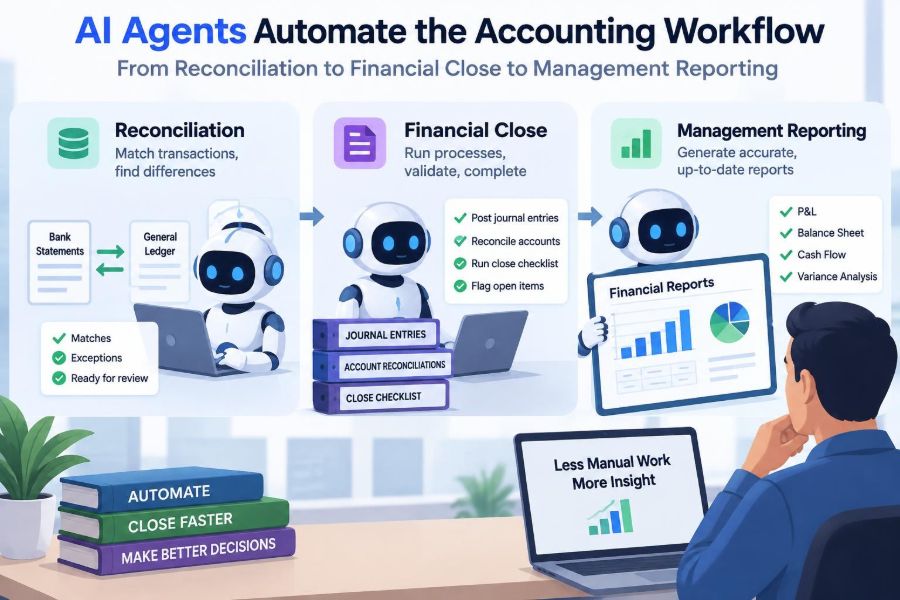

It is late in the close cycle. A controller is comparing bank activity to the general ledger, an accountant is chasing an unexplained balance, and a finance manager is waiting for a report that was supposed to be ready that morning. None of the tasks is conceptually mysterious. The difficulty is the volume, the disconnected systems, and the number of exceptions that require attention.
For many teams, month-end still means exporting files, matching rows, sending emails for evidence, copying commentary into report decks, and repeating the same checks each period. Spreadsheets can be powerful, but they often turn a well-designed accounting process into a person-dependent routine.
AI agents are beginning to change this workflow. They can retrieve information, apply instructions, use software tools, document what they did, and escalate work they cannot safely resolve. That makes them relevant to reconciliation, financial close, and management reporting.
The opportunity is not to remove accounting judgment. It is to give judgment more room by reducing the manual coordination around it.
🧠 What Makes an AI Agent Different
An AI agent is software that can pursue a defined objective through a sequence of actions. Unlike a traditional automation that follows one fixed path, an agent can assess a task, select from approved tools, and adapt its next step based on the result.
For example, a reconciliation agent might retrieve ledger entries, compare them with a bank feed, search invoices for supporting detail, propose matches, and create an exception case when evidence is incomplete. It is still operating within boundaries set by people and systems.
An agent is not automatically an autonomous accountant. Its value depends on its instructions, access rights, data quality, controls, and the review process around its output.
🔄 Why Finance Work Is a Natural Use Case
Finance operations contain many recurring tasks with clear inputs, expected outputs, and established rules. Matching transactions, checking account roll-forwards, collecting close status, and refreshing report narratives all fit that pattern.
Yet these processes also contain exceptions. A payment may cover several invoices, a journal may be posted to the wrong entity, or a variance may need a business explanation. This mix of repeatable work and contextual investigation is where agent-assisted workflows can be useful.
The goal is not simply speed. A better process can make work more traceable, reduce unnecessary handoffs, and direct skilled staff to unusual or consequential items.
🧩 The Core Building Blocks of an Agent Workflow
A reliable finance agent needs more than a language model. It needs a controlled operating environment with access to trusted information and approved actions.
- Instructions: business rules, accounting policies, priorities, and escalation criteria.
- Tools: connectors to ERP systems, bank feeds, subledgers, document repositories, workflow platforms, and reporting tools.
- Knowledge: chart-of-accounts definitions, close calendars, reconciliation procedures, and prior approved explanations.
- Guardrails: permissions, required approvals, confidence thresholds, logs, and segregation-of-duties limits.
Without these foundations, an agent may produce plausible language without producing dependable accounting work.
📚 Rules, Reasoning, and Retrieval
Not every accounting task should be handed to generative AI. Deterministic rules remain the best choice when the logic is stable: exact amount matching, tolerance checks, required-field validation, and aging calculations.
Agents are more useful when they must bring together evidence from several places. They can retrieve a contract summary, a customer email, a remittance reference, and invoice records, then organize those facts for a reviewer.
This retrieval step matters. An agent should ground its response in approved documents and system records rather than rely on general training knowledge or guess at a company-specific policy.
🏦 Reconciliation Starts With Better Matching
Reconciliation tests whether two records that should agree actually agree. Common examples include bank-to-ledger, subledger-to-general-ledger, intercompany, inventory, payroll, and balance-sheet account reconciliations.
Traditional matching often begins with simple keys: transaction date, amount, invoice number, reference number, or counterparty. An agent can extend the process by recognizing descriptions, grouping related items, and searching supporting records.
Consider a hypothetical customer receipt for $10,000 that settles three invoices after a small bank fee. Exact matching will fail. An agent can identify candidate invoices, calculate the difference, locate the fee entry, and present a proposed composite match for approval.
🎯 Exact Matches Should Remain Simple
It is tempting to apply advanced AI to every transaction, but that can make a controlled process harder to understand. If bank reference, date, and amount match a cleared ledger item exactly, a conventional matching rule is usually sufficient.
Keeping straightforward work deterministic has two advantages. It is fast and easy to audit, and it reserves agent reasoning for cases where it provides added value.
A sensible design often uses tiers: exact automatic matches first, rule-based matches second, agent-assisted proposals third, and human investigation for the remaining exceptions.
🧾 Managing Many-to-One and One-to-Many Items
Many real reconciliations are not one row against one row. A single cash deposit may represent multiple customer payments. One supplier payment may settle several invoices. A transfer can appear in one account before it reaches another.
Agents can search combinations within carefully defined limits and explain the proposed relationship. The explanation should show the constituent transactions, timing difference, fees or discounts, and any assumptions.
Controls are especially important here. A system should not silently combine items merely because their totals agree. It should retain the evidence and route material or low-confidence matches to a reviewer.
🔍 Exception Investigation Is Where Time Disappears
The largest burden is rarely matching clean transactions. It is investigating stale reconciling items, duplicate postings, missing accruals, unexplained variances, and timing differences that fail to reverse as expected.
An agent can assemble an investigation packet: transaction history, prior-period status, related journal entries, source documents, account owner, and suggested next question. That shortens the search phase without deciding the accounting conclusion on its own.
For instance, it may flag that an outstanding bank item is older than the team’s policy threshold and that no subsequent clearing transaction was found. The preparer then decides whether to correct, write off, accrue, or continue investigating.
🗂️ Evidence Is Part of the Reconciliation
A reconciliation is not complete merely because the numbers tie. Reviewers need to understand what supports the balance, why reconciling items exist, and who concluded that the account is fairly stated.
Agent workflows should attach or reference evidence at the point of work. Useful evidence may include account statements, invoices, contract extracts, system reports, correspondence, and explanations of period-end entries.
Good design also distinguishes between evidence and commentary. A generated narrative can summarize an issue, but it should not substitute for the underlying record that supports the conclusion.
📅 Financial Close Is a Coordination Problem
The financial close converts ongoing operational activity into a controlled reporting period. It involves cut-off, subledger completion, reconciliations, estimates, journal entries, review, consolidation, and reporting.
Many close delays arise because tasks are interdependent. A revenue analysis cannot finish until source data is complete; consolidation cannot finish until entity reporting is finalized; management reporting cannot finish until key variances are understood.
Agents can act as close coordinators by monitoring task status, identifying dependencies, requesting missing inputs, and producing an updated view of what is blocking completion.
🧭 Designing an Agent-Assisted Close Calendar
A close calendar should specify more than deadlines. It should identify task owners, upstream dependencies, evidence requirements, materiality or review thresholds, and escalation paths.
An agent can read this structure and send targeted prompts rather than generic reminders. If the fixed-asset reconciliation is overdue because depreciation has not been posted, the useful action is to identify that dependency and notify the appropriate owner.
It should not have authority to mark a task complete simply because a document was uploaded. Completion should reflect the defined control: preparation, review, approval, or system posting as appropriate.
✍️ Journal Entry Preparation Needs Tight Boundaries
Agents can help prepare recurring journal entries by gathering inputs, applying approved calculation templates, and drafting descriptions. Examples include routine prepaid amortization, recurring allocations, or reversals of prior-period accruals.
However, preparing an entry and posting an entry are very different permissions. For unusual, material, judgmental, or policy-sensitive entries, the agent should create a draft with sources and route it through normal review.
Never treat a well-written journal description as proof that the debit and credit are appropriate. Account mapping, period, entity, support, authorization, and accounting treatment still require control.
📈 Variance Analysis Can Become an Investigation Queue
Management often asks, “Why did actual results differ from plan or last period?” The answer may involve volume, price, foreign exchange, mix, timing, operational disruption, or accounting classification.
An agent can calculate and rank variances using established thresholds, then retrieve relevant operational metrics and prior commentary. Rather than generating a vague explanation, it can build a queue of questions for account owners.
A useful output might say that travel expense increased versus the prior month, identify the cost centers responsible, list the largest transactions, and note whether similar explanations were approved previously. The manager still validates the business story.
🗣️ Drafting Commentary Without Inventing a Story
Natural-language generation is attractive for management reporting because finance teams often rewrite similar commentary every month. Agents can turn approved data and owner notes into a consistent first draft.
The danger is unsupported causality. A model may write that margin fell “because of pricing pressure” when the available data only shows that margin fell. The wording sounds useful but exceeds the evidence.
Strong prompts require source-backed statements, clear labels for assumptions, and an explicit instruction to say when a cause is unknown. Commentary should be reviewed as analysis, not treated as a transcription task.
📊 From Data Refresh to Management Reporting
Management reporting combines financial data with decision context. Leaders need timely results, but they also need definitions that remain consistent from one period to the next.
Agents can help validate that reports use the correct reporting period, entity scope, currency, and version of plan or forecast. They can also compare totals across a dashboard, reporting package, and ledger extract to identify unexplained inconsistency.
Once the numbers are controlled, an agent can prepare a reporting pack outline: headline performance, major drivers, risks, decisions needed, and appendices containing supporting detail. This reduces assembly work without replacing finance business partnering.
🧮 A Practical Comparison of Automation Types
| Approach | Best suited to | Main limitation |
|---|---|---|
| Spreadsheet formulas | Small, transparent calculations and ad hoc analysis | Version control and manual handoffs can become difficult |
| Rules-based automation | Stable, high-volume, clearly defined actions | Handles exceptions poorly unless rules are expanded |
| Robotic process automation | Repeating user-interface steps across older systems | Can be brittle when screens or workflows change |
| AI agent workflow | Evidence gathering, exception triage, coordination, and draft analysis | Requires grounding, monitoring, and strong approvals |
These approaches are complementary. A mature finance process often combines them rather than trying to force every task into one technology category.
🛡️ Human Review Is a Control, Not a Failure
When an agent escalates an item, that does not mean the automation failed. It means the workflow recognized that ambiguity, risk, or materiality requires human accountability.
Reviewers should see what the agent did, what sources it used, which rules applied, and why it reached its proposed conclusion. A reviewer who only sees “approved by AI” cannot exercise meaningful oversight.
Approval design should reflect risk. A low-value coding suggestion may need a different review path from a revenue cut-off adjustment or intercompany elimination.
🔐 Access, Segregation of Duties, and Security
Finance systems contain sensitive commercial, employee, and customer information. An agent should receive only the access necessary for its assigned work, following the principle of least privilege.
Segregation of duties remains relevant in automated workflows. The same identity should not be able to create a vendor, initiate a payment, and approve the payment simply because a workflow is convenient.
Organizations also need to know where prompts, retrieved documents, and outputs are stored. Data retention, confidentiality, vendor arrangements, and access logging should be assessed with finance, technology, security, legal, and compliance stakeholders where applicable.
🧪 Test Before You Trust
Agent performance should be tested against representative historical cases before use in a live close. The test set should include clean matches, common exceptions, unusual edge cases, incomplete documents, and deliberately misleading descriptions.
Evaluate more than whether the final answer is correct. Check whether the agent selected valid evidence, followed the right route, avoided unauthorized actions, and produced an understandable audit trail.
Testing should continue after deployment. Source systems change, policies evolve, account structures are reorganized, and new transaction patterns emerge. A workflow that was safe last quarter may need adjustment this quarter.
📏 Confidence Scores Are Not Accounting Evidence
Some systems assign confidence scores to suggested matches or generated classifications. These can help prioritize review, but they are not a substitute for support.
A high score may mean the system has seen similar patterns before. It does not prove that the current transaction is properly recorded, authorized, or consistent with policy.
Use confidence as one routing input alongside transaction value, account risk, unusual attributes, period-end timing, and whether the agent found direct evidence. Thresholds should be documented and periodically challenged.
🧯 Common Failure Modes to Expect
Most problems arise from weak process design rather than from one dramatic technical error. Teams should anticipate failure modes and decide what the system must do when they occur.
- Hallucinated explanations: require citations to internal source records and escalate unsupported claims.
- Bad source data: validate feeds and preserve the ability to trace a result back to the originating system.
- Overbroad permissions: separate reading, drafting, posting, and approving rights.
- Silent rule changes: use change management, testing, and versioned instructions.
- Automation bias: train reviewers not to accept polished output without examining evidence.
The response to these risks is not abandoning automation. It is designing for detection, containment, and accountable correction.
🧱 Start With a Narrow, Measurable Use Case
A productive first project usually targets a frequent bottleneck with manageable risk. Examples include preparing reconciliation support packs, triaging unmatched cash receipts, collecting close-task status, or drafting variance commentary from approved inputs.
Avoid starting with an objective as broad as “automate month-end.” That label hides too many processes, systems, policies, and approvals to evaluate properly.
Define the current workflow, baseline effort, expected output, exception categories, reviewer role, and error consequences. Then automate one bounded portion of the work and learn from actual use.
🗺️ Map the Process Before Building
Process mapping exposes hidden decisions that people make automatically. Ask where data originates, who transforms it, which checks occur, what evidence is retained, and where work waits for another person.
It also reveals whether the problem is truly one of manual labor. An agent cannot solve a reconciliation that lacks a clear account owner, a close task with no acceptance criteria, or a report whose metrics have competing definitions.
Document the “happy path” and the exception paths. The latter often contain the real value because they determine when automation proceeds, pauses, or calls for help.
👥 Redesign Roles Instead of Removing Them
As routine collection and matching work decreases, finance roles can shift toward reviewing exceptions, improving controls, interpreting results, and partnering with operations. That shift requires training, not just new software.
Preparers need to understand how to challenge an agent’s output. Reviewers need enough visibility into data lineage and rule logic to approve responsibly. Process owners need to manage changes to policies and workflows.
The strongest implementation treats accountants as designers and supervisors of an automated process, not as passive recipients of a tool.
📖 Build an Audit Trail by Design
For each material action, retain a record of the initiating request, data sources accessed, rules or instructions used, proposed result, approvals, changes, and final disposition. The exact format will depend on systems and governance requirements, but traceability should be planned early.
Logs should be readable enough to support operational investigation, not merely stored for technical teams. A controller needs to answer practical questions: What was matched? Why? Who approved it? What evidence supports it?
Clear audit trails also make model monitoring easier because teams can inspect patterns in overrides, errors, and escalations.
⚖️ Policy Interpretation Still Requires Judgment
Accounting policies can contain defined rules, but applying them may require interpretation of contracts, substance, timing, estimates, and materiality. An agent can retrieve policy language and organize relevant facts, yet it may not recognize every business nuance.
Use particular caution with revenue recognition, impairment, provisions, leases, taxes, fair value, related-party matters, and non-routine transactions. These areas may involve significant judgment and should follow the organization’s established technical-accounting review process.
Automation can make the analysis more organized. It does not transfer responsibility for the conclusion.
📡 Monitoring After Go-Live
After deployment, monitor operational and control outcomes. Useful measures can include the share of items automatically resolved, exception aging, reviewer override patterns, elapsed close-task time, missing-evidence incidents, and repeat errors.
Interpret metrics carefully. A rising automatic-match rate may be good, or it may indicate that thresholds became too permissive. A high override rate may reveal poor instructions, changing transaction patterns, or a valid need for more human review.
Regular feedback sessions with preparers and reviewers help turn real exceptions into better rules, better data, or clearer escalation guidance.
🌉 A Realistic Maturity Path
Teams generally progress from assistance to controlled automation. Early use may focus on search, summaries, checklists, and drafts. Later stages can include agent-proposed matches, workflow routing, and tightly bounded system actions.
Full autonomy is rarely the appropriate destination for core accounting judgments. The right maturity level depends on the process risk, quality of source data, stability of rules, and effectiveness of oversight.
A useful question is not “Can the agent do this?” but “What level of authority can it hold while the process remains accurate, explainable, and controlled?”
✅ The Core Principle: Automate Work, Preserve Accountability
AI agents can reduce friction across reconciliation, close, and reporting by gathering evidence, applying repeatable logic, coordinating tasks, and drafting structured analysis. Their best contribution is often making the exception visible sooner and giving the reviewer a better starting point.
Reliable finance automation pairs the right technology with deterministic controls, trusted data, clear ownership, and meaningful human review. A fast process that cannot explain its results is not a strong finance process.
Use agents to handle repeatable effort and organize evidence, while people remain accountable for accounting judgments, approvals, and the integrity of reported information.
When that balance is designed deliberately, finance teams can spend less time assembling the close and more time understanding what the numbers mean. 🤖📊✅