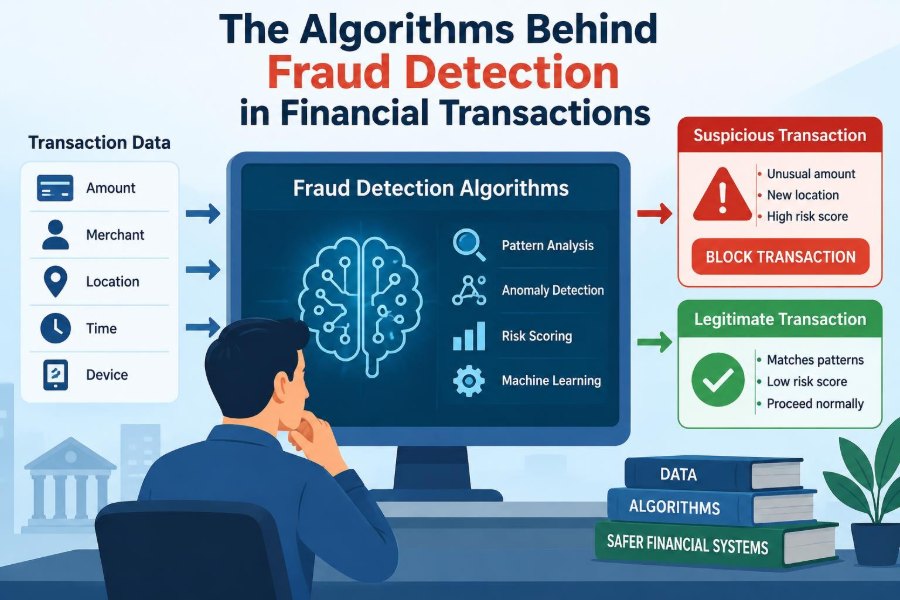

A card payment for a late-night hotel room, a transfer to a new payee, and several purchases from a phone that has never used the account before may each be perfectly legitimate. Together, they may also look like an account takeover in progress.
That is the difficult reality of fraud detection. Financial institutions and payment platforms must make decisions in seconds, often with incomplete information and no chance to ask a customer what they meant before money moves.
For accounting and finance professionals, these systems are not a distant technical curiosity. Their outputs affect chargebacks, loss provisions, control design, customer experience, audit trails, and the reliability of transaction records.
The algorithms behind fraud detection do not “know” fraud in the human sense. They identify patterns that resemble past fraud, violate expected behavior, or create an unusual combination of risk signals. Understanding that distinction makes the systems easier to evaluate—and harder to misuse.
🔍 What Fraud Detection Is Actually Trying to Decide
At its core, a fraud system estimates whether a transaction deserves intervention. The intervention might be a silent approval, a request for extra authentication, a temporary hold, a decline, or referral to a human investigator.
The question is rarely “Is this certainly fraud?” Absolute certainty is uncommon at authorization time. The practical question is: given the available evidence, is the expected loss and risk high enough to justify friction?
💳 Why Transaction Fraud Is a Classification Problem
Many fraud models are classifiers. A classifier assigns an observation to a category, such as likely legitimate or likely fraudulent, based on measurable features.
For a card payment, features can include amount, merchant type, time of day, location relationship, device signals, prior spending behavior, and the number of recent attempts. The model combines those inputs into a score rather than relying on one clue.
🏷️ The Challenge of Defining “Fraud”
A training label tells an algorithm what happened to an earlier transaction. Labels may come from confirmed account takeover cases, chargebacks, customer reports, investigations, or recovered funds.
But labels are imperfect. A chargeback can arise from friendly fraud, a merchant dispute, or customer confusion rather than stolen credentials. Some fraud is never reported, while some legitimate transactions are initially disputed. This means model outputs should be treated as risk estimates, not statements of fact.
🧩 Turning Transactions Into Usable Data
Raw payment records are not automatically suitable for modeling. Teams transform them into a consistent dataset, join them with customer and account history, standardize merchant information, and address missing or delayed fields.
A useful feature should be available when the decision is made. Including a field learned only after settlement or investigation creates data leakage: the model appears highly accurate in testing because it has accidentally seen the future.
📦 Transaction Features: The Obvious Starting Point
Some signals come directly from the transaction itself: currency, amount, channel, merchant category, entry method, and whether the payment is card-present or remote.
An amount is more useful in context. A $900 purchase may be routine for one business account and extraordinary for another. Feature engineering often converts raw amount into relative measures, such as amount compared with a customer’s recent median transaction.
⏱️ Velocity Rules Capture Speed and Repetition
Velocity measures how frequently something happens within a time window. Fraudsters often test a stolen card with small payments, retry declines, or rapidly create transfers before controls react.
Examples include counting attempts per card in ten minutes, unique merchants used in an hour, or new payees added in a day. Velocity is powerful because it captures sequence and pace, not merely the content of one transaction.
🗺️ Location Signals Need Context, Not Assumptions
Geographic inconsistency can be informative: a physical purchase in one region followed minutes later by another far away may be implausible. Yet location is noisy. Mobile devices, traveling customers, online merchants, virtual private networks, and inaccurate merchant addresses all complicate the picture.
Better systems evaluate location alongside channel and timing. A remote purchase from a different country is not equivalent to two in-person purchases separated by an impossible travel interval.
📱 Device and Digital Identity Signals
For online transactions, a platform may observe device characteristics, browser configuration, app version, IP-related signals, session history, and whether the device has successfully used the account before.
These signals can reveal abrupt changes, such as a new device logging in and immediately changing contact details before sending funds. They are probabilistic identifiers, however; they should not be treated as perfect proof that one person equals one device.
👤 Behavioral Profiles Make “Normal” More Personal
Behavioral profiling compares a transaction with an account’s own history. It may consider usual spending ranges, favored merchants, login patterns, payment timing, and relationships between accounts.
Imagine a customer who regularly buys fuel and groceries locally, then initiates several international transfers after a password reset. None of those facts proves fraud. Their combination may justify step-up verification before a transfer is released.
📏 Rules Engines Provide Clear Guardrails
A rule is an explicit condition: for example, flag an unusually high-value transfer to a newly added payee when the account has recently changed its security settings. Rules are readable, quick to deploy, and straightforward to audit.
They are especially useful for known attack patterns, policy requirements, and urgent responses. Their weakness is rigidity. Fraudsters adapt, and an expanding rule set can become difficult to maintain when rules overlap or conflict.
🧮 Scorecards Combine Evidence Transparently
A scorecard assigns points to risk indicators and totals them. It is more nuanced than a single rule while remaining understandable to operational teams.
For example, a new device, unusual amount, and recent failed authentication attempts could each increase the score. Scorecards are often valuable where explainability and stable governance matter, though they may miss complicated nonlinear relationships in the data.
📈 Logistic Regression: A Durable Baseline
Logistic regression is a common supervised learning method for estimating the probability of a binary outcome. It weighs features and produces a value that can be mapped to a fraud-risk probability.
Its strengths are relative simplicity, speed, and interpretable directional effects. It may be less flexible than more complex models, but a well-designed regression can be highly useful and provides a meaningful benchmark before adopting a harder-to-explain system.
🌲 Decision Trees and Ensemble Models
A decision tree learns a series of splits, such as whether an amount exceeds a threshold and whether a device is new. Individual trees are intuitive but can overfit: they may learn details of historical data that do not generalize.
Ensemble methods, including random forests and gradient-boosted trees, combine many trees. They often capture interactions well, such as a new device becoming much riskier only when paired with a high-velocity transfer pattern.
🧠 Neural Networks and Complex Pattern Recognition
Neural networks can model complex relationships across many inputs, particularly where data volume and feature richness are substantial. They can be useful for signals such as transaction sequences or high-dimensional digital behavior.
Complexity is not automatically an advantage. These models can be harder to explain, validate, monitor, and reproduce. In a financial control environment, the extra predictive value must justify the added governance burden.
🚨 Anomaly Detection Finds What Has Not Been Seen Before
Supervised models learn from labeled examples of prior fraud. Anomaly detection instead looks for observations that differ sharply from an expected pattern, which is useful when a new fraud technique has little labeled history.
A simple approach might flag payments far from a customer’s typical amount or frequency. More advanced methods estimate how unusual a combination of behaviors is. An anomaly is not necessarily fraudulent—it may simply be a legitimate exception.
🕸️ Graph Analytics Exposes Connected Fraud
Fraud often involves networks rather than isolated transactions. Graph analysis represents entities—accounts, devices, cards, merchants, addresses, or beneficiaries—as nodes, with relationships as links.
A single account may look ordinary, but a graph can reveal that many newly created accounts share the same device or route funds to a common beneficiary. These connections can expose organized activity that transaction-by-transaction analysis misses.
🔢 Sequence Models Look at Order, Not Just Events
The order of activity matters. A login from a new device, followed by a password reset, a profile change, and a large transfer has a different meaning from those events occurring weeks apart.
Sequence-aware approaches evaluate event history and timing. Even without an advanced neural model, carefully engineered “time since” and “event after event” features can capture much of this operationally important context.
⚖️ Fraud Data Is Usually Imbalanced
Fraud is generally much rarer than legitimate activity. That creates class imbalance: a model that labels nearly every transaction legitimate can appear accurate while failing at its actual job.
Teams therefore use techniques such as class weighting, targeted sampling, and carefully designed training data. These methods can help learning, but evaluation must still reflect the real transaction environment rather than an artificially balanced sample.
🎯 Accuracy Can Be a Misleading Metric
Fraud teams need measures that describe the trade-off between catching fraud and inconveniencing legitimate customers. Precision asks, “Of the alerts raised, how many were truly fraudulent?” Recall asks, “Of the fraud cases, how many did we catch?”
| Measure | What it helps answer | Why it matters |
|---|---|---|
| Precision | How reliable are alerts? | Low precision can overwhelm investigators and frustrate customers. |
| Recall | How much known fraud was identified? | Low recall leaves preventable losses undetected. |
| False-positive rate | How often are legitimate events flagged? | It measures customer and operational friction. |
| Value-weighted performance | What financial exposure was intercepted? | Not all missed or stopped transactions carry equal loss potential. |
🚦 Thresholds Turn Scores Into Decisions
A model score does not decide policy by itself. A threshold converts risk into action: approve below one level, challenge in a middle band, and block or review above another.
The appropriate threshold depends on the payment type, transaction value, customer segment, available authentication methods, and cost of error. A low-value purchase may warrant a different response from an irreversible business-to-business transfer.
💸 The Cost Matrix Is More Than a Model Metric
A false negative occurs when fraud is approved; a false positive occurs when a legitimate transaction is interrupted. Both have costs, but they are not fixed or equal.
Loss can include reimbursement, investigation, and recovery expense. Customer friction can include abandonment, lost sales, damaged trust, and pressure on support teams. Mature programs make these trade-offs explicit instead of optimizing a model metric in isolation.
🔐 Step-Up Authentication Creates a Middle Option
Fraud controls do not have to choose only between approval and decline. Step-up authentication asks for an additional check when risk is elevated, such as app confirmation, biometric verification, or a one-time code.
This can reduce unnecessary declines, but it introduces its own risks. Codes can be intercepted through social engineering, and an extra challenge can still cause legitimate users to abandon a transaction. The challenge must be proportionate to the risk.
👥 Human Review Still Has a Necessary Role
Investigators can examine nuance that a real-time model may not fully capture: customer contact history, supporting documents, transaction narratives, and unusual but explainable business activity.
Human review is limited by time and capacity. The best use is often for cases where potential loss is significant, evidence conflicts, or a decision has serious customer consequences. Feedback from investigators should also improve labels and rules.
🪟 Explainability Supports Operations and Governance
When a transaction is held, teams need to understand the key reasons. Reason codes such as “new device,” “unusual transfer amount,” or “high recent attempt count” help investigators, customer-service staff, and control owners act consistently.
Explanation should be accurate and appropriately bounded. A reason code explains factors behind a score; it does not prove criminal intent. Clear documentation also helps validate that a model is operating as intended.
⚠️ Bias and Fairness Require Active Testing
Risk models can produce uneven outcomes across customer groups if historical data reflects unequal access, reporting differences, or proxy variables. A location field, for example, may correlate with characteristics that should not drive unfair treatment.
Fairness assessment is context-specific and legally sensitive. Practical safeguards include reviewing feature choices, testing outcome disparities, documenting justified business purposes, and ensuring customers have a path to resolve incorrect flags.
🧪 Model Validation Tests More Than Accuracy
Before deployment, independent review should examine data quality, assumptions, feature availability, implementation logic, performance, and failure modes. Testing should include unusual cases, not merely average historical behavior.
Validation also asks whether the model’s purpose matches its use. A model trained to prioritize card-not-present fraud may not be suitable for approving high-value account transfers without additional evidence and testing.
📉 Drift Can Quietly Degrade a Good Model
Model drift occurs when relationships in the real world change. Customer behavior may shift, merchants may alter transaction coding, attackers may change tactics, or a product redesign may affect input data.
Monitoring should track score distributions, alert volumes, approval rates, observed fraud outcomes, and data completeness. A sudden change is not automatically a model failure, but it is a signal to investigate before losses or false positives escalate.
🛠️ Feedback Loops Can Distort Future Decisions
A system only observes outcomes for transactions it allows, challenges, or investigates. If it automatically blocks a group of transactions, it may never learn whether those transactions would truly have been fraudulent.
This is called selective labeling or decision feedback. Controlled sampling, delayed outcome analysis, and carefully designed review processes can reduce the blind spot. Otherwise, a model may become overconfident in its own past decisions.
🧾 Accounting Controls and Fraud Models Must Connect
Algorithmic fraud detection is part of a wider control system, not a replacement for reconciliations, authorization policies, segregation of duties, exception management, and audit evidence.
Accounting teams should understand how alerts affect transaction status. Is a held payment recorded as pending? Who can release it? How are reversals, chargebacks, recoveries, and reserves documented? Clear process design prevents the control from creating accounting ambiguity.
🧭 A Practical Implementation Roadmap
Organizations do not need to begin with a sophisticated machine-learning platform. A sensible program starts by clarifying fraud types, decision points, data availability, response options, and accountability.
- Map the transaction lifecycle and identify where intervention is possible.
- Establish data definitions and retain decision-relevant audit logs.
- Deploy clear rules for urgent, well-understood patterns.
- Measure false positives, fraud outcomes, workload, and customer impact.
- Add models only when they improve decisions beyond a transparent baseline.
- Set ownership for monitoring, change approval, investigation feedback, and periodic validation.
🚧 Common Design Mistakes to Avoid
One mistake is treating a high model score as confirmation of fraud. Another is tuning solely to reduce losses while ignoring legitimate customers who are repeatedly challenged or declined.
Teams also run into trouble when features are undocumented, labels are assumed correct, or model changes bypass control review. A fast-moving fraud environment needs speed, but speed without traceability makes errors harder to detect and correct.
🌐 Fraud Detection Is an Adaptive System
Attackers learn from controls. If small test payments are blocked, they may change merchant categories, devices, timing, or transaction channels. If verification is added, they may target customers through impersonation instead.
Defenses must adapt as well. That means combining current intelligence, monitoring, investigation feedback, resilient data pipelines, and periodic reassessment—not expecting a model trained once to remain effective indefinitely.
🧠 The Core Principle: Combine Judgment, Data, and Controls
The strongest fraud programs do not search for one magical algorithm. They combine rules for known risks, statistical models for patterns, anomaly methods for unfamiliar behavior, human judgment for ambiguity, and governance for accountability.
Most importantly, they recognize that a fraud score is a decision input. Its value comes from the action it supports, the evidence it preserves, and the way the organization learns when the decision was right or wrong.
The algorithm is not the fraud control by itself; it is one carefully governed part of a system designed to make better, faster, and more defensible financial decisions. 💳🔍📊