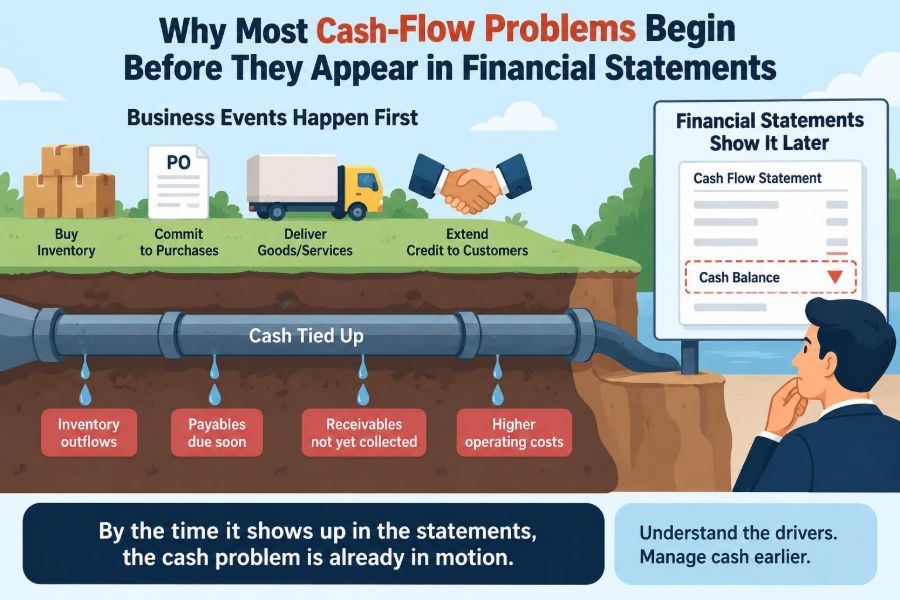

A business can look busy, profitable, and even well managed—right up until it cannot make payroll, pay a supplier, or cover a loan payment.
That moment often feels sudden. The bank balance is low, the accounts payable list is growing, and a financial statement finally confirms what everyone can now see: cash is under pressure.
But the statement did not create the problem. It recorded the aftermath.
Most cash-flow problems begin earlier, in ordinary operating decisions: a generous customer payment term, an unpriced rush order, too much inventory, an optimistic sales forecast, or a commitment made before someone asked when cash would actually leave the bank.
Understanding those earlier signals is one of the most practical skills in accounting and financial management. It shifts attention from explaining a cash shortage after it happens to designing a business that is less likely to create one.
💡 Cash Flow Is a Timing Problem Before It Is a Reporting Problem
Cash flow measures money moving into and out of a business. Profit measures whether revenues exceed expenses over an accounting period. The two are connected, but they answer different questions.
A company can earn revenue today, report a profit this month, and still wait weeks or months to collect the related cash. Meanwhile, wages, rent, taxes, suppliers, and debt payments may require payment now.
Cash-flow stress develops when the timing of payments made is faster than the timing of cash collected. Financial statements show that timing mismatch, but the operational choices creating it usually happened first.
🧾 Profit Does Not Put Money in the Bank
Accrual accounting recognizes revenue when it is earned and expenses when they are incurred, not necessarily when cash changes hands. This approach gives a better picture of performance across a period, but it can obscure short-term liquidity pressure for readers who focus only on net income.
Suppose a consulting firm completes a project in March and invoices $60,000. March profit may include that revenue. If the client pays in June, however, the firm must finance three months of salaries and other costs before receiving the cash.
The sale was real. The profit may be real. Yet the bank balance depends on collection, not merely invoicing.
🏦 Liquidity Is the Ability to Meet Today’s Obligations
Liquidity is a business’s ability to pay obligations as they fall due. It is different from long-term solvency, which concerns whether a business can ultimately meet all of its debts and remain viable.
A company may own valuable equipment, property, inventory, or receivables and still lack cash available this week. Assets cannot always be converted into cash quickly, predictably, or without a loss.
This is why a healthy balance sheet does not automatically mean a healthy cash position. Managers need to ask a more immediate question: what payments are due before the next reliable inflows arrive?
🔄 The Operating Cycle Starts Long Before an Invoice
The operating cycle traces the path from spending cash to acquire resources through selling goods or services and finally collecting from customers. For a retailer, that path may include buying inventory, storing it, selling it, and collecting payment.
For a contractor, it may include bidding, mobilizing staff, purchasing materials, completing milestones, issuing invoices, securing approval, and collecting cash. Each stage can extend the time between cash outflow and cash inflow.
The earlier cash leaves and the later it returns, the more working capital the company needs to keep operating.
⏳ Working Capital Is Cash Tied Up in Daily Operations
Working capital generally refers to current assets less current liabilities. In practical cash-management terms, it reflects resources available to support normal short-term operations.
Cash can become tied up when receivables rise, inventory accumulates, or suppliers must be paid before customers pay. This is not always a sign of poor management. Growth often consumes working capital.
The risk appears when management treats growth as automatically self-funding. A rapidly expanding business may need more cash for stock, payroll, delivery, and customer credit before the resulting sales are collected.
📦 Inventory Can Become a Quiet Cash Drain
Inventory is often purchased with cash or supplier credit before it generates a sale. Every additional unit held in a warehouse represents money unavailable for another purpose.
Buying in bulk may reduce unit cost, prevent stockouts, or secure supply. Those benefits can be valid. But the decision should also consider storage, spoilage, obsolescence, insurance, handling, and the possibility that demand is slower than expected.
A warehouse full of unsold products can make a balance sheet look asset-rich while leaving management unable to fund payroll. Inventory is useful only when its expected conversion to cash is realistic.
📬 Receivables Begin as a Sales Decision
Accounts receivable arise when a business delivers goods or services before collecting payment. The accounting entry occurs after the sale, but the cash exposure often begins earlier—when sales terms are negotiated or customer credit is approved.
Offering 30, 60, or 90 days to pay can help win business. It also means the seller is financing the customer for that period. If margins are thin or the customer pays late, that financing can be expensive.
Sales teams may understandably focus on revenue targets. Finance teams add a necessary question: is this a sale the business can afford to carry?
🧠 Customer Credit Requires More Than Trust
Credit decisions should be proportionate to the size and risk of the customer relationship. A long-standing customer with a reliable payment history may justify different terms from a new customer placing an unusually large order.
Useful checks can include confirming billing contacts, clarifying purchase-order requirements, setting credit limits, reviewing payment history, and requiring deposits or milestone payments where appropriate.
These controls are not about assuming bad faith. They reduce preventable disputes and help a business identify when a promising sale could create an outsized cash concentration.
🧷 Invoice Errors Turn Earned Revenue Into Delayed Cash
Many overdue invoices are not caused by a customer refusing to pay. They are delayed by missing purchase-order numbers, unclear descriptions, incorrect legal entities, unapproved rates, absent delivery confirmation, or invoices sent to the wrong contact.
By the time accounting discovers the error, the customer’s payment cycle may have restarted. A small administrative mistake can therefore create a significant collection delay.
Invoice accuracy is a cash-control process, not just a clerical task. The best time to gather billing requirements is before work begins, when the customer’s expectations and internal approval rules can still be clarified.
🗓️ Billing Late Means Collecting Late
A business cannot collect an invoice it has not issued. Yet billing is frequently postponed because teams are busy, supporting documents are incomplete, or no one clearly owns the final step.
For recurring services, automated or scheduled billing can reduce delay. For project work, milestone definitions should identify who confirms completion, what evidence is needed, and when the invoice is released.
One week of avoidable billing delay can become much longer once it passes through a customer’s accounts-payable schedule. Fast, accurate invoicing shortens the path from work completed to cash received.
📞 Collections Are a Process, Not an Awkward Last Resort
Professional follow-up should begin before an invoice becomes severely overdue. A courteous reminder near the due date can catch missing paperwork, approval delays, or disputes while they are still easy to resolve.
A practical collections process assigns ownership, records promised payment dates, escalates unresolved issues, and distinguishes a genuine dispute from a vague assurance that payment is “being processed.”
Consistent follow-up also protects relationships. Customers generally benefit from knowing exactly what is due, when it is due, and whom to contact if information is missing.
🧱 Contract Terms Determine the Cash Burden
Contract language can create major cash consequences before any revenue is recognized. Payment timing, retainage, deposits, acceptance criteria, change-order approval, cancellation rights, and dispute provisions all affect when cash becomes collectible.
A business that commits to purchase materials upfront but bills only after final acceptance takes on substantial financing risk. That may be acceptable for a well-capitalized company and a dependable client; it may be dangerous for a smaller supplier.
Operational teams should involve finance early when negotiating unusual terms. The question is not simply whether the contract is profitable, but whether its payment structure is financeable.
🏗️ Projects Often Consume Cash Before They Earn It
Project-based businesses face a particular challenge: costs are often incurred unevenly. Labor, subcontractors, equipment, permits, and materials may be needed at the beginning, while billing depends on milestones or client approvals later.
Consider a hypothetical manufacturer building a custom installation. If it buys specialized components before receiving a deposit, it may finance most of the job itself. A later design change or approval delay can widen the gap.
Deposits, progress billing, and clear change-order procedures do not eliminate project risk. They align cash receipts more closely with the work and costs being undertaken.
📈 Growth Can Create a Cash Squeeze
Revenue growth is often celebrated, but it can intensify cash needs. More sales may require more stock, more staff, more shipping, more marketing, and more receivables.
If a business pays suppliers in 30 days but collects from customers in 75 days, each additional sale can increase the amount of cash trapped in the gap. The company may become busier while becoming less liquid.
This does not mean a business should avoid growth. It means growth plans should include a cash forecast, capacity assumptions, collection timing, and a realistic source of funding for the working-capital increase.
🎯 Forecasts Fail When They Confuse Hopes With Commitments
A cash forecast is only as useful as its assumptions. A pipeline opportunity is not the same as a signed order, and an issued invoice is not the same as cash expected on a specific date.
Optimistic forecasts commonly assume every sale closes on time, every customer pays on terms, and every expense stays within plan. Real operations contain delays, disputes, seasonality, and surprises.
A stronger forecast uses categories of confidence. Confirmed receipts, likely receipts, and uncertain opportunities should not be treated as equally available cash.
🧮 A Rolling Cash Forecast Makes Timing Visible
A rolling forecast is updated regularly and extends forward over a defined planning horizon. It lists expected cash receipts and expected payments by week or other useful interval.
Its value is not perfect prediction. Its value is early visibility: a likely shortfall can be seen while there are still options to accelerate collections, postpone a discretionary purchase, negotiate terms, or arrange financing.
| Forecast item | Useful question | Common risk |
|---|---|---|
| Customer receipts | What date is payment actually expected? | Using invoice date instead of likely collection date |
| Payroll and taxes | What amount must clear, and when? | Forgetting periodic or statutory payments |
| Supplier payments | Which payments protect operations? | Assuming all vendors can wait |
| Debt and leases | What is contractually due? | Ignoring fixed payment dates |
| Capital spending | Can the timing be changed? | Treating discretionary purchases as unavoidable |
🚦 Cash Forecasts Need Scenario Thinking
A single forecast can create false confidence. Management should consider at least a base case, a downside case, and, where useful, an upside case that tests the effects of faster demand.
A downside case might assume a major customer pays later than expected, a planned sale slips, or a key input costs more. The purpose is not pessimism; it is to identify which assumptions would create a funding problem.
Scenario analysis helps leaders decide in advance what action they will take if a trigger occurs, rather than making hurried choices after cash is already scarce.
💳 Payment Terms With Suppliers Are a Financing Tool
Accounts payable represent amounts owed to suppliers. Carefully managed supplier terms can help align cash outflows with the time needed to sell inventory or collect from customers.
However, delaying payments without communication can damage supply relationships, reduce credit availability, trigger late fees, or interrupt essential deliveries. A supplier is not an unlimited source of emergency financing.
The constructive approach is to negotiate terms before pressure arises, pay according to agreed terms where possible, and communicate early if a genuine exception is needed.
🛒 Purchasing Decisions Often Hide the First Warning Sign
Purchase commitments can create cash obligations before the related expense appears in the income statement or before the item is delivered. A large order, nonrefundable deposit, minimum-volume agreement, or automatic renewal may be economically binding long before accounting records the full cost.
Approval processes should ask more than whether a purchase fits the annual budget. They should ask when payment is due, whether the item is essential, what happens if demand changes, and whether the forecast already includes the commitment.
Budget approval is not the same as cash availability. A budget may allow an expense over the year while the bank balance cannot support it this month.
🧾 Payroll, Taxes, and Debt Are Less Flexible Than Many Expenses
Some payments have little practical timing flexibility. Payroll affects employees directly. Tax obligations can carry legal and financial consequences. Loan and lease payments are governed by contractual schedules.
When these fixed obligations are not mapped accurately in a cash forecast, management may mistakenly believe a temporary surplus is available for inventory, equipment, distributions, or discretionary spending.
Separate known, fixed cash requirements from variable spending. That distinction makes it easier to see the real amount of cash available for choices.
🏷️ Pricing Can Create Cash Trouble Even When Sales Are Strong
Pricing must recover more than direct materials or labor. It should reflect overhead, payment-processing costs, warranty or rework risk, shipping, customer service, financing effects, and the time between incurring costs and collecting revenue.
A business can report sales volume while consistently generating too little gross margin to support its operating cycle. Discounting may win an order but also remove the cushion needed to handle collection delays or cost changes.
Pricing decisions should therefore be tested against both profitability and cash timing. A sale with a long collection period may require a different price, deposit, or payment schedule from a sale paid immediately.
🔍 Gross Margin Does Not Guarantee Cash Conversion
Gross margin is the difference between sales and the direct costs of producing goods or services. A healthy margin can support a business, but it does not guarantee that cash arrives soon enough.
For example, a company may earn an attractive margin on a large custom order while paying most costs upfront and waiting for final customer acceptance. The economics may work over time, yet short-term financing is still required.
Managers should evaluate both questions: does this work generate a sufficient return, and can the business carry the cash requirement until collection?
📊 Financial Statements Are Rear-View Mirrors With Useful Signals
Financial statements remain essential. The balance sheet can reveal rising receivables, excess inventory, declining cash, and increasing short-term debt. The income statement can show margin pressure. The statement of cash flows explains broad cash movements over a reporting period.
But periodic reports may arrive after decisions have already been made. A monthly report can identify a pattern; it cannot change the fact that inventory was ordered six weeks earlier or that a contract gave a customer overly long terms.
Use financial statements to investigate trends, then connect those trends to the operational decisions and processes that produced them.
🧭 Leading Indicators Matter More Than Waiting for a Low Balance
A bank balance is a lagging indicator: it tells you where cash stands now. Leading indicators point to where it may be heading.
- Invoices not yet issued for completed work
- Receivables past agreed terms
- Large customer balances concentrated in a few accounts
- Inventory aging beyond expected turnover
- Purchase orders and contracts not reflected in the forecast
- Declining margins on newly accepted work
- Repeated supplier requests for overdue payment
None of these signals guarantees a crisis. Together, they tell management where to investigate before a missed payment forces the issue.
👥 Cash Management Crosses Department Boundaries
Accounting records transactions and reports results, but it cannot manage cash alone. Sales sets commercial terms. Operations controls delivery and inventory. Procurement creates commitments. Project managers approve milestones. Executives decide priorities and financing.
Cash problems often persist because each team optimizes its own objective: sales seeks revenue, purchasing seeks lower unit prices, operations seeks availability, and finance seeks control. The business needs shared measures that recognize the trade-offs.
Regular cross-functional review of major receivables, inventory, commitments, forecast changes, and customer disputes turns cash management into an operating discipline rather than an accounting cleanup task.
🗣️ Incentives Can Accidentally Reward Bad Cash Behavior
If sales compensation depends only on booked revenue, employees may have little reason to care whether a customer has poor credit, demands unusual concessions, or delays payment. If purchasing is measured only on unit cost, it may favor bulk orders that consume cash and increase storage risk.
Well-designed incentives do not punish teams for factors outside their control. They make trade-offs visible. Measures may include collection quality, gross margin, timely billing, inventory turns, or adherence to approved payment terms.
The goal is alignment: revenue should be valuable not only when it is signed, but when it is delivered, billed correctly, and converted into cash.
🧰 Internal Controls Prevent Small Leaks From Becoming Large Gaps
Internal controls are procedures that reduce error, fraud, and unmanaged risk. In cash management, useful controls include approval limits, segregation of duties, bank reconciliations, review of payment changes, documented credit decisions, and reconciliation of operational records to invoices.
Controls should fit the organization. A small business may not be able to separate every duty across different employees, but it can still require independent review of bank activity, maintain approval records, and monitor unusual transactions.
Strong controls are not merely restrictive. They create reliable information, which is necessary for a forecast that management can trust.
⚠️ Emergency Financing Is Not a Substitute for Process
Lines of credit, invoice financing, owner contributions, and other funding sources can provide legitimate support during seasonal swings, planned expansion, or temporary disruption. Financing is often part of a sound capital structure.
The concern arises when borrowing repeatedly covers unresolved operating problems: chronic late invoicing, unprofitable contracts, poor collections, excess stock, or uncontrolled spending. Debt may buy time without fixing the cause.
Before seeking more funding, identify whether the gap is temporary and well understood or structural and recurring. The answer changes both the financing choice and the operational response.
🪜 A Practical Weekly Cash Review
A short weekly review can be more effective than a complex report ignored at month-end. The focus should be on changes, decisions, and accountable follow-up.
- Reconcile or verify the available bank position.
- Update expected customer receipts using actual collection information.
- List payments due over the next several weeks, separating fixed obligations from discretionary items.
- Review overdue invoices, billing holds, and customer disputes by owner.
- Add new purchase commitments, payroll changes, tax dates, and project costs.
- Compare the revised forecast with available facilities and minimum cash needs.
- Assign actions, deadlines, and escalation points for any emerging gap.
This routine is not about producing an impressive spreadsheet. It is about making decisions while choices still exist.
🧪 Test Major Decisions Against a Cash Timeline
Before approving a significant sale, purchase, hire, project, or expansion, sketch a simple cash timeline. Mark when deposits arrive, when costs are incurred, when invoices are issued, and when collection is likely.
If the timeline shows a long gap, management can change the design: request a deposit, split the purchase, negotiate terms, phase hiring, reduce order size, or arrange appropriate funding.
This test is especially useful because it converts a vague concern—“Can we afford this?”—into a concrete sequence of dates and amounts.
🚫 Common Responses That Make the Problem Worse
When cash tightens, some reactions provide temporary relief while increasing long-term damage. Stopping all payments without prioritization can disrupt critical suppliers. Aggressive discounting can worsen margins. Delaying reconciliation can hide errors precisely when information is most needed.
Another common mistake is treating every overdue invoice as equally collectible. A disputed invoice needs resolution; a customer facing financial difficulty may require escalation; an invoice missing a purchase order needs correction. Different causes require different actions.
Cash pressure calls for disciplined triage, transparent communication, and facts—not indiscriminate cuts or hopeful assumptions.
🧩 The Core Principle: Cash Problems Are Designed Into Processes
Most cash shortages are not caused by one dramatic accounting entry. They emerge from a chain of choices about customer terms, purchasing, pricing, billing, credit, inventory, forecasting, and accountability.
That is encouraging as well as cautionary. If processes can create a cash problem, processes can also reduce one. Clear commercial terms, prompt billing, credible forecasts, timely collections, and visible commitments improve the quality of decisions before the bank balance becomes critical.
The most effective cash management happens upstream, where the business decides when it will spend, when it will bill, and when it can realistically expect to collect.
Financial statements should never be ignored—they are essential evidence. But the strongest response to a future cash-flow problem is rarely found only in last month’s report. It is found in the everyday decisions being made now, before they become accounting results. 💰📈🧭