
Month-end can produce a familiar and uncomfortable result: the income statement shows a healthy profit, but the bank balance barely moved—or fell. The business owner asks where the money went. The accountant knows the answer is somewhere in receivables, inventory, debt payments, prepaid costs, or timing differences, but finding it quickly can be harder than it should be.
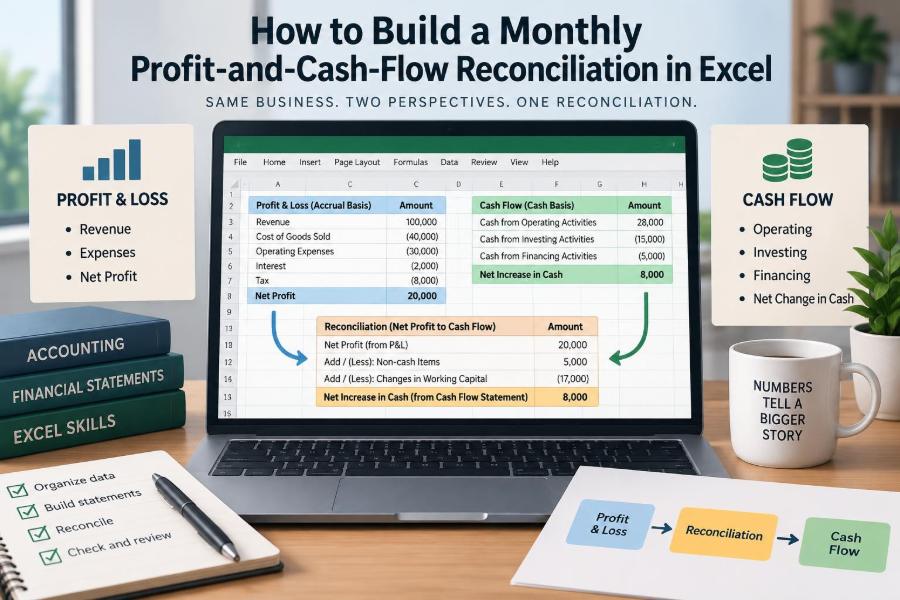
A monthly profit-and-cash-flow reconciliation turns that question into a repeatable calculation. It connects accrual-based profit to the actual change in cash, showing which balance-sheet movements explain the gap.
This is not merely a reporting exercise. A well-built workbook helps reviewers spot missing postings, classify unusual cash movements, explain performance to non-finance colleagues, and forecast whether next month’s obligations can be met.
Excel is a practical place to build the model because it can import ledger data, preserve an audit trail, calculate changes consistently, and present a compact explanation on one page. The key is to design the reconciliation as an accounting control, not as a spreadsheet full of manually typed plugs.
🧭 Start with the question the reconciliation answers
The central question is simple: why did cash change by a different amount than accounting profit? Profit measures revenue earned less expenses incurred during a period. Cash flow measures cash received and paid during that period.
A reconciliation begins with profit and adjusts for items that affected profit without affecting cash, then for balance-sheet changes that affected cash without immediately affecting profit. It should ultimately arrive at the same cash movement shown by your bank and cash ledger.
📚 Separate profit, cash flow, and cash balance
These three terms are related but not interchangeable. Net profit is a period result. Net cash flow is the movement in available cash during that period. Closing cash is the amount held at the reporting date.
The most basic relationship is:
Closing cash = Opening cash + Net change in cashYour model should reconcile both the period movement and the closing balance. Matching only one can conceal an opening-balance error or a missing cash account.
⚖️ Understand the indirect cash-flow method
Most monthly reconciliations use the indirect method. It starts with net profit and translates it into operating cash flow by reversing non-cash charges and adjusting for working-capital movements.
The alternative, direct method, lists cash received from customers and cash paid to suppliers, employees, and others. It can be highly intuitive, but it often requires transaction-level tagging. The indirect method is usually easier to build from a trial balance because the balance sheet already captures the timing differences.
🧱 Define the workbook before adding formulas
Create a clear workbook structure before importing a single number. A useful starting layout has separate sheets for source data, account mapping, calculations, review checks, and the final report.
- TB_Data: monthly trial balance or general-ledger extract
- Mapping: account classifications and reporting categories
- Calc: period movements and cash-flow adjustments
- Reconciliation: reviewer-facing report
- Checks: control totals and exception messages
Separating inputs from formulas makes the file easier to update, audit, and hand to another person without breaking it.
🗓️ Choose a consistent reporting period
Decide whether the workbook will use monthly activity, year-to-date activity, or both. For a routine management reconciliation, the report normally compares the current month’s opening and closing balance-sheet positions and uses the current month’s profit.
Be careful with trial-balance extracts. Some systems report profit-and-loss accounts as year-to-date balances while balance-sheet accounts are point-in-time balances. If so, calculate the monthly profit movement correctly rather than treating the year-to-date figure as one month of profit.
🏦 Include every account that represents cash
Cash is often spread across more than one ledger account: operating bank accounts, deposit accounts, payment-platform balances, petty cash, foreign-currency accounts, and sometimes restricted cash. Define the cash scope explicitly.
For internal management reporting, restricted cash may be shown separately because it cannot support ordinary operations. The important point is consistency: the cash accounts in the reconciliation must match the cash accounts used to calculate the actual cash change.
🔢 Build a disciplined source-data table
Load data into an Excel Table rather than leaving a loose range of cells. At minimum, retain account code, account name, opening balance, closing balance, account type, and reporting period.
Do not overwrite raw imports to “fix” them. Add a separate adjustment column or correct the issue in the source system. Preserving the original extract lets a reviewer trace every reported number back to the ledger.
🧾 Establish a reliable account-mapping table
The mapping table is the model’s translation layer. Each general-ledger account should be assigned to a cash-flow category such as accounts receivable, inventory, depreciation, loans, owner distributions, or cash.
Use account codes as the primary key wherever possible. Account names can change, may be abbreviated inconsistently, and are more prone to duplicate matches.
| Example account | Balance-sheet movement | Cash-flow treatment |
|---|---|---|
| Trade receivables | Increase | Use of operating cash |
| Inventory | Decrease | Source of operating cash |
| Depreciation expense | Expense in profit | Add back as non-cash |
| Bank loan | Increase | Financing cash inflow |
| Equipment | Increase | Usually investing cash outflow |
🔍 Make unmapped accounts impossible to ignore
An unmapped account is not a minor housekeeping issue. It means part of the ledger has not been considered in the cash-flow explanation.
Add a formula-driven status field that returns “UNMAPPED” when the mapping lookup is blank. Then calculate the total closing balance and movement of unmapped accounts on the Checks sheet. A clean reconciliation should not be considered complete while those totals are non-zero, unless a documented exception exists.
➕ Calculate movements with one sign convention
Choose a convention and apply it everywhere. A common approach is:
Movement = Closing balance − Opening balanceThis tells you how the ledger balance changed. It does not by itself tell you whether cash increased or decreased; that depends on the account’s nature. A receivable increase consumes cash, while a payable increase provides cash.
Most reconciliation errors are not advanced accounting problems. They are sign errors caused by mixing debit-and-credit logic, display signs, and cash-flow signs in the same calculation.
🔄 Translate working-capital movements into cash effects
Working capital includes short-term operating assets and liabilities. It explains the timing gap between recording revenue or expense and collecting or paying cash.
For an asset such as receivables, inventory, or prepayments, a rising balance normally means cash has been used. For an operating liability such as trade payables or accrued expenses, a rising balance normally means cash has been retained because payment has not yet occurred.
- Increase in operating asset: subtract from operating cash flow
- Decrease in operating asset: add to operating cash flow
- Increase in operating liability: add to operating cash flow
- Decrease in operating liability: subtract from operating cash flow
👥 Explain receivables without oversimplifying them
If revenue is recognized before a customer pays, profit rises before cash does. Therefore, an increase in trade receivables reduces operating cash flow under the indirect method.
Suppose a hypothetical business earns 50,000 in profit for the month, including sales that leave receivables 18,000 higher. All else equal, only 32,000 of that profit has translated into cash so far. That does not prove customers will not pay; it identifies a collection and timing question worth reviewing.
📦 Treat inventory as a cash commitment
Buying inventory can reduce cash before it appears as cost of sales. Inventory becomes an expense only when the related goods are sold, so a growing inventory balance often helps explain why a profitable business has weak operating cash flow.
Inventory decreases can improve cash flow, but the explanation needs context. The decrease may reflect healthy sales, deliberate stock reduction, write-downs, or missing purchase postings. The reconciliation identifies the movement; operational review explains its cause.
🧷 Account for prepayments and other operating assets
Prepaid insurance, rent deposits, recoverable taxes, employee advances, and similar accounts are easy to omit because their balances may be small individually. Together, they can materially affect the reconciliation.
A prepayment increase is generally a cash outflow that has not yet become an expense. When the prepaid asset is amortized later, expense reduces profit but no new cash payment occurs. That two-period pattern is exactly what the indirect method is designed to reveal.
🧮 Handle payables and accruals carefully
Accounts payable and accrued expenses represent costs recorded before payment. An increase usually adds to operating cash flow because expense reduced profit but the business has not yet paid the cash.
However, not every liability is an operating payable. Loan balances, tax payable, payroll liabilities, lease liabilities, customer deposits, and amounts due to owners may require separate classification. A label such as “accrual” is not enough; inspect what the account actually represents.
🪙 Add back non-cash expenses
Depreciation, amortization, certain impairment charges, and some provisions can reduce accounting profit without using cash in the current period. These charges are added back when reconciling profit to operating cash flow.
The add-back does not mean the cost is unreal or unimportant. Depreciation reflects the accounting allocation of a prior asset purchase. The related cash outflow generally belongs in investing activities when the asset was acquired.
🏗️ Separate capital expenditure from depreciation
Capital expenditure, often shortened to capex, is spending on long-lived assets such as equipment, vehicles, computer hardware, or qualifying software. It commonly appears as an increase in fixed assets and an investing cash outflow.
Do not assume that every fixed-asset increase equals cash capex. Assets may be acquired through finance arrangements, transferred between entities, sold, written off, or reclassified. Where movements are material, reconcile the fixed-asset register or transaction detail rather than relying only on the net balance-sheet movement.
🏦 Classify debt, equity, and owner transactions separately
Borrowing, loan repayments, capital contributions, dividends, and owner drawings are financing flows. They affect cash but are not operating performance, so combining them with working capital can make a business look operationally stronger or weaker than it is.
Interest and tax classifications can vary by reporting framework and management convention. For an internal Excel model, choose a documented policy that matches the organization’s reporting approach and apply it consistently. Formal external reporting may require more specific guidance.
🧾 Watch for taxes that distort the simple pattern
Sales taxes, value-added taxes, payroll withholdings, and income taxes can create large liability or receivable movements. They often move differently from ordinary operating expenses because the business may collect or withhold cash on behalf of a tax authority.
Keep tax accounts visible in the mapping rather than burying them in a generic “other liabilities” line. A sharp increase in tax payable may improve current-period cash, but it also signals a payment obligation that may fall due soon.
🚫 Exclude non-cash transactions from cash-flow totals
Some accounting entries change asset and liability balances without moving cash. Examples can include acquiring an asset through a new lease or financing arrangement, converting debt to equity, recording depreciation, or reclassifying balances.
These transactions should not be forced into the cash-flow bridge. Instead, identify them through journal descriptions, supporting schedules, or a non-cash adjustment log. If they are material to users of the report, disclose them separately as non-cash investing or financing activity.
🧠 Use formulas that are readable and auditable
Modern Excel functions can make the model both compact and transparent. For example, SUMIFS can sum movements by reporting category, while XLOOKUP can bring classification fields from the mapping table into the source-data table.
A conceptual cash-flow formula might be:
=SUMIFS(Data[Cash Flow Effect],Data[Category],A10)Use named tables and meaningful column headings. A long formula with hard-coded account numbers may work today, but it is difficult to test when the chart of accounts changes.
🧪 Build control checks into the workbook
A reconciliation is credible when it proves itself. Put visible controls near the top of the Checks sheet and use a clear pass/fail format, not a hidden difference several columns away.
- Trial balance debits equal credits, where applicable
- Total mapped balance equals total source balance
- No unmapped accounts have a non-zero movement
- Calculated net cash change equals actual cash movement
- Opening cash plus calculated change equals closing cash
- Cash accounts reconcile to bank or cash-ledger balances
Set a small rounding tolerance if source data is rounded. Investigate any difference beyond that threshold instead of inserting a balancing line.
🧯 Never use a plug as the final answer
A “cash-flow adjustment” line entered solely to make the reconciliation balance is a warning sign, not a solution. It can temporarily keep a report moving, but it hides the classification, timing, source-data, or formula issue that needs investigation.
If a temporary plug is unavoidable during a close, label it prominently, quantify it, assign an owner, and remove it once the underlying issue is resolved. Do not allow it to become a recurring permanent category.
📊 Design the report for a non-accounting reader
The final report should answer the owner’s question without requiring them to inspect raw data. Use a concise bridge: profit, non-cash adjustments, working-capital changes, operating cash flow, investing cash flow, financing cash flow, and net cash movement.
Show opening and closing cash alongside the bridge. A simple variance column comparing current month with prior month or budget can be useful, but only if the definitions are identical across periods.
🗣️ Write a short management explanation
Numbers become more useful when paired with a precise narrative. A strong comment identifies the driver, describes the mechanism, and indicates whether action is needed.
For example: “Operating cash flow was below profit primarily because trade receivables increased following late-month invoicing. The balance should be reviewed against the collections schedule.” This is more useful than saying simply that “cash was lower due to working capital.”
🔎 Investigate large or unexpected movements
Use thresholds based on the size and volatility of the business, rather than applying a universal amount. Review accounts with large changes, unusual sign reversals, dormant accounts that suddenly move, or balances that appear inconsistent with the operational story.
Supporting evidence may include bank reconciliations, aged receivables and payables, inventory reports, fixed-asset registers, loan statements, payroll reports, and significant journal entries. The reconciliation points you to where these documents should be examined.
🧹 Avoid common Excel model failures
Several spreadsheet habits weaken a reconciliation even when its final total happens to agree.
- Hard-coding values inside formulas instead of referencing source tables
- Copying prior-month formulas without checking new accounts
- Using inconsistent signs between sheets
- Hiding error rows with filters and forgetting they exist
- Mixing cash movements with balance-sheet balances in one column
- Overwriting imported data to make a report look cleaner
- Protecting the workbook so heavily that reviewers cannot trace logic
Good spreadsheet engineering is not about complexity. It is about making the correct process easier to repeat than the incorrect one.
🔐 Add review discipline and version control
Save each completed month as a controlled version, retaining the source extract and a note of significant adjustments. If the workbook is shared, specify who refreshes data, who investigates exceptions, and who approves the final bridge.
For sensitive files, limit edit access and protect formula cells where practical. Protection is not a substitute for review, but it can reduce accidental changes during a busy close.
⚙️ Streamline the recurring monthly process
Once the logic is stable, standardize the workflow: export the trial balance, refresh or paste data into the input table, review mapping exceptions, update supporting schedules, investigate controls, and publish the report.
Power Query can help import and transform consistently formatted files, especially when multiple entities or bank accounts are involved. Automation should be introduced gradually and tested against a manually verified month; automated errors can be repeated very efficiently.
🧩 Know when Excel is not enough
Excel is well suited to a controlled monthly reconciliation for many teams. It becomes less suitable when there are many entities, complex consolidations, frequent currency translation, high transaction volume, strict audit requirements, or multiple people editing simultaneously.
In those cases, a financial planning system, consolidation tool, or automated reporting solution may reduce operational risk. The underlying accounting logic does not change: profit must still be bridged to cash through non-cash items, working capital, investing, and financing flows.
✅ Bring the reconciliation back to its core principle
A monthly profit-and-cash-flow reconciliation is a disciplined explanation of timing and classification. Profit tells you whether the business created accounting value during the period. Cash flow shows whether cash was collected, retained, invested, borrowed, or returned.
Start with clean source data, map every account, apply one sign convention, separate operating activity from investing and financing, and make every difference visible. When the bridge balances without unexplained plugs, it becomes a practical control as well as a management tool.
The best reconciliation does not merely prove that the cash number is correct; it explains what the business must do next. 💰📊✅