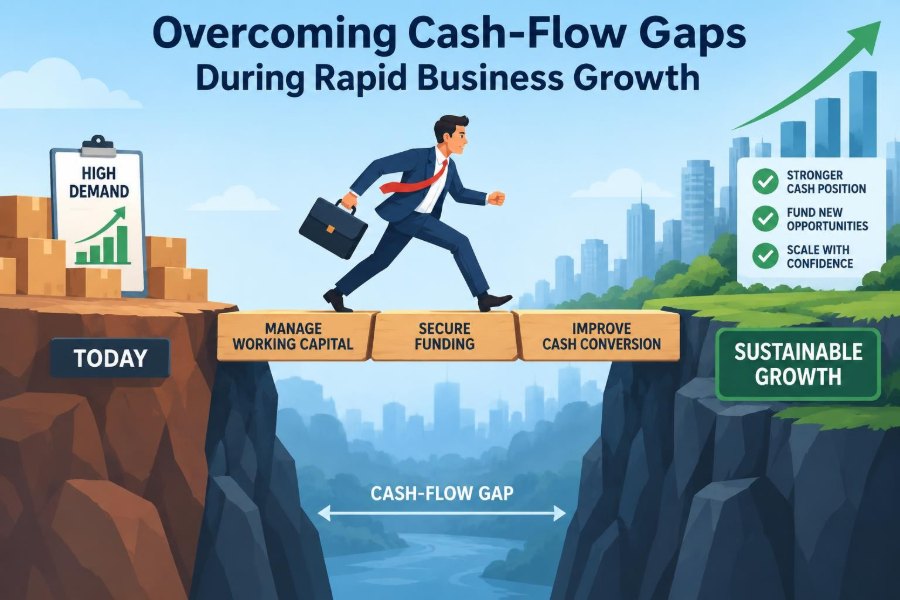

A business can look busy, profitable, and full of promise while its bank account feels unexpectedly tight. Orders are rising, staff are working harder, and customers are praising the product—yet a supplier payment is due before a major client has paid its invoice.
This is one of the most confusing moments in business growth. Owners may assume that more sales should automatically mean more cash. In reality, rapid growth often requires a company to spend money weeks or months before it collects the revenue connected to that spending.
That timing mismatch is a cash-flow gap. It does not necessarily mean the business model is failing, but it can become dangerous when management cannot see the gap early enough or fund it deliberately.
Understanding the mechanics helps leaders make calmer decisions: which orders to accept, which terms to negotiate, when to borrow, and when to slow down long enough to protect the business.
🌊 Growth Can Consume Cash Before It Creates It
Growth usually increases working demands before it increases available cash. A retailer must buy more inventory, a manufacturer must purchase materials, and a service business may need to hire and train people before serving new clients.
The revenue may eventually cover those costs and generate a profit. But “eventually” matters. If cash leaves today and arrives sixty days later, the business needs enough liquidity to bridge that period.
Think of growth as building a longer bridge while traffic is already crossing it. The business needs materials and labor now, even though the tolls are collected later.
💡 Profit and Cash Are Different Measures
Profit measures whether revenue exceeds expenses over an accounting period. Cash flow tracks when money actually enters and leaves the business. A company can record a profitable sale when it delivers goods or completes work, even if the customer has not paid yet.
For example, a consulting firm may complete a project in March, issue a $20,000 invoice, and recognize revenue under its accounting method. If the client pays in May, the firm may show profit in March while still needing cash for April payroll.
Neither measure is “more real.” Profit helps assess economic performance; cash flow determines whether bills can be paid on time. Growing firms need to manage both.
🧾 The Cash Conversion Cycle Explains the Timing
The cash conversion cycle is the period between paying cash for operating inputs and collecting cash from customers. It is especially useful for businesses that hold inventory or sell on credit.
Its broad components are inventory days, receivable days, and payable days. Inventory and receivables generally lengthen the cycle, while supplier credit—payables—can shorten it.
| Stage | Cash-flow effect | Management question |
|---|---|---|
| Buy inventory or inputs | Cash goes out | How far ahead are we purchasing? |
| Hold, produce, or deliver | Cash remains tied up | How quickly can it become a sale? |
| Invoice the customer | Revenue may be recorded, but no cash arrives yet | Are terms and invoicing accurate? |
| Collect payment | Cash comes in | Are customers paying as agreed? |
A shorter cycle is not always possible or desirable, but understanding it reveals where cash is becoming trapped.
📈 A Larger Sales Pipeline Can Widen the Gap
More orders are encouraging, but each new order can require an upfront investment. If sales double and the business must buy twice as much stock before customer payments arrive, its funding requirement may rise sharply.
A common mistake is to treat projected sales as if they were available cash. A pipeline represents opportunity, not liquidity. Even signed orders may change timing because of production delays, disputes, approval processes, or customer payment practices.
Growth planning should therefore ask not only, “How much will we sell?” but also, “What cash will leave before each sale is collected?”
🏭 Inventory Is Cash Wearing Another Form
Inventory can support reliable service and protect against stockouts, but it ties up funds until it is sold. During expansion, managers may order extra quantities to secure volume discounts or prepare for anticipated demand.
That decision can work when forecasts are reliable and storage, obsolescence, and financing costs are understood. It becomes risky when demand is uncertain or products have short shelf lives, changing designs, or seasonal appeal.
Review inventory by item, not just by total value. Slow-moving stock may represent cash that cannot support payroll, supplier bills, or urgent opportunities.
📬 Receivables Turn Sales Into Promises
An account receivable is an amount a customer owes after receiving goods or services. It is an asset, but it is not spendable cash until collected.
Long payment terms, delayed invoices, billing errors, and unresolved customer questions can all stretch the collection period. A single large late-paying customer can create pressure even when overall sales are strong.
Businesses should track receivables by due date and customer. An aging schedule makes it easier to distinguish invoices that are merely recent from balances that need immediate follow-up.
🧑💼 Customer Concentration Raises Collection Risk
Rapid growth sometimes comes from landing one major account. That customer can transform revenue, but dependence creates a liquidity risk when its payment cycle is slow or its purchasing plans change.
If one client represents a large share of receivables, a payment dispute may affect the entire operating budget. The issue is not that large customers are inherently bad; it is that their influence should be visible in the cash forecast.
Where commercially realistic, diversify the customer base, negotiate milestones, and avoid financing all delivery costs with the assumption that one payer will always pay on schedule.
🧮 Build a Rolling Cash Forecast
A cash forecast estimates future cash receipts, payments, and the resulting bank balance. Unlike an annual budget, it should be updated regularly as actual collections, orders, and spending change.
For a growing business, a weekly view is often more useful than a monthly one. The goal is not perfect prediction. The goal is early warning: identifying the weeks when cash could fall below a safe operating level.
- Start with the actual bank balance, not the accounting profit.
- List expected customer receipts by realistic payment date.
- List payroll, tax, rent, supplier payments, loan payments, and planned purchases.
- Separate committed payments from estimates and optional spending.
- Compare the forecast with actual results and revise assumptions.
🗓️ Forecast by Timing, Not Just Totals
A monthly forecast can hide a serious weekly squeeze. For example, a business may expect $100,000 of customer receipts and $100,000 of payments in the same month, yet still face a shortage if payroll and suppliers are paid in the first week and collections arrive near month-end.
Timing should be as specific as the available information allows. Use agreed payment dates, typical customer behavior, payroll calendars, tax deadlines, and supplier terms rather than simply dividing annual figures by twelve.
As uncertainty rises further into the future, forecasts become less precise. That is normal. Treat later periods as planning ranges, not promises.
🔍 Use Base, Downside, and Upside Scenarios
A single forecast can create false confidence. Scenario planning tests what happens when important assumptions move in different directions.
A base case may assume ordinary sales and normal collection patterns. A downside case could assume a major customer pays late, sales arrive more slowly, or a key supplier demands faster payment. An upside case might include earlier collections or stronger demand.
The value lies in deciding ahead of time what action each situation requires. If the downside case causes a shortfall, management can seek funding or reduce commitments before the shortage becomes urgent.
🚦 Define a Minimum Cash Buffer
A cash buffer is an amount deliberately retained to absorb timing surprises. It should be based on the business’s volatility, fixed obligations, access to credit, and ability to delay discretionary spending—not on an arbitrary percentage.
For a company with weekly payroll and unpredictable customer collections, the buffer may need to be larger than for a subscription business that receives payment in advance. Restricted cash and tax money should not be mistaken for freely available reserves.
A clear threshold also creates discipline. When the forecast approaches it, leaders know that expansion spending, purchasing, or owner withdrawals need review.
🧾 Invoice Quickly and Accurately
The collection process begins before an invoice is issued. Confirm the customer’s legal billing entity, purchase-order requirement, contact person, delivery evidence, tax treatment, and agreed payment terms before work begins.
Then invoice as soon as the contractual trigger is met. A delayed invoice adds unnecessary days to the cash conversion cycle, while an incorrect invoice can trigger a long approval delay.
Automation can help, but it does not replace accountability. Someone should own the process of checking that completed work is billed and that rejected invoices are corrected promptly.
📞 Collect Receivables With Professional Consistency
Collection does not need to be hostile. It is a routine commercial process that protects the supplier’s ability to keep serving customers.
Send polite reminders before and after the due date, confirm that the invoice was received, and resolve questions quickly. Escalate internally when a balance becomes overdue rather than allowing it to disappear into a general inbox.
Consistency matters more than dramatic last-minute chasing. Customers learn that agreed terms are meaningful when the supplier follows them in an organized, respectful way.
🤝 Negotiate Terms Before Accepting the Work
Payment terms are part of the price and risk of a sale. A profitable contract with long payment terms may require more financing than a slightly lower-priced contract that includes an upfront deposit or milestone payments.
For custom, long-running, or capital-intensive work, consider aligning cash receipts with delivery stages. Deposits, progress billing, retainers, and staged approvals can reduce the amount the business must fund itself.
Terms must be commercially acceptable to both sides. A large buyer may have limited flexibility, but asking early is generally easier than attempting to renegotiate after costs have been incurred.
🧱 Match Supplier Terms to Your Operating Cycle
Supplier credit can help a business fund the period between purchasing inputs and collecting from customers. If customers normally pay in forty-five days but key suppliers require immediate payment, the gap must be funded elsewhere.
Ask suppliers about payment terms, delivery schedules, deposits, and volume arrangements. Long-standing, reliable relationships may support better terms, but businesses should never assume an extension without agreement.
Do not solve a structural problem by simply paying suppliers late. Unapproved delays can damage trust, interrupt supply, remove early-payment discounts, and create legal or contractual consequences.
💳 Choose Financing for the Asset Being Funded
External finance can be sensible when it is matched to the purpose and repayment source. Short-term seasonal inventory, for instance, may suit a revolving working-capital facility better than a long-term fixed loan.
Equipment with a useful life of several years is often better aligned with term financing or leasing, because the asset generates value over time. Using short-term cash to buy long-lived assets can strain operations.
Financing terms vary by lender, jurisdiction, security provided, credit profile, and contract. Professional financial and legal advice is appropriate before committing to any facility.
🏦 Understand Common Working-Capital Options
Different tools solve different timing problems. The right choice depends on predictability, cost, control, and the underlying quality of receivables or inventory.
- Overdrafts or revolving credit: flexible borrowing up to an approved limit, often used for temporary operating needs.
- Invoice financing: funding linked to eligible customer invoices; the provider’s terms, fees, and customer-notification approach vary.
- Purchase-order or trade finance: may help fund specific supply transactions, usually where the order and delivery chain can be verified.
- Term loans: structured repayments that may fit equipment, systems, or other longer-lived investments.
- Equity investment: can provide patient capital without scheduled debt repayment, but generally changes ownership and decision rights.
No facility makes an unprofitable sale profitable. Finance buys time; the underlying operations must still generate enough margin and cash to support repayment.
⚖️ Compare Funding Cost With the Cost of Constraint
Borrowing has interest, fees, covenants, security requirements, and administrative effort. These costs should be understood clearly rather than dismissed because revenue is growing.
But refusing all financing can also have a cost. The business may turn away sound orders, lose supplier discounts, or fail to meet payroll during a temporary and otherwise manageable gap.
The useful comparison is not “debt is good” versus “debt is bad.” It is whether the expected return, risk, and cash timing of a specific opportunity justify the funding method.
🛒 Price for the Cash Demands of Growth
Pricing should cover more than visible production costs. It needs to reflect labor, materials, overhead, warranty exposure, delivery requirements, financing needs, and the risk of delays or changes.
A low-margin order with long payment terms may add revenue while reducing available cash. This is particularly true when the seller must pay subcontractors or suppliers before the buyer accepts the work.
When reviewing a major contract, model the cash schedule alongside the profit estimate. An order can be strategically valuable, but leaders should know how much cash it will consume at its deepest point.
🧰 Separate Essential Spending From Expansion Spending
During a cash squeeze, not every outgoing payment has the same consequence. Payroll, legally required payments, core supplier commitments, and customer-critical operations may be essential. New software, office improvements, discretionary marketing experiments, and nonurgent hiring may be deferrable.
Classification should happen before a crisis. A pre-agreed spending hierarchy allows management to move quickly without making every decision from scratch under pressure.
Deferral is not always the right answer. Cutting customer support, maintenance, or quality controls may save cash briefly while creating larger costs later.
👥 Hire Against Demand, Not Optimism Alone
Hiring is often necessary for growth, but payroll is usually a recurring and relatively inflexible obligation. A new employee’s full cost can include salary, benefits, taxes, equipment, onboarding time, and management attention.
Before adding permanent headcount, assess the durability of demand and the delay between hiring and customer cash collection. Contractors, phased hiring, cross-training, or temporary capacity may offer flexibility in some situations.
This does not mean avoiding investment in people. It means matching the commitment structure to the certainty and cash profile of the work.
🛑 Know When to Slow a Sale Down
Turning down revenue can feel counterintuitive, especially when a business is trying to establish momentum. Yet a deal may be too risky if it requires heavy upfront spending, has weak margins, gives the customer excessive payment flexibility, or depends on assumptions the business cannot verify.
A useful question is: “If this customer pays later than expected, can we still meet every essential obligation?” If the answer is no, the contract may need different terms, external funding, or a smaller initial scope.
Disciplined growth protects the ability to serve existing customers as well as new ones.
📊 Monitor Leading Indicators, Not Just Bank Balance
The bank balance tells managers where cash stands today. Leading indicators suggest where it is heading. They provide time to act before a shortage appears.
- Days sales outstanding: the average time taken to collect credit sales.
- Overdue receivables by customer and aging bracket.
- Inventory turnover and slow-moving stock.
- Upcoming payroll, tax, debt, and supplier-payment dates.
- Committed purchase orders and unbilled completed work.
- Available credit and remaining headroom under facility limits.
Metrics should prompt questions, not replace judgment. A rising receivables measure, for example, may reflect a planned move into enterprise customers—or a growing collection problem.
🔐 Protect Tax and Restricted Cash
Some cash held in a bank account is already committed. Amounts collected for taxes, payroll withholdings, customer deposits, or contractual obligations may not be safely available for ordinary operating expenses.
Mixing these funds into a general spending pool can make a business appear more liquid than it is. Set aside obligations as they arise and display them separately in cash reporting.
Rules vary by location and business structure, so companies should obtain appropriate local accounting or tax guidance rather than relying on general descriptions.
🧭 Give Finance a Seat in Sales Decisions
Cash problems often begin when sales, operations, and finance work from different assumptions. Sales may focus on winning the contract, operations on fulfilling it, and finance on finding funds after commitments have already been made.
Bring these perspectives together before signing large or unusual deals. Sales can explain customer expectations, operations can identify delivery needs, and finance can map the timing and funding requirement.
This is not bureaucracy for its own sake. It is a way to ensure that commercial success does not accidentally create a solvency problem.
🗣️ Communicate Early With Lenders and Suppliers
When a forecast indicates pressure, early communication creates more options. A lender may need time to review financial information; a supplier may be more open to a planned adjustment than to an unexplained late payment.
Credibility improves when management can explain the cause, provide a realistic forecast, and describe corrective actions. Avoid presenting hopeful sales estimates as certain receipts.
Transparency will not guarantee accommodation, but surprise usually reduces trust and negotiating room.
🚫 Avoid Emergency Fixes That Deepen the Problem
Under pressure, businesses may rely on expensive short-term borrowing, repeatedly delay suppliers, offer excessive customer discounts for immediate payment, or use tax funds to cover operating costs. These actions can create relief while worsening the underlying structure.
Another common error is increasing sales activity without checking unit economics. More low-margin, cash-hungry work can accelerate the drain.
Emergency measures may sometimes be unavoidable, but they should be paired with a clear recovery plan: improve terms, reduce the cycle, secure suitable funding, or change the work being accepted.
🧪 A Hypothetical Growth Example
Consider a small distributor that wins a new contract requiring $60,000 of inventory. Its supplier requires payment in thirty days, while the customer pays sixty days after delivery. The distributor also needs to pay freight and temporary warehouse labor before invoicing.
The order may be profitable on paper. Yet the company could face its largest cash outflow well before the customer payment arrives. If it accepts several similar orders at once, the gap multiplies.
Possible responses include negotiating a customer deposit, arranging supplier terms, drawing on a properly sized revolving facility, staging deliveries, or limiting the number of concurrent orders. The best response depends on margin, customer reliability, contract terms, and the company’s broader commitments.
🧠 Turn Cash Management Into a Regular Operating Habit
Cash control works best when it is routine rather than a reaction to panic. A short weekly review of forecast changes, overdue invoices, inventory commitments, upcoming payments, and funding headroom can keep decisions grounded.
Assign owners to actions: one person follows up collections, another approves purchases, and leadership decides whether projected gaps require a change in terms or financing. Clear ownership prevents important items from becoming everybody’s assumption.
As the business grows, systems may need to become more formal. Spreadsheets can be effective at first, but reliable data, reconciliations, approval controls, and timely accounting become increasingly valuable.
🏁 The Core Principle: Fund the Journey, Not Just the Destination
Rapid growth creates value only when the company can survive the path from upfront cost to collected revenue. Profitability, demand, and customer enthusiasm are necessary, but they do not eliminate timing risk.
The practical discipline is straightforward: understand the cash conversion cycle, forecast receipts and payments honestly, protect a buffer, negotiate terms deliberately, and match financing to the need. These habits turn cash flow from a recurring surprise into a managed operating variable.
Healthy growth is not simply selling more—it is ensuring that every stage of growth has enough cash to carry the business safely to the next stage. 💰📈🧭