
A production manager sees a part made from $12 of steel and assumes a selling price of $20 leaves a healthy margin. At month-end, however, the business reports disappointing profit. Machines consumed electricity, technicians set up the line, some pieces failed inspection, and material was lost when sheets were cut.
This is a familiar manufacturing problem: the purchase price of the material is visible, while many of the costs required to turn it into a saleable product are less obvious. If those costs are missed or spread poorly, product margins can look far better—or worse—than they really are.
True product cost is not simply an accounting exercise. It affects quotations, product mix, inventory values, production decisions, performance measurement, and the ability to explain why a busy factory may still struggle to earn money.
Manufacturers need a method that is accurate enough for decisions, practical enough to maintain, and clear enough that operations and finance can discuss the same numbers. That method begins by tracing what can be traced and allocating what must be shared.
🏭 What “true product cost” means
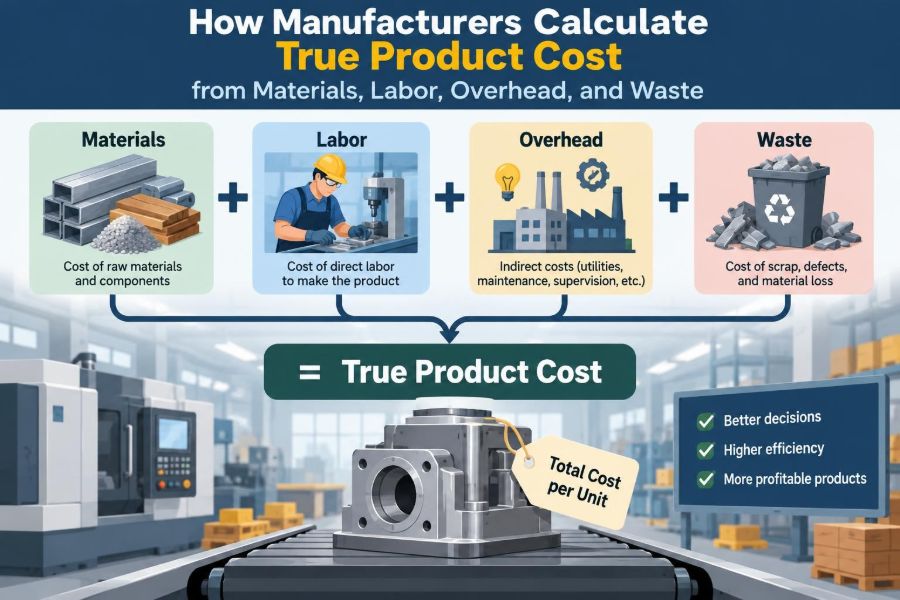
True product cost is the cost of bringing one unit to its current condition and location for sale or further production. In a factory, it commonly includes direct materials, direct labor, and manufacturing overhead.
Waste, rework, scrap, and yield losses also matter because they consume resources. Some are built into the expected cost of good units; unusual losses are often treated separately so they do not hide operational problems.
🧩 The four cost building blocks
The practical model is simple: material goes into the product, people and equipment transform it, and the factory infrastructure supports the work. The difficult part is measuring each block at a useful level of detail.
| Cost block | Typical examples | How it reaches a product |
|---|---|---|
| Direct materials | Steel, resin, packaging, purchased components | Traced through bills of materials and issue records |
| Direct labor | Assembly, machining, welding, finishing | Traced through time records or standard labor routes |
| Manufacturing overhead | Supervision, depreciation, utilities, maintenance | Allocated using a cost driver |
| Waste and losses | Scrap, spoilage, rework, startup losses | Assigned according to normal or abnormal treatment |
Costs outside production—such as selling commissions, corporate legal work, and outbound delivery—may be crucial for profitability, but they are usually analyzed separately from manufacturing product cost.
🧭 Start with the costing purpose
No single number serves every decision perfectly. Financial reporting, inventory valuation, quoting, capacity planning, and make-or-buy analysis can require different views of cost.
For example, a short-term decision about using idle capacity may focus on incremental material, labor, and energy. A long-term quotation must normally recover a reasonable share of facility, support, and equipment costs as well.
📦 Direct materials: the visible starting point
Direct material is material that becomes part of a product or can be economically traced to it. A bicycle frame’s tubing and a circuit board’s components are clear examples.
Material cost generally includes the purchase price plus costs needed to acquire it, such as freight-in, receiving-related charges, and nonrecoverable duties where applicable. Purchase discounts and returns reduce the amount.
🧾 Bills of materials turn designs into cost inputs
A bill of materials, or BOM, lists the components and quantities required for a product. It links engineering design to planning, purchasing, inventory control, and standard costing.
A usable BOM must reflect the real production version, not merely the original design. Substituted components, revised dimensions, packaging changes, and alternate suppliers can all change cost.
For a hypothetical appliance, the BOM may specify one housing, four screws, a motor, a cable, and one carton. The cost estimate starts by multiplying each required quantity by an appropriate unit cost.
📉 Material yield makes quantity more complicated
Required input is often greater than the material contained in the finished item. A fabric pattern produces offcuts; a metal blank creates trim; a chemical reaction may lose some material during processing.
If a finished unit needs 0.90 kilograms of usable resin but the expected process yield is 90%, the planned input is 1.00 kilogram. Costing only the 0.90 kilograms understates the material consumed to make a good unit.
🏷️ Choosing a material price basis
Actual cost uses the amounts recorded for materials consumed. Standard cost uses predetermined prices and quantities, then analyzes differences between standard and actual performance.
Inventory methods such as weighted average or first-in, first-out can affect recorded material cost. The best choice depends on the accounting framework, systems, and inventory flow, but consistency matters because changing methods can distort comparisons.
👷 Direct labor is more than hourly wages
Direct labor is the work of employees who physically make, assemble, process, or inspect a product when their time can be traced economically. The labor rate should usually capture more than base pay.
Depending on local practice and policy, the cost pool may include payroll-related employer costs, benefits, paid leave, and shift premiums. The goal is not to load every people-related expense onto a job, but to avoid pricing work as if employees cost only their stated wage.
⏱️ Labor routing connects time to products
A routing describes the production steps, work centers, expected setup time, and expected run time. It creates a disciplined estimate of the labor and machine effort a product should require.
Time can be captured through job tickets, barcode scans, manufacturing execution systems, or well-designed estimates. Detailed tracking has a cost, so companies should seek enough accuracy to support decisions without creating paperwork that operators cannot sustain.
🔄 Setup time deserves deliberate treatment
Setting up a press, cleaning a mixing vessel, programming a machine, or changing tooling may be necessary for a production batch but not for every unit equally. High-mix, low-volume factories can spend a large share of labor time on setups.
When setup hours are buried in one broad overhead rate, small batches may be undercosted and long runs overcosted. Tracking setup as a separate activity often produces more useful quotations and batch-size decisions.
🏗️ Manufacturing overhead supports production
Manufacturing overhead includes indirect factory costs: items required to run production but not conveniently traceable to one unit. Examples include factory rent, equipment depreciation, indirect materials, production supervision, maintenance, quality support, and some utilities.
A supervisor may assist several lines in one day, and lighting serves the whole building. Treating those costs as direct to a single job would be arbitrary; leaving them out would make every product look too cheap.
🚫 Keep period costs out of factory cost
Not every business expense belongs in inventory or product manufacturing cost. Marketing, sales salaries, executive administration, research not tied to production, and interest expense are often treated as period costs under common accounting approaches.
That distinction does not make them irrelevant. A product can recover its manufacturing cost and still fail to cover selling and administrative needs. Managers should view both manufacturing margin and broader product or customer profitability.
⚙️ Cost pools make overhead manageable
An overhead cost pool groups similar indirect costs before allocation. A factory may use one plant-wide pool, separate pools by department, or activity-based pools such as setups, purchasing, machine support, and inspection.
More pools can improve causal accuracy, especially when products use resources differently. But complexity brings data collection, maintenance, and explanation costs. A model should become more detailed only where the better signal changes meaningful decisions.
📏 Select cost drivers with cause and effect
A cost driver is the measure used to allocate a cost pool. Direct labor hours, machine hours, units produced, material moves, purchase orders, and setup counts are common drivers.
The question is not “Which driver is easiest?” but “What most plausibly causes this cost to be incurred?” Machine depreciation and power may relate more closely to machine hours than to direct labor hours in an automated plant.
🧮 Calculating a predetermined overhead rate
Many manufacturers use a predetermined overhead rate before the period begins:
Predetermined overhead rate = Budgeted manufacturing overhead ÷ Budgeted driver activity
If a machining department budgets $600,000 of overhead and expects 30,000 machine hours, its rate is $20 per machine hour. A job using 3 machine hours receives $60 of applied machining overhead.
This rate is an estimate, not a claim that each machine hour literally consumes exactly $20. It allows timely job costing and can be refined as operating conditions change.
🧱 Plant-wide, departmental, and activity-based approaches
A plant-wide rate is straightforward and may work reasonably in a stable factory with similar products. Departmental rates recognize that assembly, machining, and finishing can have different cost structures.
Activity-based costing (ABC) assigns overhead through activities and multiple drivers. It can reveal the cost of frequent setups, special testing, engineering changes, or many small purchase orders that a volume-based rate may blur.
ABC is informative, not automatically superior. If a business has a narrow product range and few differences in resource use, its added administrative burden may exceed its benefit.
🗑️ Scrap, spoilage, and waste are not identical
Scrap is leftover material with a small recoverable value, such as metal offcuts. Spoilage is a unit that does not meet specifications and cannot be economically repaired. Waste is a broader term for resources lost without creating intended value.
Clear labels matter. A part sent to recycling, a part remade through rework, and a part scrapped after a preventable process error should not disappear into one generic “variance” account.
♻️ Normal waste belongs in expected production cost
Normal waste is the expected loss inherent in an efficient process under ordinary conditions. Some trimming, evaporation, breakage, or startup loss may be unavoidable even when operations are well controlled.
Because good output bears the cost of expected loss, normal waste is generally reflected in the cost of saleable units. Selling proceeds from routine scrap may reduce the related material or production cost, depending on the company’s policy.
🚨 Abnormal loss should remain visible
Abnormal waste arises beyond what the process normally expects: a major machine malfunction, an incorrect material mix, a preventable handling incident, or an unusual quality failure. Its exact accounting treatment depends on the applicable framework and policy.
Management’s central need is visibility. Spreading abnormal loss across good units can make product costs look routine while hiding a problem that needs investigation, corrective action, or an insurance or supplier claim.
🔧 Rework requires a cause-based decision
Rework is additional effort to bring a unit back to specification. If it is an expected feature of a process, companies may include expected rework in standard conversion cost.
When rework results from a specific failed batch, design error, or supplier defect, tracking it separately makes accountability clearer. The purpose is learning, not blame: was the root cause training, equipment capability, unclear instructions, material quality, or unrealistic tolerances?
📊 Standard cost creates a benchmark
A standard cost sets expected quantities and prices for materials, labor, and overhead. It gives planners a stable cost for inventory records, quotations, and performance comparisons while actual costs fluctuate.
A good standard is neither an ideal that no one can reach nor a loose average that excuses poor performance. It should represent attainable operating conditions and be reviewed when designs, processes, wage structures, prices, or expected yields change.
🔍 Variances explain what changed
A variance is the difference between actual results and standard or budgeted expectations. Material price and usage variances, labor rate and efficiency variances, and overhead spending and volume variances each point toward different questions.
For instance, excess material usage might signal poor cutting yield, unrecorded scrap, an outdated BOM, or a quality problem. A higher purchase price could reflect supplier changes, rush freight, mix differences, or a standard price that is no longer realistic.
🧪 A compact product-cost example
Consider a hypothetical batch of 100 saleable machined brackets. Each bracket requires 1.2 kilograms of steel input at $5 per kilogram, including the expected cutting loss. Direct labor is 0.4 hours at a loaded rate of $30 per hour, and machining overhead is applied at 0.5 machine hours times $20.
- Direct materials: 1.2 × $5 = $6 per bracket
- Direct labor: 0.4 × $30 = $12 per bracket
- Applied overhead: 0.5 × $20 = $10 per bracket
- Standard manufacturing cost: $28 per bracket
If five additional brackets are spoiled because a tool fails unexpectedly, that loss should be recorded and investigated rather than silently assumed to be part of the normal 1.2-kilogram material allowance.
📈 From unit cost to a useful selling price
Manufacturing cost is a starting point, not automatically a price. A quotation may also need to cover selling, general, and administrative costs, warranty exposure, distribution, financing effects, taxes where relevant, and a profit margin appropriate to the risk and market.
Market conditions still matter. A calculated price above what customers will pay may indicate that the design, process, order size, or target segment needs reconsideration—not that the factory should casually sell below a sustainable cost.
🎯 Contribution margin and full cost answer different questions
Contribution margin is sales revenue less costs that change with the decision or volume under consideration. It is helpful for short-run choices, such as whether an idle machine should accept a special order without displacing regular business.
Full manufacturing cost includes an allocation of fixed production support costs. It is more appropriate for long-run product economics, inventory measurement, and assessing whether a product line helps sustain the factory over time.
A common error is to use one measure everywhere. A special order that contributes cash may be sensible in limited circumstances, while repeatedly pricing normal work below full cost can erode the ability to replace equipment and maintain capacity.
🧾 Job costing fits distinct customer work
Job costing collects material, labor, and overhead for a specific order, contract, batch, or project. It suits custom machinery, construction components, prototypes, repair work, and made-to-order products.
The job cost sheet becomes the audit trail: which material was issued, which hours were charged, which overhead rate was used, and what adjustments occurred. Its quality depends heavily on prompt and accurate shop-floor records.
🌊 Process costing fits continuous production
Process costing averages costs across many similar units moving through continuous departments, such as refining, food processing, chemicals, paper, or high-volume molding. Costs are accumulated by process for a period and assigned across output.
Partly completed units create an additional challenge. Manufacturers use the idea of equivalent units to express incomplete work as a fraction of fully completed units for materials and conversion costs.
🧠 Data quality determines model quality
Even an elegant costing model fails if master data is stale or shop-floor transactions are unreliable. Common issues include outdated BOMs, incorrect routings, unrecorded substitutions, missed labor scans, inventory count errors, and overhead budgets that no longer reflect operations.
Finance cannot repair these problems alone. Engineering, purchasing, production, maintenance, quality, and warehouse teams each own pieces of the information that makes a cost believable.
🔗 Reconcile operational and financial records
Useful costing connects physical flow to financial flow. Material receipts, issues, scrap tickets, completed units, work in process, finished goods, payroll records, and general ledger balances should tell a coherent story.
Regular reconciliations help identify timing differences, missing transactions, double-counted usage, or improper account coding. They also improve trust when a plant manager challenges a reported cost increase.
⚠️ Common costing mistakes
Many errors are not mathematical; they are assumptions left unexamined. Watch for these recurring problems:
- Using only purchase prices and ignoring freight, yield, and conversion effort.
- Applying labor-hour overhead rates in heavily automated operations.
- Allowing obsolete standards to remain in place after product or process changes.
- Hiding abnormal scrap and rework inside normal unit costs.
- Using average product cost to make a decision that depends on incremental cost.
- Adding too many cost pools without reliable drivers or a clear decision use.
🛠️ Build a costing system people can operate
Begin with the decisions the system must support: inventory valuation, recurring quotes, product profitability, capacity choices, or continuous improvement. Then map the production flow and identify the material, labor, machine, and support resources consumed at each step.
- Validate BOMs, routings, work centers, and expected yields.
- Define cost pools and choose drivers with a defensible causal relationship.
- Set standards or budgets and document the assumptions behind them.
- Capture actual usage and review meaningful variances on a regular cycle.
- Update the model when products, volumes, technology, or process conditions change.
The most valuable system is usually not the most elaborate one. It is the one that staff understand, data can support, and managers actually use to improve decisions.
🤝 Make costing a shared operational discipline
Cost reports should lead to practical conversations. If setup cost is high, production and sales might examine order policies, batch sizes, tooling, and scheduling. If material usage worsens, quality and engineering can examine nesting, tolerances, supplier consistency, and equipment condition.
Used well, costing does not merely assign blame after the month closes. It shows where resources are being consumed and gives teams a common language for improving the process.
✅ The core principle: cost the resources required for good output
True product cost combines traceable material and labor with a sensible allocation of shared factory resources. It also recognizes that good units must absorb expected process loss, while exceptional losses deserve separate attention.
Precision has limits: allocation is inherently an estimate, future volumes can change rates, and operational conditions evolve. The objective is not a mythical perfect number, but a transparent, consistently applied cost that is fit for the decision at hand.
A trustworthy product cost follows the physical reality of production: what went in, what work was performed, what support was consumed, and what usable output came out. When that connection is clear, pricing, planning, and improvement become far more grounded. 💰🏭📊