
It is budget season, and a department head asks for next year’s hiring plan. The sales team is still revising its pipeline, procurement cannot confirm a supplier price, and leadership wants one number for the board pack by Friday.
Many organizations respond by building a detailed annual budget, locking it, and hoping the business follows the plan. Others keep updating forecasts every month. A third group runs several possible versions of the future before making major commitments.
These are not interchangeable financial-planning tools. A static budget, a rolling forecast, and a scenario model answer different management questions, use different assumptions, and create different kinds of accountability.
The practical challenge is not choosing the most sophisticated spreadsheet. It is choosing the approach that helps people make a better decision at the moment they need to make it.
🧭 Three tools, three planning questions
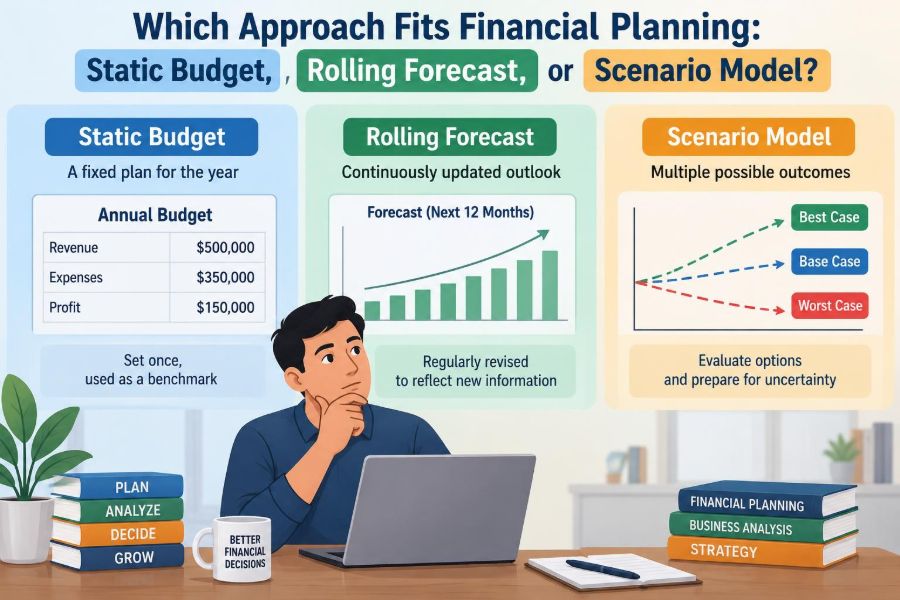
A static budget asks, “What resources and results are we committing to for a defined period?” A rolling forecast asks, “Based on what we know now, where are we likely to land?” A scenario model asks, “What could happen if key conditions change?”
Confusion begins when one tool is forced to do another’s job. An annual budget is usually a poor early-warning system, while a scenario model is not automatically a suitable basis for performance evaluation.
📌 What a static budget is designed to do
A static budget sets planned revenue, costs, cash movements, and often capital spending for a fixed period, commonly a fiscal year. Once approved, its core targets generally stay unchanged even if actual conditions move.
It creates a clear operating contract: managers receive a resource envelope and are expected to deliver against agreed priorities. That clarity is valuable for authorization, coordination, and control.
🗓️ The fixed planning horizon
A static budget normally has a defined start and end date. It may be allocated by month, cost center, product, or project, but the annual total remains the reference point.
This fixed horizon is helpful when spending patterns are stable. It becomes less informative when a business experiences rapid demand shifts, volatile input costs, or a changing product mix.
🏛️ Why organizations still need annual budgets
Static budgets are sometimes described as outdated, but they solve enduring governance problems. Leaders need an approved spending framework, and boards or owners often need a coherent annual financial plan.
- They clarify strategic priorities and trade-offs.
- They set delegated spending authority.
- They support staffing and capital-allocation decisions.
- They provide a common baseline for accountability.
A fixed plan does not claim to predict the future perfectly. It records the choices an organization has chosen to fund.
⚖️ Budget versus actual performance
Budget-to-actual analysis compares what happened with what was planned. The difference is a variance, which may arise from volume, price, timing, efficiency, foreign exchange, or a change in scope.
A variance is a prompt for investigation, not a verdict by itself. For example, overspending on marketing may be sensible if it supported a profitable product launch that was not included in the original plan.
🧱 Strengths of a static budget
The main advantage is discipline. A fixed baseline makes it easier to see whether spending is drifting and whether managers are reallocating resources without approval.
It also reduces planning churn. Teams can focus on execution rather than rebuilding the entire plan every time a weekly sales result changes. In a stable operating environment, this simplicity can be a major benefit.
🚧 Limits of a static budget
Its central weakness is that relevance declines when assumptions change. A budget prepared months ago may retain its authority while losing its usefulness as a decision-making guide.
It can also create unhelpful behavior. Managers may delay useful spending to stay “on budget,” accelerate purchases before year-end, or defend old assumptions because changing the plan feels like admitting failure.
🔄 What makes a forecast rolling
A rolling forecast is updated regularly and always looks forward over a consistent future horizon. For example, a business might refresh its view every month while maintaining an 18-month outlook.
When one month closes, the new month is added at the end. The forecast therefore keeps management focused on the upcoming period rather than solely on the calendar year.
🔭 Forecasting is not target setting
A forecast should be an honest estimate of expected outcomes, given current information and planned actions. A target expresses an aspiration or required level of performance. Treating them as the same number damages both.
If a sales manager is judged only on meeting a target, there is pressure to report an optimistic forecast. Separating targets, forecasts, and incentive measures makes bad news easier to surface early.
📡 The value of frequent updates
Rolling forecasts improve visibility into emerging gaps. If orders weaken for two months, management can reassess hiring, inventory, marketing, and cash before the issue becomes embedded in a year-end surprise.
Frequency should match the business rhythm. A seasonal retailer may need frequent trading updates, while a long-cycle infrastructure business may gain little from weekly full-company replanning.
🧮 Building blocks of a useful forecast
A forecast is more reliable when it is built from operational drivers rather than a broad percentage adjustment to last year. Relevant drivers might include units sold, headcount, utilization, conversion rates, delivery milestones, or customer churn.
Finance should connect those drivers to revenue, costs, working capital, and cash. This makes assumptions visible and lets managers see how an operational change flows into financial results.
📈 The rolling forecast process
A practical refresh process usually begins with actual results, updates the near-term outlook using current evidence, and then extends the longer-term horizon with driver-based assumptions. Material changes should be explained, not merely overwritten.
- Close and validate recent actuals.
- Update operational drivers and known commitments.
- Recalculate financial statements and cash effects.
- Review major movements against the prior forecast.
- Agree actions, owners, and decision dates.
The goal is not a perfectly precise number. It is a timely, decision-useful view of likely outcomes.
⏱️ When rolling forecasts become burdensome
Frequent reforecasting fails when every cycle rebuilds hundreds of low-value lines. Teams can spend so much time explaining minor changes that they have little time to act on major risks.
Use detail where decisions need it. Near-term payroll, liquidity, inventory, and major projects may warrant granular estimates. Distant periods often work better with higher-level driver assumptions.
🌦️ What scenario modeling adds
A scenario model examines multiple coherent versions of the future. Rather than claiming one outcome is most likely, it asks what financial and operational consequences follow from a specific set of assumptions.
A scenario might consider weaker demand, a delayed product launch, a supplier disruption, or an acquisition. It is especially useful when uncertainty is material and management has choices to make before outcomes are known.
🛣️ Scenarios are narratives with numbers
A good scenario is more than “revenue down 10%.” It describes what changes in the real business: fewer customer orders, lower factory utilization, slower collections, different staffing requirements, or delayed investment.
The numbers should follow the narrative. If demand falls, the model should consider variable costs, fixed costs, inventory, receivables, debt covenants where relevant, and cash—not only the income statement.
🎲 Base, upside, and downside cases
Many teams begin with three cases: a base case, an upside case, and a downside case. This can be useful, provided each case has explicit assumptions and is not simply an arbitrary percentage movement.
| Case | Purpose | Typical management use |
|---|---|---|
| Base case | A reasonable planning view using current evidence | Operating plan and near-term expectations |
| Upside case | Conditions develop more favorably than expected | Capacity, hiring, or investment readiness |
| Downside case | Adverse but plausible conditions occur | Contingency actions and liquidity protection |
These labels do not assign probabilities unless the organization has a defensible method for doing so.
🧪 Sensitivity analysis versus scenarios
Sensitivity analysis changes one variable at a time, such as the effect on operating profit if unit volume is lower while all other inputs stay constant. It is useful for identifying which assumptions matter most.
A scenario changes a connected set of variables. Lower volume might coincide with discounting, slower customer payments, reduced production, and postponed capital expenditure. Both methods belong in a finance toolkit, but they answer different questions.
💵 Cash belongs in every serious model
A profitable forecast can still hide a cash problem. Revenue may be recognized before customers pay, inventory can consume cash before goods are sold, and debt repayments do not disappear because an income statement looks healthy.
For this reason, significant budgets, rolling forecasts, and scenarios should connect profit to working capital, capital expenditure, financing, and cash balances. The level of detail can vary, but the connection should be explicit.
🏭 Example: a growing manufacturer
Consider a hypothetical manufacturer planning a new product line. Its static budget might authorize equipment, marketing, and initial hiring for the year. That is the commitment framework.
Its rolling forecast would update expected monthly sales, materials purchases, labor needs, and cash based on orders and production progress. Its scenario model could test what happens if certification is delayed, a key component costs more, or demand exceeds available capacity.
Using all three is not duplication. Each tool supports a different decision.
🧑💼 Who should own the assumptions
Finance should design the process, challenge logic, maintain model integrity, and explain financial implications. It should not invent all operating assumptions in isolation.
Sales owns pipeline quality and conversion assumptions. Operations owns capacity and efficiency assumptions. HR owns recruitment timing and compensation inputs. Clear ownership improves accountability and makes forecast discussions more productive.
🔗 Aligning operational and financial plans
Planning breaks down when operational plans and financial models tell different stories. A revenue target requiring 20 new sales representatives is not credible if the people plan funds 10 hires, or if onboarding capacity can support only five.
Linking plans exposes these gaps early. The aim is not to eliminate uncertainty; it is to ensure that revenue, headcount, production, project delivery, and cash assumptions can coexist.
📊 Choosing the right level of detail
More detail does not automatically produce better planning. Every extra line requires inputs, review, maintenance, and explanation. False precision can make uncertain estimates look more reliable than they are.
Use detail where variability is high, decisions are reversible only with difficulty, or cash exposure is significant. Aggregate immaterial, stable, or remote items. A model should be as detailed as the decision requires, not as detailed as the chart of accounts allows.
🚨 Early-warning indicators to monitor
A forecast is more useful when it includes leading indicators—measures that may signal a future financial movement before it appears in reported results. The right indicators depend on the business model.
- Order intake, backlog, and sales-pipeline conversion
- Customer retention, cancellations, or renewal rates
- Production yield, utilization, and supplier lead times
- Vacancy levels, hiring progress, and employee turnover
- Inventory days, receivables aging, and cash collections
Indicators should trigger discussion and action thresholds, not become a dashboard of numbers no one uses.
🧯 Turning scenarios into contingency actions
Scenario modeling is most valuable when it changes preparedness. For each material downside, identify actions that can be taken, who can authorize them, and the evidence that should trigger a response.
A contingency might include pausing discretionary hiring, renegotiating purchase schedules, using a pre-approved credit facility, or accelerating collections. The aim is not to react automatically to every fluctuation, but to avoid designing responses during a crisis.
🏁 Static budgets and performance evaluation
Budgets remain useful for evaluating stewardship: did leaders manage authorized resources responsibly and deliver agreed initiatives? Yet evaluation should account for events outside a manager’s reasonable control.
Many organizations supplement budget comparisons with operational measures, relative performance, or updated expectations. Otherwise, a manager facing a changed market may be judged against assumptions that no longer represent sensible decisions.
🧷 Common planning mistakes
Several errors recur across organizations. They are usually process failures rather than spreadsheet failures.
- Using the budget as the latest forecast.
- Updating numbers without documenting changed assumptions.
- Confusing an optimistic target with an unbiased outlook.
- Modeling profit without balance-sheet and cash effects.
- Creating scenarios with no linked actions or decision owners.
- Changing assumptions quietly to remove accountability for prior decisions.
Simple controls—version dates, assumption logs, review notes, and clear approvals—can prevent much of this confusion.
🛠️ A practical planning architecture
For many organizations, the strongest answer is a layered system rather than a single winner. The annual budget sets priorities and authorized resources. The rolling forecast updates the expected financial path. Scenario models test uncertainty around major decisions and risks.
Keep the models connected through shared drivers where possible. If each process uses a different definition of headcount, customer, unit volume, or gross margin, reconciliation will consume the time that should go to decisions.
🪜 A sensible implementation sequence
Teams do not need to build a sophisticated planning platform before improving the process. Start by clarifying the decision calendar: when do leaders need to approve spending, revise capacity, protect cash, or communicate expectations?
Then establish a small driver set, a consistent forecast horizon, and an assumption-review routine. Add scenario capability first for the uncertainties that could materially change decisions. Expand only after the process is trusted and used.
🤝 The conversations matter more than the workbook
A planning model is a structured conversation about the future. Its quality depends on whether people can challenge assumptions, surface uncomfortable risks, and distinguish evidence from hope.
Finance adds value by making trade-offs visible: what must be true for the plan to work, what cash is required, what capacity is constrained, and what management can do if conditions differ from expectation.
✅ Choosing the approach that fits
Choose a static budget when the immediate need is annual alignment, spending authority, and a stable accountability baseline. Choose a rolling forecast when managers need a regularly refreshed view of expected performance and resource needs.
Use scenario models when uncertainty around a few critical drivers could alter a major decision. In practice, mature planning uses all three with clear boundaries: budget for commitment, forecast for expectation, and scenarios for preparedness.
The best financial-planning approach is the one that gives decision-makers a clear commitment, an honest current outlook, and a prepared response to uncertainty. When those roles are separated and connected, planning becomes less about defending a number and more about running the business well. 📊💡💰