
It is late afternoon, and a finance team is still waiting for a sales export, a bank feed update, and approval of three purchase invoices. The monthly management meeting is tomorrow. Someone is reconciling transactions in a spreadsheet, someone else is chasing a department manager, and the forecast has already become stale before it is presented.
This situation is familiar because traditional accounting work has often been organized around reporting cycles: close the books, assemble reports, explain what happened, then begin planning the next period. That sequence still matters, but it is no longer the only way information moves through a business.
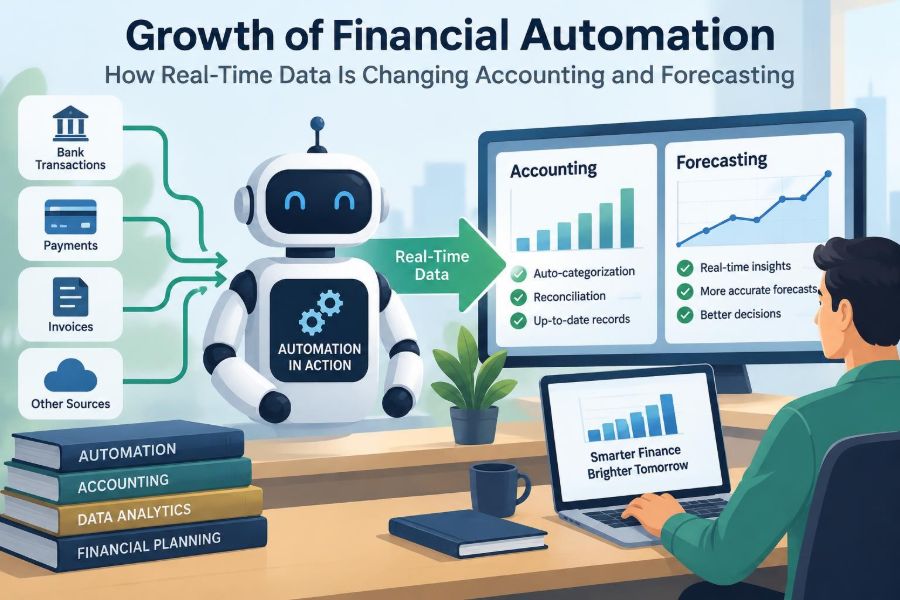
Financial automation and real-time data are changing the rhythm. Transactions can flow from operational systems into accounting records sooner, controls can flag exceptions as they arise, and forecasts can respond to current conditions rather than relying entirely on last month’s assumptions.
The opportunity is not simply to produce numbers faster. It is to make financial information more reliable, more useful for decisions, and less dependent on repetitive manual work—without losing the judgment, governance, and skepticism that good accounting requires.
📈 Financial Automation Is More Than Faster Bookkeeping
Financial automation is the use of software, rules, workflows, and connected systems to perform or assist finance processes with limited manual intervention. It can include invoice capture, bank reconciliation, expense coding, journal-entry workflows, consolidation, reporting, and forecasting.
Automation does not mean every decision is handed to a machine. A sensible design separates routine, repeatable work from tasks that need professional interpretation. Matching a known supplier invoice to an approved purchase order is a strong automation candidate; assessing an unusual impairment indicator is not.
The aim is to reduce avoidable handling, improve consistency, and direct people toward analysis, controls, and business partnership.
⏱️ What “Real-Time” Actually Means in Finance
Real-time does not always mean that every number changes every second. In accounting, it more often means information is updated close enough to the underlying event to support the decision at hand.
A retailer may need near-immediate visibility of card sales and cash balances. A company preparing statutory financial statements may still use a controlled month-end close. The appropriate speed depends on materiality, risk, and the decisions users must make.
It helps to distinguish three common patterns:
- Real-time: data updates as an event is recorded or received.
- Near-real-time: data refreshes on a short scheduled interval.
- Periodic: data is compiled at defined points, such as month-end.
Faster refreshes are valuable only when the source data and review processes are dependable.
🔗 The Data Pipeline Behind Modern Finance
Real-time finance begins with a pipeline, not a dashboard. Operational events—such as an order shipped, employee expense submitted, payment received, or inventory movement—originate in source systems. Those events are then transferred, transformed, checked, and made available to finance applications.
Application programming interfaces, or APIs, allow systems to exchange data in structured ways. File imports, workflow platforms, and integration tools may serve the same purpose where direct connections are not available.
Each handoff creates a question: did the complete, correct data arrive once, in the right accounting period, and with enough context to be useful? The quality of the answer matters more than the apparent sophistication of the technology.
🧾 From Source Transaction to Accounting Entry
A simple example is a customer payment. A payment processor may record the receipt, a sales system may identify the customer order, a bank feed may confirm settlement, and the accounting system may post cash, fees, and receivables.
Automation can propose or create entries when the rules are well defined. It might match the payment to an open invoice, split processing fees according to configured terms, and identify exceptions such as a short payment or duplicated receipt.
However, a posted entry is not automatically correct just because it was generated quickly. The process needs clear rules for timing, currency, taxes, revenue recognition, and unmatched items.
🧠 Rules, Workflows, and Machine Learning Are Different Tools
Finance teams sometimes describe all intelligent software as “AI,” but the underlying methods have different strengths. Understanding the distinction helps organizations choose appropriate controls.
| Method | Best suited to | Primary concern |
|---|---|---|
| Rule-based automation | Stable, explicit decisions such as approval routing | Rules can become outdated or overly broad |
| Workflow automation | Hand-offs, reminders, evidence collection, approvals | Poorly designed workflows can preserve poor processes |
| Machine learning | Pattern recognition, classification, anomaly prioritization | Outputs require validation and monitoring |
A rule might say that recurring software invoices under an approved threshold go to a named cost center. A machine-learning model might suggest a category based on historical invoice descriptions. The latter is a recommendation, not a substitute for accountable review.
🏦 Bank Feeds and Continuous Cash Visibility
Automated bank feeds can reduce the delay between a bank transaction and its appearance in the accounting environment. When combined with matching rules, they help teams see cash movements, unreconciled items, and unexpected payments sooner.
This can improve day-to-day treasury awareness, particularly for businesses with high transaction volumes or tight liquidity. A controller may spot that a large supplier payment cleared earlier than expected and reassess the short-term cash position.
Bank feeds are not the same as a completed bank reconciliation. Pending transactions, timing differences, duplicate imports, and mapping errors still require investigation. Cash visibility is useful; reconciled cash is stronger evidence.
📥 Accounts Payable Moves From Inbox to Workflow
Accounts payable is often one of the first areas to benefit from automation because invoice handling contains repetitive steps. Optical character recognition can extract invoice fields, while matching logic compares a bill with purchase orders, goods receipts, contracts, and prior payments.
A well-designed workflow routes only the exceptions that need attention. For example, an invoice that agrees with an approved order and receipt may move through a lower-touch route, while a price variance, missing receipt, or unfamiliar vendor is escalated.
Automation should not weaken authorization. Vendor master-data changes, payment detail updates, and unusual invoices deserve strong segregation of duties and independent verification.
🧮 Accounts Receivable Gets Earlier Signals
On the receivables side, connected billing, customer relationship, payment, and accounting systems can show which invoices are issued, disputed, overdue, or paid. This supports collections work before a balance becomes seriously delinquent.
A real-time view can distinguish between a customer who has not received an invoice, one who disputes a delivery, and one who has simply not paid. These are different operational problems, and treating them identically produces poor collection decisions.
Automated reminders can help with routine follow-up, but customer relationships still call for judgment. A strategic customer with a documented dispute should not receive a sequence of impersonal escalation notices.
📦 Operational Data Makes Finance More Forward-Looking
General ledger balances explain part of the financial picture, but they are often lagging indicators. Operational data can offer earlier clues about what may happen next: orders booked, units shipped, projects staffed, inventory turns, subscription renewals, or support tickets.
Consider a hypothetical manufacturer. A rising order backlog may suggest future revenue, but it does not guarantee cash collection or profit. Material availability, customer credit, production capacity, contract terms, and cancellation risk still matter.
The value comes from connecting financial outcomes to their drivers rather than treating the ledger as the only source of insight.
🔮 Forecasting Shifts From Annual Event to Ongoing Process
A traditional annual budget can establish goals and resource plans, but it may become less informative when assumptions change. Rolling forecasts extend the planning horizon regularly—for example, by adding a new future month or quarter as one period closes.
Real-time or near-real-time inputs can make those updates more responsive. Current sales pipeline movement, utilization, labor scheduling, purchase commitments, and collections data may revise the outlook before the formal month-end cycle is complete.
This does not eliminate the need for a budget. The budget sets an agreed baseline; the forecast estimates the most plausible current path. Mixing the two can obscure whether performance changed or expectations changed.
🧭 Driver-Based Forecasting Connects Activity to Results
Driver-based forecasting estimates financial outcomes from operational assumptions. Instead of entering a single revenue number, a team might model customer count, average selling price, conversion rate, usage, renewal rate, or production volume.
For a service business, revenue may be influenced by billable headcount, utilization, billing rates, project start dates, and completion schedules. Payroll costs may be driven by staffing plans, pay changes, and contractor usage.
Drivers make a forecast easier to challenge constructively. Rather than debating whether “revenue feels optimistic,” managers can ask whether planned hiring, expected utilization, or pipeline conversion is realistic.
🌦️ Scenario Planning Tests Uncertainty
A single forecast can create false confidence. Scenario planning develops several coherent views, such as a base case, upside case, and downside case, based on different assumptions.
The purpose is not to predict every surprise. It is to identify sensitivities: which assumptions have the largest effects, what warning signals to watch, and what actions become necessary if conditions change.
For example, a business may test slower customer collections, lower sales conversion, or higher material costs. The resulting scenarios can guide contingency planning for hiring, purchasing, borrowing, or discretionary spending.
⚡ Faster Close Does Not Mean Reckless Close
Continuous data flows can reduce the monthly close burden by reconciling accounts and resolving issues throughout the period. This is sometimes called a continuous close approach.
The goal is not to rush past controls. It is to move routine preparation earlier so that the close focuses on informed estimates, unusual transactions, review, and explanation.
A useful test is whether a faster close produces evidence that is as complete and reviewable as before. If teams merely replace documented checks with unchecked system outputs, the process has become quicker but weaker.
✅ Reconciliation Remains a Core Control
Automation can match thousands of transactions rapidly, but reconciliation remains essential because systems can disagree. A payment may appear in the bank but not the ledger, an interface may fail, or a transaction may be recorded twice.
Effective automated reconciliation uses tolerances and match criteria that fit the account. It also produces clear exception queues, showing what did not match, why it may not have matched, and who owns the resolution.
Do not judge a reconciliation process only by its match rate. A very high match rate can be misleading if the rules are too permissive and allow incorrect matches to pass unnoticed.
🚨 Exception Management Is Where Human Attention Belongs
The best automation removes noise so people can focus on exceptions. Exceptions may be transactions outside normal ranges, missing approvals, unusual counterparties, duplicate invoice indicators, or forecast movements that exceed a defined threshold.
Each exception needs a route, owner, due date, and documented disposition. Without this structure, alerts accumulate into another unread inbox.
Risk-based prioritization is helpful. A small coding inconsistency and a supplier-bank-detail change should not receive the same urgency, even though both may require review.
🔐 Access Controls Protect Automated Processes
Connected systems can create efficiency, but they also expand the paths through which financial data and payment instructions move. Access management must therefore be designed into automation, not added after implementation.
Key practices include least-privilege access, multi-factor authentication where available, prompt removal of former-user access, approval controls for sensitive changes, and audit logs that show who did what and when.
Segregation of duties remains central. A person should not be able to create a supplier, change its bank details, approve an invoice, and release payment without independent controls.
🧹 Data Quality Determines the Value of the Output
Automation amplifies the quality of the inputs. Clean supplier records, consistent chart-of-accounts design, reliable customer identifiers, and defined data ownership enable useful analysis. Duplicates, inconsistent names, and unclear master data create confusion at greater speed.
Data quality is not a one-time cleanup. New records enter systems constantly, so teams need validation rules, stewardship responsibilities, and a process for correcting errors at their source.
A dashboard can be visually polished and still misleading if it combines mismatched definitions of “customer,” “revenue,” or “active project.” Shared definitions are finance infrastructure.
🗂️ Master Data Is an Accounting Control
Master data is the relatively stable reference information used across transactions: vendors, customers, products, employees, legal entities, accounts, tax codes, and cost centers. It determines how transactions are classified and connected.
If one supplier appears under several names, spending analysis may understate concentration. If cost centers are added without governance, managers may receive incomparable reports. If a tax code is wrong, repeated transaction processing can spread the error widely.
Finance should partner with procurement, sales, operations, and information technology on master-data standards. Ownership belongs across the organization, even when accounting bears much of the reporting impact.
📊 Dashboards Should Lead to Decisions
A real-time dashboard is useful when it answers a decision question. “Which customer balances need collection action?” and “Can we fund planned payments over the next few weeks?” are better starting points than “What can we display?”
Good dashboards show a small set of measures, context, trends, and drill-down paths. They identify the reporting date or refresh time and make assumptions visible. A cash dashboard should clarify whether it shows bank balances, available cash, forecast cash, or all three.
More charts do not necessarily create more understanding. A focused dashboard with trusted definitions is more valuable than a dense screen that invites interpretation errors.
🧪 Forecast Accuracy Needs Thoughtful Measurement
Forecasts should be reviewed after actual results arrive, but “accuracy” is not a single universal measure. A forecast may be evaluated by absolute variance, directional accuracy, bias, or the quality of its ranges and scenarios.
Teams should examine why material differences occurred. Was a driver assumption wrong, did an unforeseen event occur, was source data delayed, or did a model calculation fail? Treating every variance as poor performance discourages honest forecasting.
Persistent optimism or pessimism is particularly useful to investigate. Bias can affect staffing, cash planning, inventory decisions, and confidence in finance.
👥 Roles Change Rather Than Disappear
Automation changes the mix of finance work. Repetitive data entry, routine matching, and report assembly may decline, while data governance, process design, control review, explanation, and stakeholder communication become more prominent.
Accountants remain necessary because financial information is shaped by judgment. They interpret standards, assess evidence, question assumptions, understand business context, and explain consequences to decision-makers.
For students and professionals, valuable skills increasingly include data literacy, spreadsheet discipline, systems thinking, internal controls, visualization, and the ability to translate a business question into a reliable financial analysis.
🛠️ Building Skills for an Automated Finance Team
Learning does not require becoming a software engineer. It does require confidence working with structured data and digital processes. Start by understanding how a transaction travels from source document to financial statement.
- Learn to map a process and identify control points.
- Practice checking data for duplicates, missing values, and inconsistent categories.
- Understand basic database and integration concepts, including fields, identifiers, and refresh timing.
- Develop clear variance explanations that connect numbers to operational causes.
- Document assumptions, logic, and review evidence so work can be tested.
These abilities make professionals more effective whether their organization uses simple cloud accounting software or a complex enterprise platform.
🚧 Common Implementation Mistakes
A frequent mistake is automating a broken process. If approval rules are unclear, coding is inconsistent, or teams use shadow spreadsheets, digitizing the workflow may simply make the flaws less visible.
Another mistake is treating implementation as an information technology project only. Finance owns accounting logic and control requirements; operations owns many source events; technology teams understand architecture and security. Sustainable design requires all three perspectives.
Finally, organizations sometimes aim for total automation too soon. Begin with stable, high-volume processes, measure results, and expand only after controls and exception handling work reliably.
🧩 A Practical Roadmap for Adoption
A phased approach reduces disruption and reveals where the real value lies. Start with a defined business problem, such as slow bank reconciliation, invoice backlog, or unreliable cash forecasting.
- Map the existing process, data sources, approvals, and failure points.
- Set success criteria that include control quality, not only speed.
- Standardize key data and policies before configuring automation.
- Pilot the workflow with a manageable scope and real exception cases.
- Review outputs, permissions, audit trails, and user feedback.
- Expand gradually, with ongoing monitoring and ownership.
This approach creates learning loops. It also avoids a costly outcome: a technically successful implementation that users bypass because it does not fit how work actually happens.
🏢 Small Businesses and Large Enterprises Face Different Trade-Offs
Smaller organizations may gain quickly from integrated accounting, invoicing, expense, and banking tools because they reduce manual switching between systems. Their challenge is often limited time to define processes and review configurations carefully.
Larger organizations may have more specialized expertise but face complex entity structures, legacy platforms, multiple currencies, local requirements, and large volumes of master data. Integration and governance become major workstreams.
The principle is the same at both scales: choose an approach that matches transaction complexity, risk exposure, and the team’s ability to maintain it. Sophisticated software cannot compensate for unclear accountability.
📜 Compliance, Audit, and Evidence Still Matter
Automated processes need evidence just as manual processes do. Auditors, controllers, and management may need to understand the system logic, approval history, changes to rules, access rights, reconciliations, and how exceptions were resolved.
Where financial reporting requirements apply, organizations must assess whether automated controls operate as intended. A system-generated report may be useful evidence, but its reliability can depend on input completeness, configuration, access controls, and change management.
Consult relevant accounting, tax, regulatory, legal, and audit professionals for requirements specific to the organization and jurisdiction. Technology changes the process, not the obligation to maintain defensible records.
🤝 Human Judgment Is the Final Safeguard
Real-time data can make information available earlier, but it cannot decide what management should do in every circumstance. A sudden decline in margin might reflect pricing pressure, a product mix change, a coding issue, or a temporary timing effect.
Professional skepticism means asking whether a result is plausible, tracing it to evidence, and recognizing uncertainty. It also means resisting the temptation to treat a precise-looking dashboard number as a complete answer.
The strongest finance teams combine automated processing with accountable human review. Technology handles scale; people provide context, challenge, ethics, and judgment.
🎯 The Core Principle: Faster Information Must Remain Trustworthy
Financial automation is most valuable when it improves the connection between business activity, accounting records, and decisions. Real-time data can shorten the distance between an event and management’s awareness of it, while driver-based forecasting can translate current conditions into a more useful outlook.
But speed alone is not progress. Reliable definitions, controlled integrations, reconciliations, exception management, access governance, and thoughtful review are what turn rapid data flows into dependable financial insight.
For accountants, the shift is an invitation to spend less time assembling information and more time ensuring that it is credible, explaining what it means, and helping the organization act responsibly.
The future of finance is not automated numbers replacing accountants; it is trustworthy, timely information strengthening human judgment. 💰📊🔍