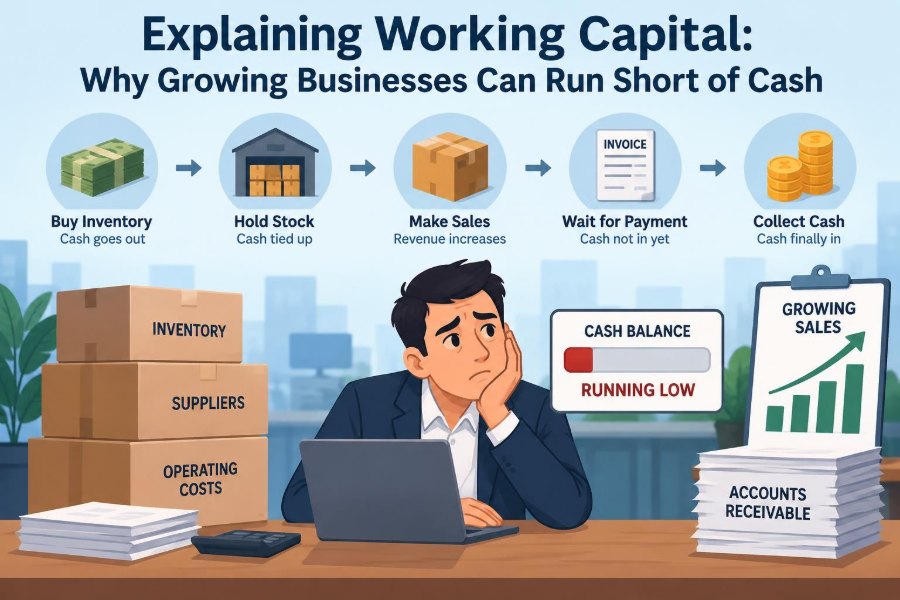

A small wholesaler wins several large customer orders. Revenue rises, the warehouse is busier, and the income statement shows a healthy profit. Yet, two months later, the owner is postponing supplier payments and worrying about payroll.
This situation is not a contradiction. It is a common consequence of growth: the business has committed cash to inventory, paid staff, and delivered goods, but has not collected cash from customers yet.
Working capital explains the space between those events. It shows how much short-term funding a company has tied up in day-to-day operations—and why an apparently successful business can still face a cash shortage.
For students, working professionals, managers, and business owners, this is one of the most useful bridges between accounting theory and operational reality. Profit measures performance over a period; cash determines whether the business can keep operating tomorrow.
💡 Working capital in plain language
Working capital is the difference between a company’s current assets and its current liabilities. Current items are generally expected to be converted into cash, used, or settled within the normal operating cycle or within about a year.
The basic calculation is:
Working capital = Current assets − Current liabilities
A positive amount usually means that short-term assets exceed short-term obligations. But it does not automatically mean the company has cash available, because inventory and unpaid customer invoices may make up much of those assets.
🧾 The current assets that support operations
Current assets are resources expected to support near-term activity. Their quality and timing matter as much as their total value.
- Cash and cash equivalents: immediately available funds.
- Accounts receivable: amounts customers owe after receiving goods or services.
- Inventory: materials, work in progress, and finished goods held for sale or production.
- Prepaid expenses: payments already made for future benefits, such as insurance.
Cash is the most liquid current asset. A receivable may become cash soon, while inventory must first be sold and collected. This difference is central to understanding liquidity risk.
📅 The current liabilities that demand payment
Current liabilities are obligations due in the near term. They include accounts payable to suppliers, wages payable, short-term borrowings, taxes payable, and the current portion of long-term debt.
These are not necessarily signs of trouble. Trade credit—buying now and paying later—is an ordinary and useful financing source. The issue is whether payment dates arrive before the business receives enough cash from customers.
A company can have positive working capital on paper and still struggle if its most liquid assets cannot cover obligations when they fall due.
⚖️ Net working capital versus cash
Net working capital is an accounting measure, not a bank balance. Consider a hypothetical retailer with current assets of $260,000 and current liabilities of $180,000. Its working capital is $80,000.
That sounds comfortable until we look closer: perhaps $15,000 is cash, $95,000 is receivables, and $150,000 is inventory. If suppliers need payment this week, the retailer cannot use unsold inventory directly to pay them.
Liquidity depends on timing and convertibility, not merely on the working-capital total.
📈 Why growth increases the need for cash
Growth often requires a business to spend before it collects. A manufacturer purchases more materials, schedules more labor, and carries more finished goods to serve larger orders. A service firm may hire employees before a new client’s invoices are paid.
When sales grow, receivables and inventory frequently grow too. Unless supplier credit grows at the same pace, the business must supply the difference from cash, retained earnings, owner investment, or external financing.
This is why rapid growth can strain a company even when margins are sound. More activity can mean more cash trapped in the operating cycle.
🔄 The operating cycle: cash’s round trip
The operating cycle measures the time between paying for inventory or inputs and collecting cash from customers. In a simple merchandise business, cash buys goods, goods are sold, an invoice is issued, and the customer eventually pays.
A longer cycle means cash is committed for longer. A company that buys inventory in January, sells it in March, and collects in May has funded several months of activity before recovering its original outlay.
The cycle differs by industry. A restaurant may receive payment immediately, while a construction contractor may wait through lengthy project and billing stages.
⏳ The cash conversion cycle
The cash conversion cycle refines the operating cycle by recognizing supplier credit. It estimates the period for which the business’s own cash is tied up.
Cash conversion cycle = Days inventory outstanding + Days sales outstanding − Days payable outstanding
Days inventory outstanding estimates how long goods remain in inventory. Days sales outstanding estimates collection time after a sale. Days payable outstanding estimates how long the company takes to pay suppliers.
A shorter cycle generally reduces funding pressure, but “shorter” is not always better if it comes from stockouts, overly aggressive collection, or damaged supplier relationships.
🧮 A simple growth example
Imagine a distributor that normally sells $100,000 of goods each month. It keeps about one month of inventory and gives customers 30 days to pay. Its suppliers allow 30 days to pay.
When monthly sales rise to $160,000, the distributor may need substantially more inventory and will generate substantially more receivables. The supplier balance may rise as well, but often not enough to offset the additional stock and unpaid invoices.
Sales may be profitable, but cash leaves first. Until collections catch up, the business needs a funding bridge. The faster the sales increase, the larger that bridge may become.
💵 Profit is not the same as cash flow
Accrual accounting recognizes revenue when it is earned, not necessarily when cash arrives. It recognizes expenses when incurred or matched with revenue, not always when cash is paid.
If a company makes a credit sale, revenue and profit can be recorded even though the customer has not paid. If it buys inventory, cash may leave before the related cost becomes an expense through cost of goods sold.
This timing difference is why a profitable company can be short of cash, and why cash generated in one period may reflect sales from an earlier period.
📊 Reading working capital on the balance sheet
A balance sheet is a snapshot at one date. It helps identify where funds are tied up and which claims are approaching maturity.
| Balance-sheet movement | Typical cash-flow implication |
|---|---|
| Accounts receivable increase | Sales have not yet been collected; operating cash flow is reduced. |
| Inventory increase | Cash has been invested in goods or materials; operating cash flow is reduced. |
| Accounts payable increase | Supplier payments have been delayed or credit has expanded; operating cash flow is supported temporarily. |
| Accounts receivable decrease | Collections may exceed new credit sales; operating cash flow is supported. |
| Inventory decrease | Prior inventory may be converting to sales; cash pressure may ease if collection follows. |
The word “typically” matters. A movement should be investigated in context, not treated as a verdict by itself.
🧭 The indirect cash flow statement connection
Under the indirect method of presenting operating cash flows, net income is adjusted for non-cash items and changes in operating working-capital accounts.
An increase in receivables is usually subtracted because the company recorded revenue without collecting all related cash. An increase in inventory is also usually subtracted because cash was used to acquire or produce more goods. An increase in payables is usually added because cash payments to suppliers were lower than expenses or purchases recognized in the period.
This reconciliation makes the link between profit and cash visible rather than mysterious.
🚦 Positive working capital is not always healthy
Positive working capital is often desirable, especially for businesses that need inventory or must give customers time to pay. It provides a buffer against delayed receipts and unexpected bills.
However, an unusually large balance can reveal inefficient operations: slow-moving stock, weak collection practices, or cash left idle without a clear reason. More current assets are not automatically more useful.
The best level depends on the business model, seasonality, bargaining power, access to financing, and predictability of cash inflows.
🏪 Negative working capital can be a business model
Negative working capital means current liabilities exceed current assets. That can be a warning sign, but it is not universally bad.
Some retailers and subscription businesses collect cash from customers quickly or in advance while paying suppliers later. Their operating model can produce negative working capital while still generating reliable cash.
The risk rises when negative working capital reflects overdue bills, emergency borrowing, or an inability to turn inventory into cash. The same ratio can describe very different realities.
📏 The current ratio and its limits
The current ratio compares current assets with current liabilities:
Current ratio = Current assets ÷ Current liabilities
A ratio above 1 suggests that current assets exceed current liabilities. It is a useful starting point, but it does not tell us whether inventory is obsolete, receivables are collectible, or liabilities are due tomorrow.
Comparisons work best across time for the same company and against genuinely similar businesses. A broad “ideal” ratio cannot replace knowledge of the company’s cash cycle.
⚡ The quick ratio asks a stricter question
The quick ratio, sometimes called the acid-test ratio, excludes inventory and usually other less liquid current assets. A common formulation is:
Quick ratio = (Cash + Short-term investments + Accounts receivable) ÷ Current liabilities
It asks whether more readily convertible assets could cover near-term obligations. This matters where inventory may take months to sell or may be difficult to value reliably.
Even this ratio has limits. Receivables are only “quick” if customers pay on time, and a seasonal balance-sheet date can distort the picture.
📦 Inventory: useful asset, frequent cash trap
Inventory exists for good reasons: it prevents stockouts, supports reliable delivery, and can protect operations from supply disruption. But every extra unit ties up cash and creates risks of deterioration, obsolescence, theft, or discounting.
A growing business may over-order because demand looks promising. If demand slows, it can end up with shelves full of products and little money for rent, payroll, or new opportunities.
Inventory discipline means matching replenishment decisions to realistic demand, lead times, service targets, and storage capacity—not simply buying more because sales increased last quarter.
🧾 Receivables: revenue waiting to become cash
Accounts receivable are promises to pay. The collection process begins well before an invoice is issued: with customer selection, credit checks where appropriate, contract terms, accurate order fulfillment, and clear billing information.
Disputes, missing purchase-order references, incorrect prices, and late invoices can delay payment even when the customer is financially sound. Collections are therefore an operational process, not only a finance department task.
Tracking aging—grouping invoices by how long they have been outstanding—helps identify accounts that need attention before they become serious collection problems.
🤝 Payables: financing with a relationship attached
Accounts payable give a company short-term supplier financing. Managing payment dates carefully can protect cash, particularly during a period of expansion.
But treating payables as a limitless source of funding can be costly. Repeated late payments may cause suppliers to tighten terms, stop shipments, remove discounts, or require payment in advance. Those changes can make a cash problem worse.
A sustainable approach is to negotiate terms openly, pay according to agreed commitments, and prioritize suppliers whose goods or services are essential to operations.
🧱 Fixed assets create a different cash need
Not every cash outflow belongs to working capital. Equipment, vehicles, facilities, and technology systems may be long-term investments, often recorded as non-current assets.
The distinction matters because a business can face pressure from both sources at once: buying a new machine may require cash while growth also demands more inventory and receivables. The total funding requirement may be much larger than either issue viewed separately.
Financial planning should separate recurring operating working-capital needs from one-time or long-lived capital expenditures.
🗓️ Seasonality makes snapshots misleading
Many businesses build inventory before a busy season and collect cash afterward. A toy seller, for example, may show high inventory and borrowings before a holiday sales period, then generate cash once sales and collections occur.
A single year-end balance sheet may capture the company at its most cash-intensive point or at its strongest point. Trend analysis across months or quarters gives a more useful view.
Seasonal businesses should forecast their cash low point, not just their annual profit. The lowest point determines how much liquidity they may need.
🧪 Forecast cash, not just revenue
A sales forecast answers, “How much might we sell?” A cash forecast answers, “When will money arrive and leave?” Both are needed.
A practical short-term cash forecast commonly includes expected customer collections, payroll dates, supplier payments, rent, tax obligations, debt payments, and planned inventory purchases. It should use timing assumptions that reflect actual payment behavior rather than invoice due dates alone.
Update the forecast regularly as orders, delivery schedules, and collection expectations change. A forecast is not a prediction of certainty; it is an early-warning tool for decisions.
🔍 Build a working-capital dashboard
A useful dashboard concentrates on measures that lead to action. It should be simple enough to review routinely and detailed enough to reveal the source of pressure.
- Cash balance and available borrowing capacity
- Receivable aging and overdue invoice value
- Collection days and significant customer disputes
- Inventory by category, turnover, and slow-moving items
- Payables due by week and supplier terms
- Cash conversion cycle trend
Metrics should prompt questions. Rising collection days, for example, may come from one large disputed account, a shift in customer mix, or a broadly weakening collection process.
🎯 Improve collections without damaging customers
Reducing collection time can release cash, but an overly harsh approach may harm valuable relationships. The objective is accurate, timely payment—not pressure for its own sake.
Useful practices include invoicing immediately after delivery or milestones, confirming billing contacts, resolving disputes quickly, sending courteous reminders before and after due dates, and offering payment methods that reduce administrative friction.
For new or higher-risk customers, businesses may consider deposits, progress billing, credit limits, or shorter terms. The appropriate choice depends on the industry, customer relationship, and competitive environment.
🛠️ Improve inventory without creating stockouts
Inventory reduction is not simply a command to buy less. Cutting stock too deeply can lead to missed sales, rushed freight, production stoppages, and disappointed customers.
A better process separates fast-moving, strategic, seasonal, and slow-moving items. It then sets reorder rules that reflect demand variability and supplier lead times. Regularly reviewing obsolete or excess stock helps management make deliberate choices: return it, bundle it, discount it, repurpose it, or stop buying it.
The goal is the right inventory, in the right place, at the right time, rather than the lowest possible inventory balance.
🏦 Match financing to the use of cash
Short-term working-capital needs are often financed with cash reserves, supplier credit, revolving credit facilities, or other short-term arrangements. Longer-lived investments may be better matched with longer-term financing or equity, depending on the company’s circumstances.
Using a very short-term loan to fund a long-term asset can create refinancing pressure before the asset has generated enough cash. Conversely, financing a brief seasonal inventory build solely with long-term funding may add unnecessary cost or inflexibility.
Financing decisions involve interest costs, covenants, security requirements, repayment schedules, and risk. Businesses should seek appropriate professional advice for their legal, tax, and financing context.
🧷 Protect a buffer for surprises
Working-capital plans are built on assumptions: customers pay, suppliers deliver, demand continues, and costs stay manageable. Real operations are less tidy.
A late payment from a major customer, a shipping delay, a product return, or an unexpected repair can disrupt a narrow cash plan. Liquidity buffers and access to pre-arranged financing give management time to respond without making rushed decisions.
The right buffer is not a universal number. It depends on volatility, concentration of customers and suppliers, fixed payment commitments, and the company’s ability to obtain funds quickly.
⚠️ Common mistakes that make growth harder
Several recurring errors turn ordinary expansion into a cash crisis:
- Celebrating sales growth without estimating the cash needed to fulfill it.
- Extending generous customer terms without assessing collection risk.
- Ordering inventory based on optimism rather than demand evidence.
- Paying suppliers early while customers routinely pay late.
- Ignoring small invoice disputes until they delay major collections.
- Using profit reports as a substitute for a weekly cash view.
- Waiting to seek financing until cash is already critically low.
None of these mistakes is solved by accounting entries alone. They require coordinated decisions across sales, purchasing, operations, and finance.
🧑💼 Working capital is everyone’s responsibility
Sales teams influence payment terms and customer quality. Operations teams influence inventory accuracy and delivery performance. Purchasing teams negotiate lead times and supplier terms. Finance teams provide visibility, controls, and forecasts.
When these functions work independently, one team can create a cash burden another team must manage. For example, a sales promotion may increase orders while purchasing rushes stock at higher cost and finance waits for invoices to be collected.
Shared targets and regular cross-functional review turn working capital from a back-office number into an operating discipline.
🧠 Questions to ask when cash tightens
When a growing company runs short of cash, the first question should not always be “Can we borrow more?” Borrowing may be appropriate, but management should first understand the cause.
- Has inventory grown faster than sales, and which items explain it?
- Are customers paying more slowly, or has credit sales volume simply increased?
- Have supplier terms changed or have payments been accelerated?
- Is the cash need temporary, seasonal, or structural?
- Are expansion plans generating margins sufficient to support their funding needs?
Answers distinguish a manageable timing gap from a business model problem that additional debt might only postpone.
🧩 Bringing the numbers and operations together
Working capital becomes most useful when it connects accounting records to real operating events. An inventory increase may represent a deliberate seasonal build, an inaccurate forecast, or a supply-chain precaution. A receivables increase may represent healthy growth, a billing failure, or customer distress.
Financial ratios identify where to look; operational knowledge explains why the number moved. Good analysis requires both.
The core principle is simple: growth consumes cash when money must be spent before it is collected. Businesses that measure the timing gap, manage it deliberately, and arrange suitable funding are better equipped to turn revenue growth into durable financial strength.
Profit tells part of the story, but the rhythm of collections, inventory, and payments determines whether a business can keep moving forward. Watch the cash cycle as carefully as the sales line, especially when growth is accelerating. 💰📈🔄