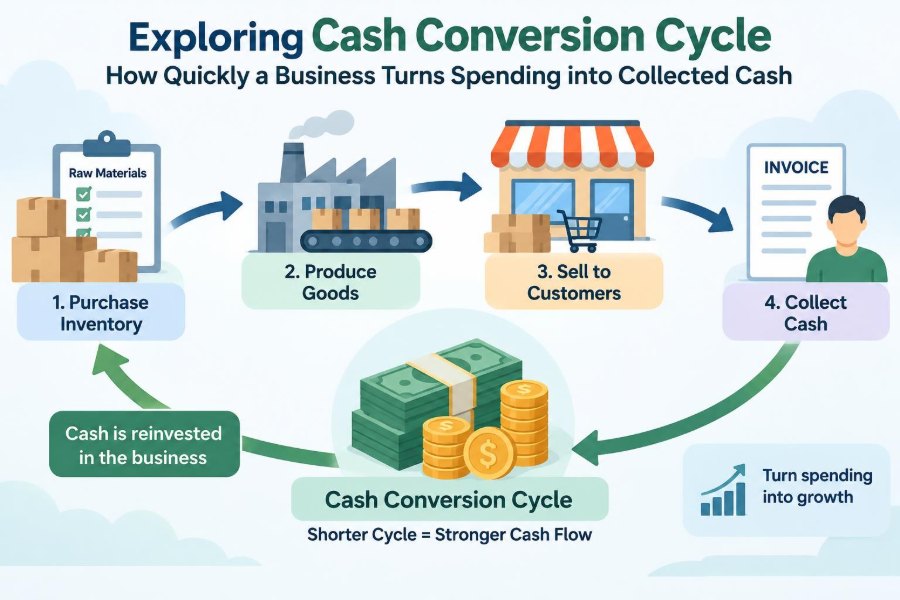

A retailer orders popular products, pays suppliers, places those products on shelves, and makes sales. The sales look encouraging—but much of the money may still be tied up in unsold inventory or invoices customers have not yet paid.
Meanwhile, rent, payroll, taxes, loan payments, and the next supplier order do not wait for an invoice to become cash. A profitable business can therefore feel surprisingly short of money.
This gap between spending cash and collecting cash is one of the most practical realities in business finance. It affects whether a company can fund day-to-day operations, take advantage of opportunities, and withstand a slow month.
The cash conversion cycle, often shortened to CCC, gives that gap a measurable form. It tracks how long cash is committed to operating activities before it returns as cash collected from customers.
🧭 What the Cash Conversion Cycle Measures
The cash conversion cycle estimates the number of days it takes to turn cash spent on inventory and production inputs into cash received from customers. Put simply, it follows the operating journey from buying materials or goods to collecting payment for the resulting sale.
CCC is a working-capital efficiency measure. Working capital refers broadly to short-term operating assets and liabilities, such as inventory, customer receivables, and supplier payables. These balances continuously move as a business buys, sells, bills, pays, and collects.
A shorter cycle generally means less cash is tied up in routine operations. That can improve liquidity, but a very short cycle is not automatically ideal if it results from stockouts, overly harsh customer terms, or strained supplier relationships.
🔄 The Three Moving Parts
The standard cash conversion cycle combines three timing measures: days inventory outstanding, days sales outstanding, and days payables outstanding. Each asks a different operational question.
| Measure | What it tracks | Cash effect |
|---|---|---|
| Days inventory outstanding (DIO) | How long inventory is held before sale | Longer holding usually ties up more cash |
| Days sales outstanding (DSO) | How long customers take to pay after a credit sale | Slower collection delays cash inflow |
| Days payables outstanding (DPO) | How long the business takes to pay suppliers | Longer payment timing preserves cash temporarily |
Inventory and receivables generally lengthen the cycle because they represent cash invested but not yet recovered. Payables shorten it because supplier credit allows the business to use inputs before paying for them.
➗ The Core Cash Conversion Cycle Formula
The usual formula is:
Cash Conversion Cycle = DIO + DSO − DPO
The result is expressed in days. If a company holds inventory for 50 days, collects from customers in 35 days, and pays suppliers in 30 days, its cash conversion cycle is 55 days.
50 + 35 − 30 = 55 days
That does not mean every dollar is tied up for exactly 55 days. It is an average-based indicator, built from accounting balances and flows, that helps managers see the direction and scale of operating cash timing.
📦 Understanding Days Inventory Outstanding
Days inventory outstanding (DIO) estimates the average number of days inventory remains on hand before it is sold or used. It applies to merchandise in a retailer, raw materials in a factory, and work-in-progress or finished goods in a manufacturer.
A common formula is:
DIO = Average Inventory ÷ Cost of Goods Sold × Days in Period
Average inventory is commonly calculated as opening inventory plus closing inventory, divided by two. Cost of goods sold is used rather than sales revenue because inventory is recorded at cost, not at its selling price.
A rising DIO can signal slower sales, excessive purchasing, weak forecasting, obsolete stock, production bottlenecks, or a deliberate decision to build inventory before a seasonal rush. The cause matters as much as the number.
🧾 Understanding Days Sales Outstanding
Days sales outstanding (DSO) estimates how long, on average, customers take to pay credit invoices. It is most meaningful for businesses that make material sales on account, such as wholesalers, manufacturers, agencies, contractors, and business-to-business service providers.
A basic formula is:
DSO = Average Accounts Receivable ÷ Credit Sales × Days in Period
In practice, some analysts use total sales when credit-sales data are unavailable. That is easier, but it can distort the result for businesses with significant cash or card sales. The most useful measure matches receivables with the sales that actually created them.
Higher DSO means more revenue is sitting in receivables rather than the bank. A customer can be valuable on paper while still creating pressure if its payments consistently arrive late.
🤝 Understanding Days Payables Outstanding
Days payables outstanding (DPO) estimates the average time a business takes to pay suppliers. Supplier credit is a major source of short-term operating finance, especially for companies that regularly purchase goods, materials, packaging, or outsourced services.
A common calculation is:
DPO = Average Accounts Payable ÷ Purchases × Days in Period
Purchases are the best denominator where available. Since purchase data may not be visible in published statements, analysts sometimes use cost of goods sold as an approximation. That shortcut needs care because COGS is not always equal to purchases during the period.
Extending DPO can improve near-term cash availability. But routinely paying beyond agreed terms may cause lost discounts, supply interruptions, damaged trust, credit holds, or more restrictive terms later.
🧮 A Simple Worked Example
Consider a hypothetical small wholesaler. Over a 365-day year, it reports average inventory of $240,000, cost of goods sold of $1,460,000, average accounts receivable of $180,000, credit sales of $2,190,000, and average payables of $120,000. Assume purchases are approximately $1,500,000.
- DIO = $240,000 ÷ $1,460,000 × 365 = about 60 days
- DSO = $180,000 ÷ $2,190,000 × 365 = about 30 days
- DPO = $120,000 ÷ $1,500,000 × 365 = about 29 days
The CCC is about 61 days: 60 + 30 − 29. In broad terms, cash committed to routine trading takes roughly two months to return through customer collections. The figure becomes a useful starting point for asking where time is being lost.
💡 Why Profit Does Not Equal Cash
Profit is based on accounting recognition rules, while cash flow records actual receipts and payments. A business can recognize revenue when it delivers goods or services even if the customer will pay later.
Likewise, it may record the cost of inventory when the inventory is sold, although it paid the supplier weeks earlier. These timing differences are normal under accrual accounting, but they create a gap between reported profit and available cash.
The cash conversion cycle focuses on that gap in the operating process. It does not replace the income statement or cash flow statement; it helps explain why their stories can differ in a given period.
🏪 Why Business Models Have Different Cycles
There is no universal “good” cash conversion cycle. A grocery store with fast-moving inventory and immediate card or cash payment has very different economics from a manufacturer that buys materials, builds complex equipment, and invoices customers on 60-day terms.
Subscription businesses may collect before delivering the full service, creating deferred revenue and sometimes a favorable operating cash position. Construction and project-based businesses may face long production periods, milestone billing, retainage, and irregular collections.
Comparisons are most meaningful among businesses with similar products, customer types, sales channels, seasons, and accounting practices. A lower CCC in one industry may be unremarkable—or unsustainable—in another.
📉 When a Negative Cycle Is Possible
A negative cash conversion cycle occurs when DPO exceeds the combined DIO and DSO. In effect, the business collects cash from customers before it must pay suppliers for the goods or inputs connected to those sales.
This can occur in certain high-volume retail, marketplace, membership, and advance-payment models. Customers pay immediately or upfront, inventory turns quickly, and suppliers provide payment terms.
A negative CCC can be operationally powerful, but it is not free cash that can be spent without thought. It depends on continuing sales, supplier confidence, and an operating model that supports those payment patterns. A decline in demand can change the picture quickly.
🧱 Inventory Is Often the Largest Cash Commitment
Inventory is necessary to serve customers, avoid lost sales, and smooth production. Yet every additional unit on a shelf or in a warehouse represents cash that cannot be used elsewhere until that unit is sold.
Excess inventory creates more than a financing cost. It may require storage space, insurance, handling, markdowns, quality checks, and eventual write-downs if goods become damaged, obsolete, or unfashionable.
The goal is not simply to minimize inventory. A business needs enough stock to meet realistic demand and protect critical operations. The stronger goal is to hold the right inventory, in the right location, at the right time.
🔍 Diagnosing a Rising DIO
When DIO rises, managers should look beneath the total inventory number. A growing balance may be driven by a few slow-moving stock-keeping units, a one-time purchase, seasonal buildup, delayed shipments, or a deliberate expansion into a new product line.
- Review inventory aging by product category and location.
- Separate fast sellers from dormant or obsolete items.
- Compare purchase quantities with revised demand forecasts.
- Investigate production delays and quality holds.
- Check whether replenishment rules create unnecessary safety stock.
Cutting inventory indiscriminately can damage service levels. A better response differentiates between productive inventory that supports demand and avoidable inventory that merely occupies capital and space.
📬 Receivables Turn Sales Into Collection Risk
When a business sells on credit, it accepts both a timing risk and a credit risk. The customer may pay later than expected—or may not pay in full. DSO measures average timing, but it does not reveal every risk inside the receivables ledger.
A stable overall DSO can conceal a serious issue if a few large invoices are overdue. An aging schedule, which groups receivables by how long they have been outstanding, is essential alongside the headline ratio.
For example, a company may have many customers paying promptly while one major account slips further past due each month. The average can look manageable even as the concentration risk becomes substantial.
🗓️ Practical Ways to Improve Collections
Collection improvement starts before the invoice is issued. Clear credit approval, agreed payment terms, accurate customer setup, and complete order documentation reduce preventable disputes.
- Invoice promptly when contractual conditions are met.
- Make invoices clear, accurate, and easy to match with orders or delivery evidence.
- Send reminders before and after due dates using a consistent process.
- Assign ownership for disputed invoices and resolve them quickly.
- Review credit limits as customer circumstances and payment behavior change.
Offering early-payment discounts can accelerate cash, but the cost should be evaluated. The benefit of faster collection must justify the reduction in revenue or margin.
⚖️ Supplier Terms Are a Relationship, Not a Lever to Maximize
Payables management can improve liquidity by using agreed payment terms efficiently. Paying an invoice immediately when payment is not due may reduce cash unnecessarily, unless an early-payment discount offers an attractive return.
However, treating suppliers as a permanent source of delayed financing has consequences. Suppliers may prioritize more reliable customers, stop shipping on credit, reduce service, raise prices, or require deposits.
A sustainable approach is to negotiate terms openly, pay according to agreement, and communicate early if a genuine issue affects timing. Strong supplier relationships can be especially valuable when supply is tight or demand is unpredictable.
🏷️ Discounts and the True Cost of Waiting
Payment terms sometimes include an early-payment discount, such as a reduction for paying within a short window rather than at the normal due date. Declining a discount preserves cash for longer, but it may be costly when measured against the benefit given up.
The decision should consider the company’s borrowing cost, current liquidity, available cash uses, and the supplier relationship. It is not enough to assume that extending DPO is always financially smart.
Conversely, a business should avoid paying early merely because an invoice arrived. A disciplined payment calendar helps finance teams capture worthwhile discounts while retaining cash until payment is actually required.
📊 Read the Trend, Not One Isolated Number
A CCC calculated for one month, quarter, or year is only a snapshot. Trend analysis is more revealing: Is the cycle improving steadily? Did it spike after a product launch? Is DSO worsening while DIO stays stable?
Seasonality needs particular care. A retailer that builds inventory before a holiday period may show a temporarily longer cycle. A business that invoices heavily at quarter-end may show unusually high receivables at the reporting date.
Use consistent time periods and, where possible, monthly rolling data. This reduces the risk of drawing broad conclusions from an unusually high or low closing balance.
🧪 Distinguish Operational Change From Accounting Noise
Ratios can move because operations changed, but they can also move because classifications, acquisitions, foreign currency movements, or accounting estimates changed. A business might reclassify a balance, alter payment processing, or acquire inventory through a transaction that makes simple comparisons less clean.
Changes in revenue recognition, a major customer dispute, or a temporary supply disruption can also affect the inputs. The calculation remains useful, but interpretation requires context.
Before praising or criticizing a movement in CCC, reconcile it to operational evidence: order volumes, inventory reports, aging schedules, purchase terms, and actual cash receipts and payments.
🏭 Manufacturing Adds Production Time
For manufacturers, inventory often passes through raw materials, work-in-progress, and finished goods. A long DIO may reflect time spent in production, inspection, curing, testing, transport, or storage before final sale.
This makes broad inventory analysis insufficient. A buildup in raw materials may suggest overbuying or a planned production run, while a buildup in work-in-progress may point to bottlenecks, capacity constraints, or quality problems.
Operations and finance teams should examine the cycle together. Improving machine uptime, reducing rework, or shortening setup time can free cash just as surely as changing a payment reminder process.
🛒 Retail and E-Commerce Have Their Own Timing Patterns
Many retailers collect cash immediately through cards, wallets, or cash registers, so DSO is often very low. Their central CCC challenge is usually inventory turnover and supplier terms.
E-commerce introduces extra timing details. Payment processors may settle funds after a short delay, returns can reverse sales, and inventory may be held in multiple fulfillment locations. Gross sales do not always equal cash that is fully available to use.
Promotions may accelerate sales and reduce DIO, but they can also reduce margins or create a post-promotion inventory hangover. Cash-cycle decisions should be assessed alongside profitability, not in isolation.
🧑💼 Service Businesses May Have Little Inventory
Consultancies, software firms, agencies, and professional service businesses may carry little or no physical inventory. Their cash conversion cycle is often driven primarily by billing practices, project delivery milestones, and customer collections.
A service company can improve cash timing by invoicing deposits, billing at milestones, shortening the delay between work completion and invoicing, and establishing clear acceptance procedures. These practices must fit contractual obligations and the customer relationship.
For these businesses, unbilled work can be as significant as inventory. Work performed but not yet invoiced may indicate a process delay, a contract limitation, or uncertainty about whether billing conditions have been met.
🌍 Growth Can Consume Cash Before It Produces It
Growth is often welcomed, but rapid sales growth can increase the need for working capital. More sales may require more inventory purchases, more production, and more receivables before collections arrive.
A company can therefore grow revenue and profit while facing tighter cash. This is especially common when it offers generous credit terms or must purchase inventory well ahead of seasonal demand.
Forecasting is crucial. Management should model how planned sales growth affects inventory, receivables, payables, payroll, and financing needs rather than assuming that higher sales will automatically fund themselves.
🏦 How Lenders and Investors Use the Metric
Lenders often examine operating cash timing because it affects a borrower’s ability to meet short-term obligations. Investors may use CCC trends to assess operational discipline, competitive position, demand quality, and the capital intensity of growth.
Neither group should rely on CCC alone. A short cycle does not eliminate risks related to debt, declining margins, customer concentration, capital expenditure, or weak demand. A longer cycle may be reasonable for a business with durable contracts and specialized production.
The most useful analysis connects the cycle with cash flow from operations, liquidity facilities, debt terms, margin trends, inventory quality, and the company’s industry model.
🚦Set Targets That Do Not Damage the Business
A target such as “reduce CCC by ten days” can focus attention, but it can also lead to poor decisions if imposed without safeguards. Teams may understock essential products, pressure customers unfairly, or delay supplier payments beyond reasonable terms.
Better targets include both timing and quality measures. For instance, a company may aim to reduce obsolete inventory while maintaining fill rates, or reduce overdue receivables while preserving customer retention and dispute-resolution standards.
Useful metrics are balanced metrics. They improve cash conversion without quietly transferring cost, risk, or frustration to customers, employees, or suppliers.
🧩 Build a Cross-Functional Improvement Plan
The cash conversion cycle is not solely a finance department responsibility. Purchasing influences supplier terms and order quantities. Operations influences production flow. Sales influences customer terms. Logistics influences delivery evidence. Finance owns measurement, credit control, and payment governance.
An effective plan assigns specific actions and owners rather than treating CCC as a vague corporate objective. For example:
- Procurement reviews minimum order quantities and lead times.
- Operations identifies bottlenecks holding work-in-progress.
- Sales obtains accurate purchase-order details before delivery.
- Accounts receivable follows up on invoices before they become overdue.
- Accounts payable schedules payments in line with agreed terms.
Shared visibility matters because a collection problem may originate in a missing delivery document, not in the collections team’s effort.
🖥️ Use Systems and Data Carefully
Enterprise resource planning systems, inventory tools, customer relationship software, and accounts payable platforms can provide timely data on orders, stock, invoices, due dates, and disputes. Automation can reduce manual delays and make exceptions easier to spot.
But poor data can produce precise-looking, misleading ratios. Duplicate customer accounts, incorrect payment terms, unrecorded goods receipts, stale inventory records, and mismatched dates all undermine analysis.
Before building elaborate dashboards, establish definitions. Decide which balances are included, which denominator is appropriate, how averages are calculated, and whether the measure is reported by business unit, product group, or customer segment.
⚠️ Common Calculation Mistakes
Several shortcuts can make CCC less meaningful. They are not always fatal, but they should be disclosed and applied consistently.
- Using ending balances alone when activity changed significantly during the period.
- Using total sales for DSO when a large portion of sales is paid immediately.
- Using COGS as a substitute for purchases without considering inventory changes.
- Combining businesses with fundamentally different operating cycles.
- Comparing a 30-day calculation with a 365-day calculation without adjusting the basis.
- Ignoring credit notes, returns, disputed invoices, or obsolete inventory.
The aim is not mathematical perfection. It is a reliable measure that supports informed operating decisions and clearly communicates its assumptions.
🧯 Do Not Improve CCC by Hiding Problems
Some actions make ratios look better without strengthening the business. Selling inventory at damaging discounts, pressuring customers to prepay without value in return, or stretching supplier payments past agreed terms may improve a reporting-period number while creating future costs.
Likewise, reducing inventory below a safe level can produce stockouts, missed revenue, emergency freight, and disappointed customers. A lower DIO is not a success if it weakens fulfillment.
Healthy improvement removes delay, error, excess, and uncertainty. It does not simply shift the burden elsewhere or defer a problem until after the reporting date.
📝 A Practical Monthly Review Routine
A monthly CCC review can be concise but disciplined. Start with DIO, DSO, DPO, and the combined cycle. Compare them with prior months, budget, and relevant seasonal expectations.
- Identify the largest movements in inventory, receivables, and payables.
- Break those movements down by product, customer, supplier, business unit, or aging category.
- Separate planned changes from unexpected exceptions.
- Assign actions, deadlines, and accountable owners.
- Review whether prior actions improved both cash timing and service outcomes.
This routine turns a ratio into a management process. Over time, it also creates organizational memory about recurring seasonal and operational patterns.
🎯 The Core Principle: Speed With Balance
The cash conversion cycle shows how effectively a business moves cash through its ordinary operating engine. It joins inventory discipline, customer collection, and supplier payment practices into one understandable measure.
The objective is not to chase the lowest possible number. The objective is to convert spending into collected cash efficiently while maintaining product availability, customer trust, supplier reliability, profitability, and appropriate risk controls.
A thoughtful CCC analysis asks more than “How many days?” It asks why those days exist, which are necessary, which are avoidable, and what trade-offs a proposed improvement might create.
A business becomes more financially resilient when it manages the timing of inventory, invoices, and supplier payments as carefully as it manages sales and expenses. That discipline helps turn reported activity into cash that can fund the next decision. 💰📈🤝