
A customer pays a software company for a full year of access in January. The cash arrives immediately, which feels like a successful sale. But the company has promised to provide access, support, and updates for the next 12 months.
A gym collects an annual membership fee before the member attends a single class. A magazine receives payment for issues it has not printed. A contractor collects a deposit before ordering materials or starting work.
In each case, cash has changed hands. Yet accounting asks a second question: has the business earned that cash yet?
That distinction is the heart of deferred revenue. It affects profit reporting, taxes, forecasts, performance bonuses, and the decisions managers make from financial statements.
💡 The plain-English meaning of deferred revenue
Deferred revenue, also called unearned revenue, is money a business receives before it has delivered all of the promised goods or services. Until the promise is fulfilled, the payment is not fully revenue for accounting purposes.
Instead, it is generally recorded as a liability. A liability is an obligation: the business owes the customer something, such as service time, a product, access, or a refund under applicable terms.
🧾 Cash receipt and revenue are different events
Cash accounting focuses primarily on when money moves. Accrual accounting, which is used in most formal financial reporting, separates cash movement from economic performance.
A business can receive cash before earning revenue, earn revenue before receiving cash, or do both at roughly the same time. Deferred revenue appears in the first situation.
This timing difference is not a technical inconvenience. It stops a company from reporting an entire year’s sales performance on the first day of a year-long contract.
⚖️ Why accounting delays revenue recognition
Revenue recognition follows the basic idea that income should be reported when the business has substantially performed what it promised, not merely when it has been paid.
If a customer prepays for future service, the business still has work to do. Recording all the cash as immediate revenue would make the current period look stronger and later periods look weaker, even though service is delivered evenly over time.
Deferral therefore improves the connection between reported revenue and the period in which customers receive the benefit.
🏦 Why prepaid cash starts as a liability
Calling customer cash a liability can feel counterintuitive. The business has more money in its bank account, so why describe anything as owed?
The answer is that a balance sheet records both resources and obligations. The cash is an asset, while the unfinished promise to the customer is a liability. Both can be true at once.
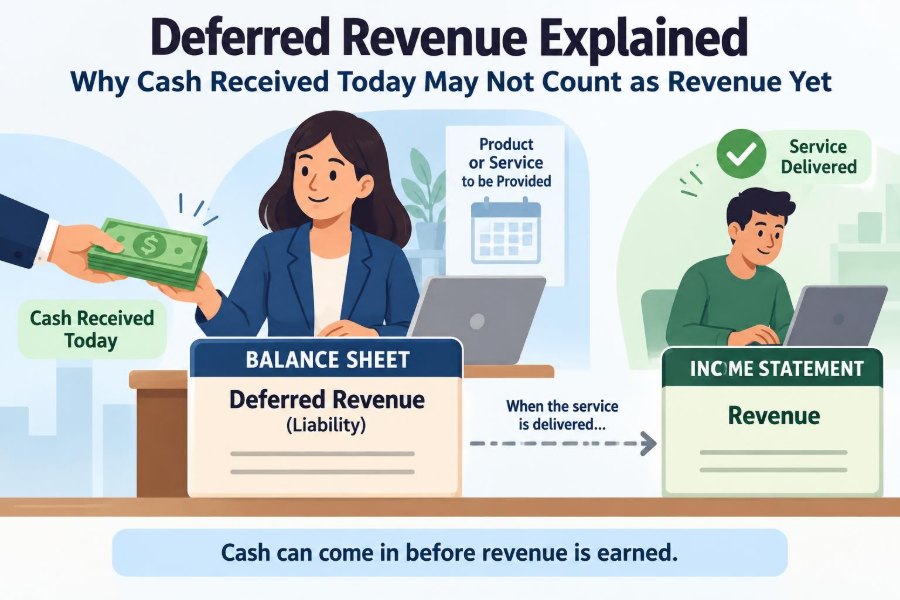
Once the company provides the agreed service or goods, the obligation declines and revenue is recognized.
🔄 The core accounting cycle
The process has two stages. First, record the advance payment. Later, recognize revenue as performance occurs.
| Timing | Typical entry | What it means |
|---|---|---|
| Customer pays in advance | Debit Cash; Credit Deferred Revenue | Cash increased, but the service obligation also increased. |
| Service is delivered | Debit Deferred Revenue; Credit Revenue | The obligation is reduced and earned income is reported. |
“Debit” and “credit” are bookkeeping labels, not judgments about whether something is good or bad. In this case, the entries simply keep assets, liabilities, and revenue in the right places.
📅 A simple subscription example
Suppose a hypothetical online learning platform sells a 12-month subscription for $1,200 on January 1. The customer pays at the start of the term.
On January 1, the platform records $1,200 of cash and $1,200 of deferred revenue. Assuming access is provided evenly and there are no special contractual features, it may recognize $100 of revenue each month.
After January, deferred revenue is $1,100. After six months, it is $600. By the end of the service period, the deferred balance related to that contract is zero.
🛠️ Performance, not invoices, drives the answer
An invoice tells a customer what to pay. A contract explains what the business must provide. Neither document alone always determines the timing of revenue recognition.
The central question is usually whether the relevant performance obligation has been satisfied. This is the promised good or service that the customer is entitled to receive.
For simple arrangements, the answer may be obvious. For bundled products, long projects, or contracts with variable fees, it can require careful judgment.
🧩 Common transactions that create deferred revenue
Deferred revenue arises across many industries, not only in subscription businesses.
- Annual or monthly software subscriptions paid before the access period.
- Magazine, streaming, education, and membership subscriptions.
- Gift cards and store credits sold before redemption.
- Advance ticket sales for future events, travel, or performances.
- Retainers and deposits for professional or project work.
- Prepaid maintenance, insurance-related service arrangements, or support plans.
- Payments for products not yet shipped or delivered.
The label may differ by company, but the principle is consistent: cash received before performance creates an obligation.
📦 When a product sale is earned
For a straightforward retail sale, revenue is often recognized when control of the product transfers to the customer. That might occur at a store checkout, on delivery, or at another contractually defined point.
If a customer prepays for a product that will ship next month, the seller generally has not earned the amount simply because the payment cleared. The seller still owes delivery.
Shipping terms, cancellation rights, acceptance clauses, and installation requirements can affect the conclusion. Businesses should not assume every invoice date is a revenue date.
⏳ Revenue recognized over time
Many promises are fulfilled continuously rather than at one final moment. Hosting, security monitoring, access to a platform, and routine support are common examples.
When a customer receives and consumes benefits throughout a period, revenue is often recognized over that period. A straight-line monthly pattern can be appropriate when service is provided evenly.
But straight-line recognition is not automatic. If the value delivered is concentrated in a particular stage or usage pattern, the recognition pattern may need to reflect that reality.
🏗️ Long-term projects need careful measurement
Construction, implementation, engineering, and custom development contracts may involve work over many months. In some circumstances, revenue is recognized over time based on progress toward completing the promised work.
Progress can be measured using inputs, such as costs incurred relative to expected total costs, or outputs, such as milestones delivered. The method should faithfully reflect performance, not merely accelerate reported income.
Estimated costs and project scope can change. That makes controls, updated budgets, and documented judgments especially important.
🎁 Gift cards are a familiar form of deferred revenue
When a retailer sells a gift card, it has received cash but has not yet delivered merchandise or services. The initial amount is normally recorded as a liability.
Revenue is recognized as the card is redeemed. Amounts expected never to be redeemed, often called breakage, may be recognized under applicable accounting requirements when the business has a valid basis for doing so.
Rules and consumer-protection laws around gift cards vary by jurisdiction. Accounting treatment should be coordinated with legal and operational policies rather than handled as a simple estimate.
🔍 Deposits are not always revenue advances
The word “deposit” is imprecise. A payment labeled a deposit may be an advance payment for services, a refundable security deposit, or a nonrefundable amount that compensates the business for a specific right or activity.
A refundable security deposit is often a liability, but not necessarily deferred revenue, because the company may need to return cash rather than provide future goods or services. The contract terms determine the accounting.
Reading the substance of the arrangement matters more than relying on a label in a receipt or invoice.
🧮 Current versus noncurrent deferred revenue
Balance sheets often separate obligations due within the next year or operating cycle from those due later. Deferred revenue expected to be recognized soon is commonly classified as a current liability.
A multi-year contract can therefore create both current and noncurrent deferred revenue. The classification helps readers understand when the company expects to perform its obligations.
This presentation does not change total revenue. It improves clarity about the timing of obligations.
📈 What deferred revenue can reveal about a business
A growing deferred revenue balance may indicate that customers are committing cash for future products or services. In recurring-revenue models, that can be a useful signal of contracted future activity.
However, it is not a universal measure of business health. The balance can rise because of price changes, longer billing cycles, delayed delivery, contract timing, acquisitions, or changes in refund policies.
Readers should compare deferred revenue with bookings, churn, cash flow, remaining obligations, and the company’s ability to deliver—not treat one balance as a complete verdict.
📉 Why a decline is not automatically bad news
Deferred revenue can decline when a company fulfills previous commitments faster than it obtains new prepaid contracts. That may reflect lower sales, but it may also reflect normal seasonality or a move from annual billing to monthly billing.
A business can have strong current revenue while deferred revenue falls, particularly if it is working through a large prior-period balance. Context matters.
The useful question is: what changed in customer commitments, billing timing, and delivery patterns?
💵 Cash flow can look stronger before profit does
Advance payments improve operating cash flow when they are collected. Yet the related revenue may be recognized gradually in later periods.
This creates an important distinction for managers: cash can support payroll and operations now, but it may represent work the business must still fund and perform later.
Companies that spend advance cash too freely can face pressure when service costs continue after new customer payments slow down.
🧭 Deferred revenue and the income statement
The income statement reports earned revenue for a period. It does not simply report all customer payments received during that period.
For a subscription business, the amount billed in a month may differ significantly from revenue recognized in that month. Billing reflects contract and payment timing; recognized revenue reflects delivered service.
Confusing these measures can lead managers to celebrate sales too early or misunderstand why reported revenue lags cash collections.
🧱 Deferred revenue and the balance sheet
On the balance sheet, deferred revenue represents unfinished obligations to customers. It is a reminder that part of the cash on hand is connected to future delivery.
Unlike debt, deferred revenue generally does not require a cash repayment if the company performs as promised. But it is still a real obligation, and failure to perform may lead to refunds, penalties, disputes, or reputational damage.
This is why liability does not always mean borrowed money.
🧾 The matching idea behind related expenses
Revenue recognition does not mean every related cost is recognized at exactly the same instant. Still, accrual accounting seeks to present economic activity in periods where it meaningfully belongs.
For example, a company may receive annual subscription cash upfront while paying customer-support staff throughout the year. Gradual revenue recognition gives a more useful view of margin across the service period than recording all revenue on day one.
Expense timing follows its own accounting rules, so it should not be mechanically forced to mirror revenue.
🚫 The mistake of booking cash as sales immediately
A common error is crediting revenue as soon as cash arrives. This overstates current-period revenue and profit while understating liabilities.
The next period can then look artificially weak because services are delivered without the related revenue being recognized. Comparisons become distorted, and internal targets may be misleading.
For public companies and regulated entities, premature revenue recognition can also create serious reporting and compliance consequences.
🧷 Another mistake: releasing the balance too late
Deferral errors can run in both directions. A company may leave amounts in deferred revenue after it has already fulfilled the related obligation.
That understates revenue and may conceal trends in performance. It can also complicate contract renewals, customer reporting, and tax reconciliations.
A reliable close process reviews both new advances and the schedule for releasing existing balances.
🗂️ Build a contract-level revenue schedule
For recurring or complex arrangements, a revenue schedule is the practical bridge between contracts and financial statements. It records what was promised, when service begins and ends, how much consideration is allocated, and when revenue will be recognized.
Useful fields often include:
- Customer and contract identifier.
- Contract start and end dates.
- Products, services, and obligations promised.
- Cash collected, invoiced amounts, refunds, and credits.
- Recognition method and monthly or milestone-based release schedule.
- Current and noncurrent deferred revenue classification.
Even a small business benefits from a schedule that can be traced back to signed terms and billing records.
🔗 Systems must connect sales, billing, and delivery
Revenue errors often begin when departments use disconnected information. Sales may know what was promised, billing may know what was invoiced, and operations may know what was delivered—but finance needs all three.
Automation can help generate schedules and journal entries, especially for high-volume subscriptions. It does not remove the need to configure contract rules correctly or review unusual transactions.
Strong processes include handoffs for amendments, cancellations, upgrades, credits, and delayed starts.
📝 Contract changes can reset the analysis
Customers frequently upgrade plans, add users, extend terms, pause service, or negotiate discounts. These modifications can change the amount or timing of revenue recognition.
For example, an additional service sold at a distinct standalone price may be handled differently from a price concession on an existing service. The accounting depends on the contract’s facts and the applicable reporting framework.
Teams should capture changes when they occur. Reconstructing them months later from emails and invoices is slow and error-prone.
↩️ Refunds, cancellations, and credits require prompt updates
If a customer cancels a prepaid service and is entitled to a refund, the deferred revenue balance may need to be reduced and a refund liability or payable recorded. If the customer receives a credit, the treatment depends on what the credit represents and whether future service remains owed.
Ignoring these events can leave liabilities and revenue overstated. It can also produce a mismatch between customer account balances and the general ledger.
Clear cancellation policies make the accounting easier because they define what each party is entitled to when service ends early.
🌍 Accounting frameworks use detailed guidance
Businesses reporting under US GAAP or IFRS apply detailed revenue-recognition guidance. The broad principle is similar: recognize revenue as promised goods or services transfer to the customer, using a disciplined analysis of the contract.
The specific outcome can vary with contract terms, industry practices, collectibility, return rights, variable consideration, licenses, and principal-versus-agent relationships. This article explains the core concept, not a substitute for a technical accounting conclusion.
When amounts are material or contracts are unusual, qualified accounting advice and documented analysis are sensible safeguards.
🧠 A practical checklist before recognizing revenue
Before moving an amount from deferred revenue into revenue, ask whether the records support the release.
- What exactly did the business promise the customer?
- Has that good or service been transferred, delivered, or provided?
- Is revenue earned at a point in time or over time?
- Does the recognition pattern reflect actual performance?
- Have refunds, modifications, discounts, or cancellations changed the obligation?
- Can the entry be traced to a contract, invoice, and delivery evidence?
This checklist is simple, but it forces attention onto performance rather than payment.
👥 What managers should monitor
Managers should monitor deferred revenue alongside operational capacity. A large balance may mean a large future workload: support tickets, hosted usage, shipments, classes, maintenance visits, or project milestones still need to be delivered.
Useful internal reporting can show opening deferred revenue, new cash advances, revenue recognized, refunds, and ending balance by product or customer group. That movement explains the balance better than a single ending number.
Finance and operations should discuss whether staffing, systems, and inventory can support the obligations already sold.
🎓 What students should remember for journal entries
The recurring pattern is straightforward. When cash arrives before performance, increase cash and increase deferred revenue. When performance occurs, reduce deferred revenue and increase revenue.
Do not confuse deferred revenue with accounts receivable. Accounts receivable means the business has earned revenue but has not collected cash. Deferred revenue means the business has collected cash but has not yet earned all of it.
These are opposite timing situations, and they appear on opposite sides of the balance sheet: receivables are assets; deferred revenue is a liability.
🏁 The core principle to carry forward
Deferred revenue is not an attempt to hide cash or make accounting needlessly complicated. It is a structured way to show two realities at once: the business has received money, and it still owes performance.
That separation gives owners, lenders, employees, investors, and customers a clearer view of what has actually been earned and what remains to be delivered.
The principle applies whether the arrangement is a $25 class pass, a one-year software subscription, or a multi-year implementation contract: recognize revenue when the promised value reaches the customer.
Cash received today becomes revenue when the business earns it by fulfilling its promise—not simply when the payment arrives. That is the essential logic behind deferred revenue, and it keeps financial reporting connected to real economic activity. 💰📅📘