
A business buys a delivery van for £30,000. The van will help make deliveries for years, but its value will not stay at £30,000 forever. It will wear out, become less useful, and eventually need replacing.
The accounting question is not whether the van loses value. It is when and how that cost should appear in profit. Charge too much too soon and early profits fall; charge too little and the balance sheet may make the asset look more valuable than its remaining service potential suggests.
Two common answers are straight-line depreciation and reducing balance depreciation. Both spread an asset’s cost over time, but they produce very different expense patterns, carrying amounts, and reported profits.
For students, the calculations are a core accounting skill. For managers and working professionals, the choice matters because it shapes performance trends, budgets, asset replacement decisions, and the story the financial statements tell.
🧾 What depreciation actually represents
Depreciation is the systematic allocation of the depreciable amount of a tangible non-current asset over its useful life. It is an accounting expense, not a yearly estimate of what the asset could be sold for.
The depreciable amount is usually the asset’s cost less its estimated residual value. Residual value, sometimes called salvage value, is the amount the business expects to recover when it disposes of the asset at the end of its useful life.
Depreciation applies the matching idea: if an asset helps generate revenue over several periods, its cost should normally be recognised across those periods rather than entirely on the purchase date.
🏗️ Why a purchase is not usually expensed immediately
Buying machinery, vehicles, computer equipment, or office furniture often creates benefits beyond the current accounting period. Recording the whole purchase as an immediate expense would make one year look unusually unprofitable and later years look artificially strong.
Instead, the initial entry generally records a non-current asset. Depreciation then moves part of that recorded cost into the statement of profit or loss each period as the asset is consumed in operations.
This does not mean the business avoids the cash cost. The cash may leave on day one. Depreciation simply separates cash timing from expense recognition timing.
🔍 The three estimates behind every calculation
Before choosing a method, an accountant needs reliable assumptions. Depreciation is inherently estimate-based, even when the arithmetic is simple.
- Cost: purchase price plus directly attributable costs needed to bring the asset into working condition, such as delivery and installation where applicable.
- Useful life: the period, or sometimes the expected output, over which the business expects to use the asset.
- Residual value: the expected amount recoverable on disposal after considering the asset’s expected condition and selling costs where relevant.
A method cannot rescue unrealistic assumptions. A five-year straight-line calculation is still misleading if the asset will realistically be obsolete after three years.
📏 Straight-line depreciation in one sentence
Straight-line depreciation charges the same depreciation expense in each full accounting period of an asset’s useful life. It assumes that the asset’s service potential is consumed evenly over time.
The basic formula is:
Annual depreciation = (Cost − Residual value) ÷ Useful life
It is popular because it is transparent, easy to forecast, and often suitable for assets whose usefulness declines fairly evenly, such as office furniture or buildings in some circumstances.
🧮 A straight-line example
Assume a business purchases equipment for £50,000. It expects to use the equipment for five years and estimates a residual value of £5,000.
Annual depreciation = (£50,000 − £5,000) ÷ 5 = £9,000
The business records £9,000 of depreciation each year. At the end of five years, the carrying amount—the cost less accumulated depreciation—will be £5,000, assuming no impairment or revised estimates.
| Year | Depreciation charge | Accumulated depreciation | Carrying amount |
|---|---|---|---|
| 1 | £9,000 | £9,000 | £41,000 |
| 2 | £9,000 | £18,000 | £32,000 |
| 3 | £9,000 | £27,000 | £23,000 |
| 4 | £9,000 | £36,000 | £14,000 |
| 5 | £9,000 | £45,000 | £5,000 |
📉 Reducing balance depreciation explained
Reducing balance depreciation, also called diminishing balance or written-down value depreciation, applies a fixed percentage to the asset’s carrying amount at the beginning of each period.
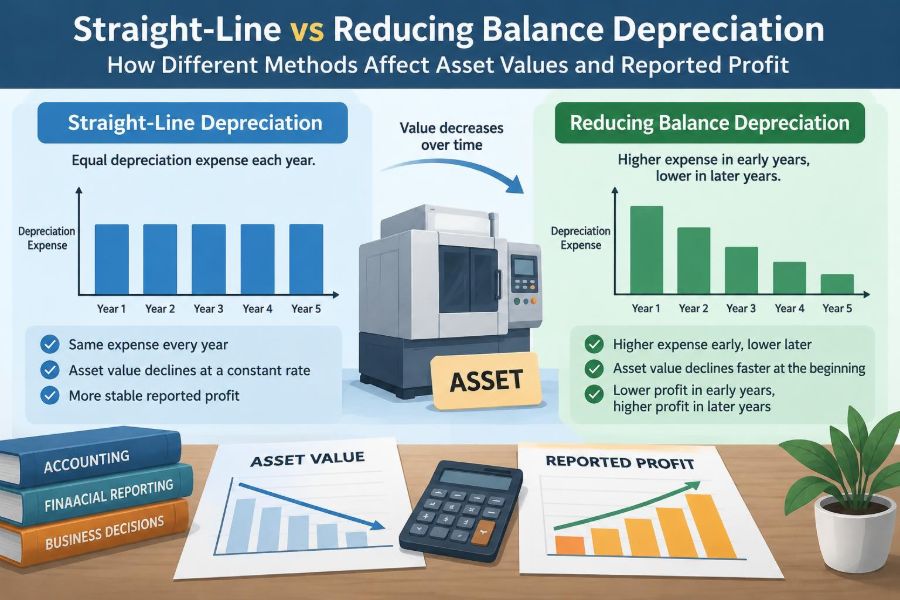
Because the carrying amount falls every year, the depreciation charge also falls. The method therefore records more depreciation in earlier years and less in later years.
This pattern can be appropriate when an asset delivers more benefit when new, loses value rapidly, or faces increasing repair and maintenance needs as it ages.
🧮 A reducing balance example
Use the same £50,000 equipment purchase, but assume the business applies a 30% reducing balance rate. For simplicity, this example ignores residual value until the final-year adjustment, although in practice depreciation must not reduce an asset below its residual value.
| Year | Opening carrying amount | 30% depreciation | Closing carrying amount |
|---|---|---|---|
| 1 | £50,000 | £15,000 | £35,000 |
| 2 | £35,000 | £10,500 | £24,500 |
| 3 | £24,500 | £7,350 | £17,150 |
| 4 | £17,150 | £5,145 | £12,005 |
| 5 | £12,005 | £3,602 | £8,403 |
Unlike straight-line depreciation, a percentage method does not naturally reach a specified residual value at a specified date. The business may need a final adjustment, or it may use a rate designed to approximate the expected useful-life pattern.
⚖️ The central difference: timing, not total cost
If the same cost and residual value are ultimately recognised, the total depreciation over the asset’s life is broadly the same under either method. What changes is the timing of expense recognition.
Straight-line spreads expense evenly. Reducing balance front-loads it. Consequently, reducing balance normally produces lower profit in the early years and higher profit in the later years than straight-line, assuming revenue and other costs are unchanged.
This is why depreciation method is not a minor mechanical choice. It affects how users interpret year-on-year results.
📊 Comparing early-year reported profit
In the examples above, year-one straight-line depreciation is £9,000, while year-one reducing balance depreciation is £15,000. All else equal, year-one profit before tax is therefore £6,000 lower under reducing balance.
By year five, the comparison reverses: straight-line still charges £9,000, while the reducing balance charge has fallen to approximately £3,602. Later profits may therefore look stronger under the reducing balance approach.
Neither result is automatically “better.” The relevant question is whether the expense pattern reflects the asset’s expected pattern of economic benefit.
🏦 How asset values differ on the balance sheet
Depreciation reduces the asset’s carrying amount on the statement of financial position. Under reducing balance, the carrying amount typically falls more quickly at first.
Using the earlier illustrations, the equipment has a £41,000 carrying amount after year one under straight-line, compared with £35,000 under reducing balance. The latter method presents a more rapidly declining book value.
Carrying amount is not necessarily market value. A well-maintained machine may be worth more or less than its accounting carrying amount, and a business should consider impairment indicators separately.
🧠 Matching the method to the pattern of benefits
Accounting policy should follow economic substance rather than a preference for smooth earnings or a desire to minimise early profit. The depreciation method should reflect how the asset’s future economic benefits are expected to be consumed.
Straight-line may fit an asset that provides broadly consistent service each year. Reducing balance may fit technology that becomes outdated quickly, a vehicle that loses more value when new, or equipment that is most productive in its earlier years.
Where the expected pattern cannot be determined reliably, straight-line is often used because it is a practical and systematic approximation. The exact requirements depend on the reporting framework used by the entity.
🚚 Assets that may suit straight-line depreciation
Straight-line is often reasonable where time, rather than intensive early use or rapid obsolescence, is the main driver of consumption.
- Office desks, chairs, and fixtures used consistently over time.
- Leasehold improvements that provide a relatively even benefit over the usable period.
- Buildings where the pattern of consumption is expected to be steady, subject to component accounting and local reporting requirements.
- Simple production equipment operating at a stable level throughout its useful life.
These are examples, not automatic rules. A factory machine used heavily in its first two years may not be well represented by an equal annual charge.
💻 Assets that may suit reducing balance
Reducing balance is commonly considered for assets that lose utility or value more quickly in the early years. Computer hardware is a familiar example: newer devices can offer greater capability before technological change reduces their usefulness.
Motor vehicles can also fit this pattern because their resale value may decline substantially soon after purchase. However, accounting depreciation should still reflect expected use, not merely a generic market-value curve.
Specialised equipment may justify an accelerated pattern if output, efficiency, or revenue-generating capacity is demonstrably strongest at the start of its life.
🛠️ Repairs, maintenance, and the total cost pattern
An older asset often costs more to maintain. Reducing balance depreciation can sometimes create a more even combined annual cost when falling depreciation charges are offset by rising repairs.
For example, a new van may have high depreciation but low repair bills. Several years later, depreciation may be lower while servicing and repair costs rise. Looking only at depreciation can hide this broader operating pattern.
Maintenance expense and depreciation remain separate concepts. Repairs usually maintain an asset’s current condition and are expensed as incurred, while expenditure that enhances future benefits may need different accounting treatment.
🧾 The journal entry for depreciation
The basic periodic entry is straightforward:
Dr Depreciation expense
Cr Accumulated depreciation
Accumulated depreciation is a contra-asset account. It is shown against the asset’s cost, allowing users to see both the original cost and the total depreciation recognised to date.
Some accounting systems credit the asset account directly instead. The economic outcome is similar, but separate accumulated depreciation records are often more informative for tracking history and disposals.
📅 Depreciation from the date an asset is available for use
Depreciation generally starts when an asset is in the location and condition necessary for it to operate as management intends—not simply when the invoice is paid or when the asset is ordered.
A machine delivered in December but not installed and ready until January may not be depreciated during December under many reporting approaches. Conversely, an available-for-use asset does not necessarily stop depreciating merely because it is temporarily idle.
Businesses need a consistent convention for partial periods, such as monthly depreciation or a half-year policy where permitted. Consistency improves comparability, but the convention should not create a material distortion.
🧭 Useful life is not the same as physical life
An asset may physically function for ten years but have a useful life of only five years to a particular business. A company might replace it early because of new technology, capacity needs, safety requirements, changing customer expectations, or high operating costs.
Useful life can also be limited by legal rights, contractual terms, or a planned disposal date. The relevant question is how long the entity expects to obtain economic benefit, not how long the asset could theoretically survive.
This distinction is especially important for rapidly changing equipment and assets used in demanding environments.
♻️ Residual value requires disciplined estimation
Residual value should reflect what the business expects to receive at the end of useful life, based on the asset’s expected age and condition at that date. It should not be an optimistic number chosen simply to reduce annual depreciation.
If an asset is expected to have little resale value after removal or disposal costs, residual value may be nil. If a reliable resale market exists, a positive estimate may be appropriate.
Residual value is reviewed when estimates are reconsidered. A revised estimate changes future depreciation; it does not normally require the business to rewrite previously issued accounts.
🔄 Revising useful life or residual value
Management may discover that a machine will last longer than expected, or that technological change will shorten its useful life. Such changes are usually treated as changes in accounting estimates.
Suppose an asset has a carrying amount of £12,000 and is now expected to have three remaining years of use with no residual value. Future annual straight-line depreciation becomes £4,000. Earlier charges are not automatically recalculated.
Reviewing estimates is not optional housekeeping. Outdated useful lives can cause expenses and carrying amounts to drift away from economic reality.
🚨 Depreciation is not impairment
Depreciation is planned, systematic allocation. Impairment is a separate reduction when there is evidence that an asset may not recover its carrying amount through use or sale.
For instance, severe damage, unexpected technological obsolescence, or a major fall in demand may indicate impairment. Regular depreciation does not eliminate the need to consider such signs.
An impairment loss can create a sharper reduction in carrying amount than the normal depreciation schedule. The detailed testing rules depend on the accounting framework and circumstances.
🧮 Choosing a reducing balance rate carefully
A reducing balance rate should not be selected because it produces a convenient profit number. It should represent, as reasonably as possible, the expected consumption pattern.
One way to derive a rate is to connect the expected ending carrying amount to the asset’s cost and useful life. In simplified form:
Rate = 1 − (Expected residual value ÷ Cost)^(1 ÷ Useful life)
This produces a mathematical rate that reaches the expected residual value over the chosen life, assuming the same annual pattern. In practice, organisations may use approved policy rates, round rates for practicality, and make a final adjustment so depreciation does not fall below residual value.
📈 Ratios and performance measures can move
Because depreciation affects profit and carrying amounts, the method can influence reported ratios. In early years, reducing balance may lower operating profit and return-on-assets measures, while also reducing total assets more quickly.
It can also affect metrics such as asset turnover, profit margins, and earnings before tax. Analysts should therefore understand the policy before comparing two businesses or interpreting a sudden change in performance.
Measures excluding depreciation, such as EBITDA, remove this particular expense from the calculation, but they do not remove the economic need to replace assets eventually.
💷 Cash flow does not follow depreciation expense
Depreciation reduces accounting profit, but it does not itself involve a current-period cash payment. The cash outflow generally occurred when the asset was bought, or when related financing obligations are settled.
In an indirect cash flow statement, depreciation is commonly added back to profit when reconciling to cash generated from operations because it is non-cash. Capital expenditure appears elsewhere as an investing cash flow.
Tax treatment can differ from accounting depreciation. Tax deductions may use capital allowances, tax depreciation, or other jurisdiction-specific rules, so businesses should not assume the accounting charge determines taxable profit.
🧩 Component accounting can change the answer
Some significant assets contain parts with different useful lives. An aircraft, a major building, or complex industrial equipment may have components that are replaced on different cycles.
If a component is significant relative to the total cost and has a materially different useful life, accounting frameworks may require it to be depreciated separately. A single straight-line rate for the entire asset could then be too simplistic.
This is a reminder that the real decision is not merely “straight-line or reducing balance.” It may also involve identifying what the asset is made of and how each material component is consumed.
🗂️ Consistency and disclosure matter
A business should apply its chosen policy consistently to similar assets unless a different pattern of consumption justifies a different method. Consistency helps users compare periods without mistaking an accounting-policy shift for a change in operations.
Financial statement disclosures commonly explain depreciation methods, useful lives or rates, and movements in asset classes. Clear records also support audit work, internal review, and asset-control procedures.
Changing a method simply to improve a performance target creates credibility and governance risks. A genuine change in expected consumption pattern is a different matter and should be supported by evidence.
⚠️ Common calculation mistakes
Many depreciation errors arise from assumptions or timing rather than difficult mathematics. A review checklist can prevent repeated corrections.
- Depreciating land as though it has a finite useful life, when it often does not; exceptions can arise in particular circumstances.
- Forgetting to deduct residual value in a straight-line calculation where a material residual value exists.
- Applying a reducing balance percentage to original cost every year rather than to the opening carrying amount.
- Depreciating below residual value without a justified change in estimate.
- Using a full year of depreciation for an asset not yet available for use, without a valid and consistently applied policy.
- Ignoring disposals, additions, impairment, or revised useful-life estimates.
🧪 A decision process for selecting a method
A useful policy decision starts with evidence about how the asset will be used. The process should be documented rather than based on habit.
- Identify the asset or significant components.
- Estimate useful life and residual value using operational information.
- Consider whether benefits are consumed evenly, faster at the start, or according to units produced.
- Select the method that best reflects that pattern and is practical to apply reliably.
- Set a partial-period convention and control procedures.
- Review estimates and indicators of impairment at appropriate reporting dates.
Where usage is the real driver, a units-of-production method may sometimes be more faithful than either time-based approach. For example, certain mining or manufacturing assets may be consumed according to output rather than calendar years.
🎓 A compact exam and workplace comparison
| Feature | Straight-line | Reducing balance |
|---|---|---|
| Calculation base | Depreciable amount spread over life | Opening carrying amount each period |
| Annual charge | Usually constant | Falls over time |
| Early-year profit | Usually higher than reducing balance | Usually lower than straight-line |
| Early carrying amount | Falls evenly | Falls faster |
| Potential fit | Even consumption of benefits | Accelerated consumption or obsolescence |
| Key practical issue | Realistic life and residual-value estimates | Justifying the rate and final residual-value adjustment |
For an assessment, show the formula, workings, and carrying amount clearly. In a workplace, add the reasoning: why does this method reflect expected use better than the alternatives?
🔚 The core principle: represent consumption faithfully
Straight-line and reducing balance are not competing shortcuts where one is always superior. They are different tools for allocating an asset’s cost in a way that reflects its expected use and benefit pattern.
Straight-line produces predictable, even charges. Reducing balance recognises a larger share of cost earlier, reducing both early reported profit and early carrying amounts. Over an asset’s life, the total depreciable amount is the key economic cost; the method determines when that cost appears.
The strongest policy is supported by realistic estimates, consistent application, regular review, and a clear link between accounting numbers and operational reality.
Choose depreciation to reflect how an asset is consumed—not to manufacture a preferred profit trend. That principle makes the numbers more useful to managers, investors, lenders, and anyone learning to read financial statements. 📘💼📉