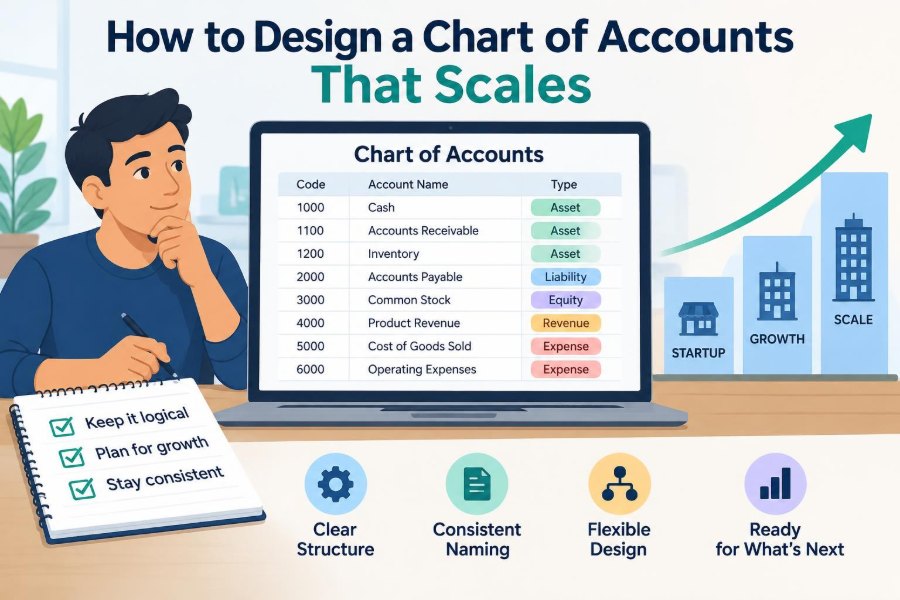

A company can begin with a perfectly workable chart of accounts and still outgrow it surprisingly fast. A few products become several product lines. One location becomes a regional footprint. A simple payroll account starts hiding wages, bonuses, commissions, and contractor costs that leaders need to understand separately.
At that point, the usual reaction is to add more accounts. Then more. The general ledger becomes crowded with slightly different labels, inconsistent numbering, and reporting workarounds that only one experienced accountant understands.
A scalable chart of accounts, or COA, prevents that drift. It creates a durable structure for recording transactions while giving management enough detail to make decisions without turning the ledger into an unsearchable catalog.
This is not just a bookkeeping design task. A thoughtful COA affects financial statements, monthly close, budgeting, tax work, audit support, systems integrations, and the quality of every dashboard built from accounting data. 🧮
🧭 1. Start With the Job the COA Must Do
A chart of accounts is an organized list of the accounts a business uses to classify transactions in its general ledger. Each account captures a type of asset, liability, equity, revenue, expense, gain, or loss.
The goal is not to describe every possible business event with a unique account. The goal is to produce financial information that is consistent, useful, and controllable.
- Support external financial statements.
- Enable internal management reporting.
- Allow reliable budgets and forecasts.
- Preserve an understandable audit trail.
- Work efficiently in the accounting system.
A COA that serves only bookkeeping often lacks decision-useful detail. A COA built only for management questions often becomes difficult to reconcile and close.
🏗️ 2. Design for Growth, Not Today’s Org Chart
Current operations are the starting point, not the boundary. A small business may have one office, one revenue stream, and a few vendors today, but its accounting structure should accommodate plausible expansion without a major redesign.
Planning for scale does not mean creating hundreds of empty accounts. It means leaving room in numbering sequences, separating concepts that are likely to diverge, and using dimensions for analysis that should not live in account codes.
Ask practical questions: Could the company add locations? Sell through a new channel? Acquire another entity? Offer subscriptions alongside one-time sales? The answers reveal where flexibility matters.
🧱 3. Establish the Five Core Account Classes
Most charts of accounts begin with the fundamental categories used in financial reporting. The exact numbering convention can vary, but the categories should be unmistakable.
| Account class | What it represents | Typical examples |
|---|---|---|
| Assets | Resources controlled by the business | Cash, receivables, inventory, equipment |
| Liabilities | Obligations owed to others | Payables, loans, accrued expenses |
| Equity | Owners’ residual interest | Capital, retained earnings, distributions |
| Revenue | Income from ordinary activities | Product sales, service revenue |
| Expenses | Costs incurred to earn revenue and operate | Payroll, rent, software, depreciation |
Some organizations also distinguish cost of sales, other income, and other expenses in their top-level layout. What matters most is a logical hierarchy that supports the entity’s reporting framework and operating model.
🔢 4. Create a Numbering Scheme With Open Space
Account numbers help users sort, search, import, and identify accounts. They should communicate broad structure without trying to encode every reporting attribute.
A common approach assigns a numeric range to each major class. For example, assets may occupy one range, liabilities the next, then equity, revenue, and expenses. Within each range, related accounts are grouped together.
1000–1999  Assets
2000–2999  Liabilities
3000–3999  Equity
4000–4999  Revenue
5000–5999  Cost of sales
6000–7999  Operating expenses
Leave meaningful gaps between accounts. If 6100 is rent expense, placing utilities at 6120 rather than 6101 gives the business room for future occupancy-related accounts.
🗂️ 5. Build a Clear Account Hierarchy
A scalable COA has levels. At the top are financial statement classes. Below them are groups, subgroups, and posting accounts used for journal entries.
For instance, operating expenses may contain occupancy, personnel, technology, marketing, and professional-services groups. Each group contains the accounts that hold actual balances.
Do not confuse a parent grouping with a posting account. In systems that support account hierarchies, parent accounts can summarize children while remaining unavailable for direct entries. That separation strengthens reporting discipline.
Example: an occupancy hierarchy
- Operating expenses
- Occupancy expense
- Rent expense
- Utilities expense
- Repairs and maintenance expense
🎯 6. Define Materiality Before Adding Detail
Every additional account has a cost. It must be selected correctly, reconciled when relevant, explained in reporting, maintained in budgets, and understood by employees.
Create a separate account when the information is likely to influence a financial statement, a management decision, a compliance requirement, or a recurring control activity. Otherwise, the distinction may belong in a memo field, vendor report, or reporting dimension.
Materiality is not only about the size of a dollar amount. A small category may deserve its own account if it is unusually risky, contractually restricted, tax-sensitive, or strategically important.
🧩 7. Separate Natural Accounts From Reporting Dimensions
A natural account answers what kind of transaction is this? A reporting dimension answers another question, such as where it occurred, who is responsible, which product it supports, or which project caused it.
Trying to answer all questions with account numbers causes account proliferation. Imagine separate travel accounts for every department, office, project, and product. The list becomes impossible to maintain.
Instead, use the natural account for travel expense and dimensions such as department, location, project, customer, or product line where the accounting system supports them.
🧬 8. Choose Dimensions Deliberately
Dimensions are powerful, but each one adds data-entry rules and reporting complexity. Introduce a dimension only when there is a stable business question it will answer.
- Department or cost center: Which team incurred or controls the cost?
- Location: Which site, region, or legal operation is involved?
- Project or job: Which temporary initiative should absorb the cost?
- Product or service line: Which offering generated revenue or required investment?
- Customer or channel: Which commercial relationship is being analyzed?
Decide whether each dimension is optional, required, or prohibited for each account group. Requiring a project on bank fees, for example, may create noise rather than insight.
📊 9. Let Financial Statements Lead the Structure
Start with the balance sheet and income statement the organization needs to produce. Work from those statements downward into groups and posting accounts.
This approach prevents a common problem: designing accounts around individual invoices or vendor names rather than around meaningful financial categories. Financial statements should summarize transactions; they should not be reconstructed manually every month.
Map each posting account to a reporting line. If an account does not have a clear destination, determine whether it is necessary or whether its classification is incomplete.
💵 10. Treat Cash and Liquidity Accounts Carefully
Cash deserves a structure that supports daily operations and reconciliation. Separate bank accounts, cash equivalents, restricted cash, petty cash, and undeposited funds when those distinctions matter to reporting or control.
A dedicated clearing account can be useful for payment processors, payroll funding, intercompany transfers, and other timing differences. However, clearing accounts require explicit ownership and frequent reconciliation.
Never use a clearing account as a permanent parking place for items no one understands. An old balance in a clearing account is a signal to investigate. 🔍
🧾 11. Design Accounts Receivable for Collection Insight
Accounts receivable is typically controlled through customer subledgers, invoices, credit notes, and aging reports. The general ledger should align with those detailed records.
Create separate receivable-related accounts only when they support genuine distinctions, such as trade receivables, employee receivables, or other nontrade amounts. Avoid creating an individual general ledger account for each customer.
Consider how allowances, write-offs, deposits, and unapplied cash will be represented. These are often operationally important and should have defined treatment rather than improvised entries.
📦 12. Match Inventory Accounts to the Operating Model
Inventory structures vary widely. A service business may need none; a manufacturer may need separate accounts for raw materials, work in process, finished goods, inventory reserves, and production variances.
The COA should reflect the level of inventory accounting the business can reliably maintain. Overly detailed inventory accounts without disciplined processes create misleading precision.
Link inventory accounts to purchasing, warehouse, and cost-accounting workflows. A chart cannot fix weak item records, receiving procedures, or physical count controls, but it must not obstruct them.
🏭 13. Keep Cost of Sales Distinct From Operating Expenses
Cost of sales, sometimes called cost of goods sold or cost of revenue, includes costs directly associated with delivering goods or services. Operating expenses support the business more broadly.
This distinction affects gross profit reporting and management analysis. The exact classification depends on the business model and accounting policies, so document the organization’s approach.
Potential cost of sales categories
- Product costs and inventory write-downs.
- Direct labor where applicable.
- Freight-in or fulfillment costs under the company’s policy.
- Third-party delivery costs directly tied to revenue.
- Hosting or service-delivery costs in applicable service models.
Apply the policy consistently. Moving costs between these sections simply to improve a metric undermines comparability.
🧑💼 14. Organize Payroll Without Losing Accountability
Payroll is often one of the largest expense areas, yet it can be poorly designed. Separate wages, salaries, payroll taxes, employee benefits, bonuses, commissions, and contractor costs when those categories support reporting or planning.
Use a department or cost-center dimension to show where people work. Do not create separate salary accounts for every team unless the system lacks dimensions and the reporting need is enduring.
Accrued payroll and related liabilities should also be clear enough to support reconciliation to payroll records, benefits administrators, and tax filings.
🧠 15. Reserve Special Treatment for Revenue Recognition
Revenue accounts should reflect the organization’s significant revenue streams, not every customer or invoice type. A useful structure might distinguish products, professional services, subscriptions, usage-based charges, or licensing when those streams are managed differently.
When revenue is recognized over time or depends on performance obligations, related balance-sheet accounts may be needed for contract liabilities, contract assets, deferred revenue, or unbilled receivables, depending on the facts and reporting framework.
Revenue recognition requires policy judgment. The COA should support that policy, while detailed contract schedules and subledgers provide the underlying evidence.
🪙 16. Make Accruals and Prepayments Visible
Accrual accounting relies on recognizing costs and income in the appropriate period. Clear accounts for accrued expenses, prepaid expenses, deferred revenue, and similar timing items make the close process more reliable.
Do not combine every accrual into one opaque liability account if management or auditors need to understand significant categories. At the same time, avoid dozens of tiny accrual accounts that are harder to reconcile than a well-maintained schedule.
Each balance-sheet timing account should have a named reconciliation, supporting detail, and a process for reversal or amortization.
🏦 17. Account for Debt and Financing Separately
Debt arrangements can involve principal, accrued interest, current portions, long-term portions, fees, and covenant-related reporting. A simple “loan payable” account may not be enough once financing becomes more complex.
Separate accounts should follow the legal terms, financial-reporting presentation, and information needed for reconciliation. Keep an accessible schedule that ties the general ledger to lender statements and amortization calculations.
Equity accounts also deserve care. Owner contributions, distributions, retained earnings, additional paid-in capital, and other equity movements should not be blended without understanding their legal and reporting implications.
🛠️ 18. Plan for Fixed Assets and Depreciation
Fixed-asset accounting benefits from a consistent asset-class structure. Common classes may include leasehold improvements, furniture, computer equipment, vehicles, machinery, or internally used software where applicable.
Pair asset accounts with accumulated depreciation or amortization accounts and corresponding expense accounts. This arrangement helps users see original cost, accumulated charges, and net carrying amount.
Use an asset register for item-level details such as acquisition date, location, useful life, disposal information, and identification number. The general ledger should summarize; the register should provide depth.
🔄 19. Treat Intercompany Activity as a Design Requirement
Groups with multiple legal entities need a disciplined intercompany approach. Transactions between entities should be identifiable, balanced, and eliminable during consolidation.
Many organizations use due-to and due-from accounts by counterparty entity, supported by intercompany dimensions or dedicated entity codes. The best method depends on the consolidation process and system capabilities.
Do not wait until year-end to discover that one entity posted an intercompany charge while the other did not record its counterpart. Establish matching rules, settlement procedures, and ownership from the beginning.
🧪 20. Avoid the “Miscellaneous” Account Trap
Miscellaneous accounts can be useful temporarily for genuinely infrequent, immaterial items. They become harmful when they turn into a default classification for transactions that staff do not understand.
Review miscellaneous activity during each close. Reclassify recurring items to appropriate accounts and investigate unusual entries before they become embedded in comparative reports.
A good test is simple: if a manager asks what makes up the balance, can the accounting team answer quickly? If not, the account needs either cleanup or better design.
📝 21. Write Naming Rules People Can Follow
Account names should be concise, specific, and consistent. They should describe the nature of the transaction rather than the person who usually posts it.
Choose a naming convention and apply it throughout the chart. For example, use either “Expense — Legal” or “Legal Expense,” rather than mixing both patterns.
- Avoid vague labels such as “General” or “Other” where a clearer name is available.
- Use singular or plural consistently.
- Distinguish similar concepts, such as bank charges and interest expense.
- Include a qualifier when needed, such as “Software Subscriptions” rather than “Software.”
Clear names reduce coding errors before controls ever need to catch them.
📚 22. Create an Account Dictionary
The COA itself is not enough. Maintain an account dictionary that explains each posting account’s purpose, normal balance, permitted uses, required dimensions, financial-statement mapping, and examples of typical transactions.
This document is especially valuable when new accountants, approvers, and systems administrators join the organization. It turns institutional memory into a repeatable process.
Useful dictionary fields
- Account number and name.
- Definition and inclusion or exclusion rules.
- Account owner and reconciliation requirement.
- Required dimensions and allowable values.
- Reporting group and tax or compliance notes where relevant.
🔒 23. Build Controls Into the Structure
A chart of accounts contributes to internal control when accounts are restricted, approval workflows are appropriate, and reconciliations have clear owners. Structure alone cannot prevent errors or fraud, but unclear structure makes both harder to detect.
Limit who can create accounts, alter mappings, post manual journals, or use sensitive accounts. Changes to revenue, cash, equity, tax, and intercompany accounts often merit additional review.
Also consider whether accounts should allow manual posting at all. System-controlled accounts linked to subledgers may need protection to preserve the tie between operational detail and the general ledger.
⚙️ 24. Design With Systems and Integrations in Mind
Modern accounting systems receive data from payroll platforms, expense tools, billing systems, banks, inventory applications, and payment processors. The COA must work with these integrations rather than forcing endless mapping exceptions.
Document how source-system categories map to general ledger accounts and dimensions. Review mappings when a vendor changes its product setup, when new transaction types appear, or when an integration is replaced.
Automation is most reliable when account choices are stable and unambiguous. A clean COA reduces the number of rules required to transform operating data into accounting entries. ⚙️
🧾 25. Make Budgeting and Forecasting Use the Same Language
Actual results are far easier to compare with plans when the budget uses the same account hierarchy and dimensions as the general ledger. A disconnected budget structure creates manual mapping work and weakens variance analysis.
Not every posting account needs a separate budget line. Management may budget at a higher group level while accounting records at a more detailed level. The hierarchy should make that roll-up automatic.
Design reports so users can move from a high-level variance into the accounts, dimensions, transactions, and explanations behind it. That path is where a scalable COA proves its value.
🧹 26. Govern Changes Instead of Freezing the Chart
A scalable chart of accounts changes carefully; it does not stay frozen forever. New business models, regulations, systems, and reporting needs can justify new accounts or revised groupings.
Create a simple change process. A request should state the business purpose, proposed name and number, reporting impact, dimension requirements, system mappings, owner, and whether an existing account could serve the need.
Periodically review inactive, duplicate, confusing, and miscellaneous accounts. Retire accounts by blocking future postings rather than deleting historical records when the system and retention requirements call for preservation.
🌱 27. Test the Design With Real Transactions
Before finalizing a COA, walk through real scenarios: a customer invoice, a payroll run, a software subscription paid annually, inventory received before its vendor invoice, a fixed-asset purchase, and a month-end accrual.
For each scenario, ask whether the entry is intuitive, whether required dimensions are available, whether the resulting report is useful, and whether the balance can be reconciled.
Testing exposes design gaps that a spreadsheet review may miss. It also reveals where staff will need guidance, default rules, or system validation.
✅ 28. Keep the Core Principle in View
The best chart of accounts is not the longest, most detailed, or most technically elaborate. It is the structure that captures transactions consistently, supports the required financial reporting, and provides decision-useful analysis as the business evolves.
Use natural accounts for the economic nature of transactions. Use dimensions for repeatable views such as department, location, project, or product. Govern changes, document definitions, and protect the connections between the ledger, subledgers, and reports.
A scalable chart of accounts creates enough structure to trust the numbers and enough flexibility to keep trusting them as the organization grows. 🧮 📈 🌱