
At month-end, a controller notices that profit looks unusually strong. Sales activity seems normal, cash has not surged, and nothing obvious appears wrong in the trial balance. Yet the financial statements are telling a more flattering story than the underlying business activity supports.
The cause may not be fraud, a missing spreadsheet, or a failed accounting system. It may be one routine journal entry: a repair charged to equipment, a supplier invoice posted to the wrong expense account, or a liability recorded one period too late.
Journal entries are the instructions that turn business events into financial reports. When those instructions are incomplete, misclassified, duplicated, or dated incorrectly, the reports can remain mathematically balanced while becoming economically misleading.
For students, these errors explain why debits equaling credits is not enough. For working professionals, they show where review, documentation, and reconciliation must go beyond checking arithmetic. 🧾
🔍 1. Why journal entry errors are deceptively dangerous
A journal entry affects at least two accounts, but its consequences can extend across the income statement, balance sheet, cash flow statement, tax calculations, and performance metrics. A small coding decision can therefore change several reported conclusions at once.
The most dangerous errors are often quiet errors: entries that post successfully, contain equal debits and credits, and look plausible at a glance. They do not create an obvious system exception.
⚖️ 2. A balanced entry is not necessarily a correct entry
The fundamental posting rule is simple: total debits must equal total credits. This rule protects the double-entry system, but it does not prove that the correct accounts, amounts, dates, entities, or descriptions were used.
For example, debiting Office Supplies Expense and crediting Accounts Payable for an equipment purchase will balance perfectly. It still understates assets and may overstate current-period expense.
- Arithmetic accuracy asks whether the entry balances.
- Accounting accuracy asks whether it represents the event faithfully.
- Reporting accuracy asks whether the resulting statements are useful and fairly presented.
🧭 3. Start with the business event, not the account code
Reliable journal entries begin with an explanation of what happened in the business, before anyone selects a general ledger account. Was an asset acquired, a service consumed, a customer billed, cash received, or an obligation created?
That sequence matters because account codes are labels, while the business event determines recognition and classification. An accountant who begins with “which code is easiest?” is more likely to force an event into the wrong category.
📝 4. The essential anatomy of a journal entry
A complete entry typically identifies the posting date, accounts affected, debit and credit amounts, a clear description, support for the transaction, and an appropriate preparer and reviewer trail. In many organizations, it also includes a source-system reference or approval evidence.
Good descriptions answer the future reviewer’s first question: “What is this, and why was it recorded?” “Adjustment” or “reclass” alone rarely provides enough context.
💥 5. Error one: recording the wrong amount
An amount error occurs when the right transaction is posted to the right general type of accounts, but the numerical amount is wrong. Causes include data-entry mistakes, misunderstood invoices, spreadsheet formula errors, incorrect units, and currency conversion mistakes.
A common example is recording a vendor bill for 5,400 as 4,500. The entry may balance and look reasonable, particularly where expenses fluctuate from month to month.
Typical consequences
- Expenses, assets, liabilities, revenue, or receivables are misstated.
- Profit is overstated or understated for the period.
- Ratios such as gross margin, current ratio, and expense percentages may be distorted.
- Cash forecasts may become less reliable if payables are wrong.
🔢 6. Why transposition errors deserve special attention
A transposition error is a specific amount error in which digits are reversed, such as entering 6,318 instead of 6,138. Another variant is a slide error, where a decimal point is misplaced or zeros are added or omitted.
These errors can evade casual review because both amounts look believable. In some cases, a difference divisible by nine is a clue that digits may have been transposed, but it is only an investigative hint, not proof.
Controls such as invoice-to-entry matching, reasonableness review, and automated data import can reduce risk. The best control depends on where the number originated. 🔢
🔄 7. Error two: reversing debits and credits
A reversal error posts the correct amount to the intended accounts but places the debit and credit on the wrong sides. Instead of increasing an expense and payable, for instance, the entry could decrease both.
This error is especially harmful because it can turn an obligation into an apparent reduction of obligations. If posted without detection, it may materially overstate profit and understate liabilities.
| Transaction | Correct treatment | Reversed treatment |
|---|---|---|
| Utilities invoice received | Debit Utilities Expense; credit Accounts Payable | Debit Accounts Payable; credit Utilities Expense |
| Effect | Recognizes expense and obligation | Reduces both, producing an implausible result |
Account normal balances are useful review anchors. Expenses and assets generally increase with debits, while revenue, liabilities, and equity generally increase with credits.
🧩 8. Error three: using the wrong account
An account classification error occurs when an amount is posted to an inappropriate account. The debit and credit may have the right direction and amount, but the account label does not describe the transaction properly.
For example, posting shipping expense to advertising expense may leave total operating expenses unchanged while distorting departmental reporting, margin analysis, and management decisions. Financial statement totals can look acceptable even as the underlying story becomes unreliable.
Classification questions to ask
- Does this cost relate to production, selling, administration, financing, or another function?
- Is the item current or noncurrent?
- Does the account belong to the correct legal entity, location, project, customer, or department?
- Will the classification support useful external and internal reporting?
🏗️ 9. Capitalizing a cost that should be expensed
One important classification error is treating a current-period cost as a long-term asset. Capitalization is appropriate only when the applicable accounting framework’s recognition criteria are met; it is not a way to avoid an expense.
Routine repairs and ordinary maintenance commonly preserve an asset’s existing condition rather than create a separate asset or substantially enhance future benefits. Recording them as property, plant, and equipment can overstate assets and defer expense into future periods through depreciation.
The immediate effect is often higher profit. The longer-term effect is a pattern of depreciation expense that does not reflect the economics of the original spending.
📦 10. Expensing a cost that should be capitalized
The reverse error can also distort reports. When a qualifying long-lived asset is charged immediately to expense, current-period profit may be understated and assets may be understated.
Not every purchase with a long useful life is capitalized automatically. Organizations apply their accounting policies, materiality thresholds, and relevant recognition requirements. The key is to evaluate the nature of the expenditure rather than rely only on the vendor’s description.
Supporting documents should explain what was acquired, when it was available for use, and whether it creates future economic benefit.
🚫 11. Error four: omitting an entry entirely
An omission error occurs when a transaction that should be recorded is not recorded at all. A missed supplier invoice, unrecorded payroll accrual, absent depreciation entry, or forgotten customer credit memo can all create omissions.
Because no entry exists, the trial balance still balances. This is why trial-balance agreement cannot detect a complete omission on its own.
Omissions frequently arise at cut-off points: invoices arrive after closing, services are received without an invoice, or recurring entries depend on one person’s manual calendar reminder.
📅 12. Accrual omissions distort the period, not just one account
Under accrual accounting, expenses and revenues are recognized in the periods to which they relate, rather than only when cash moves. Missing an accrual shifts activity from one reporting period to another.
If December services are not accrued until the January invoice arrives, December expenses and liabilities may be understated, while January expenses may be overstated. Annual totals may eventually converge, but each period’s performance is less meaningful.
This matters for bonuses, lending measures, budgets, tax estimates, and management decisions based on monthly trends. 📅
✂️ 13. Cut-off errors are timing errors with reporting consequences
A cut-off error records a valid transaction in the wrong period. It differs from omission because the transaction may be recorded, just not when it should be.
Revenue recognized before control of goods or services has transferred, or purchases recorded after the related inventory was received, can make one reporting period look stronger and the adjacent period weaker. The error may reverse later, but the original report was still distorted.
Useful cut-off evidence
- Receiving reports and shipping documents
- Service completion records
- Invoice dates considered alongside the underlying performance date
- Bank activity and payment records near period-end
- Subsequent invoices and credit notes reviewed after closing
👯 14. Error five: posting a transaction twice
Duplicate entries occur when the same event is recorded more than once. A manual entry may be posted after an automated subledger feed has already captured the invoice, or an invoice may be entered twice under slightly different references.
Duplicates can overstate expenses and liabilities, revenue and receivables, or assets and cash movements, depending on the transaction. They can also create operational confusion when teams attempt to pay an invoice twice.
Unlike some errors, duplication may look like a legitimate burst of activity. Duplicate invoice checks, unique document identifiers, and review of unusual transaction patterns are valuable controls.
🔁 15. Reversing entries: useful tool, common trap
A reversing entry is intentionally posted at the beginning of a new period to reverse a prior-period accrual or adjustment. Used properly, it simplifies the later recording of the regular invoice or payroll entry.
Used carelessly, it can create duplicates or erase an amount that should remain on the books. The preparer must understand whether the subsequent transaction will be posted gross, net of the accrual, or through an automated process.
Every reversal should be linked clearly to its original entry. A reviewer should be able to see the purpose, date, amount, and expected follow-up without reconstructing the story from memory.
🏢 16. Error six: posting to the wrong entity, department, or project
In multi-entity, multi-location, or project-based organizations, a transaction can be economically real and still be assigned to the wrong reporting dimension. The general ledger may balance while one subsidiary, cost center, grant, or contract carries costs that belong elsewhere.
This error can distort legal-entity statements, project profitability, transfer pricing records, budget accountability, and intercompany balances. It is particularly difficult to spot when the same vendors and account codes are used across several units.
Required fields, entity-specific approval workflows, and reconciliations between operational systems and ledger dimensions help prevent this quiet misstatement.
🌐 17. Intercompany entries require two-sided discipline
Intercompany activity must be recorded consistently by each participating entity. One entity’s receivable or revenue entry should correspond appropriately to the other entity’s payable, expense, asset, or other related entry, depending on the facts.
If one side is omitted, dated differently, or coded to an external party account, consolidated reporting can contain unexplained balances. Eliminations at consolidation may then become difficult and error-prone.
Intercompany confirmations and matching processes are not merely administrative tasks. They test whether internal transactions tell the same story from both sides. 🌐
💵 18. Cash entries need independent evidence
Cash is highly visible, yet cash-related journal errors remain common. A receipt can be posted to the wrong customer, a payment can be credited to the wrong bank account, or a bank fee can be missed because it appears only on the statement.
Bank reconciliations compare book records with independent bank evidence. They can reveal timing differences, missing transactions, duplicates, and posting mistakes that a review of the general ledger alone may not expose.
Prompt investigation matters. Old reconciling items become harder to explain and may conceal a recording error rather than a genuine timing difference.
📊 19. The trial balance has clear limits
A trial balance confirms that recorded debit totals equal recorded credit totals. It is an important checkpoint, but it cannot detect every error.
- It will not detect a transaction omitted entirely.
- It will not detect equal debit-and-credit amounts posted to the wrong accounts.
- It will not detect a duplicate entry that is internally balanced.
- It will not detect an entry posted in the wrong period if it still balances.
- It will not prove that the description and support match the recorded transaction.
Think of the trial balance as a structural test, not a full test of financial reporting quality.
🧠 20. Use analytical review to find what balancing cannot
Analytical review asks whether the numbers make sense in relation to prior periods, budgets, operational activity, and related accounts. It is often the method that brings quiet journal errors to the surface.
An unexpected decline in repairs paired with an increase in fixed assets may suggest inappropriate capitalization. A sharp rise in one department’s travel expense may indicate coding to the wrong cost center rather than a real change in activity.
Variances are questions, not conclusions. They should prompt investigation supported by source documents and informed business knowledge.
📚 21. Source documents are the entry’s evidence trail
A journal entry should be traceable to reliable support: invoices, contracts, receiving records, payroll reports, calculations, approvals, bank statements, or other evidence appropriate to the event. The required support depends on the transaction’s nature and risk.
Documentation should establish the amount, date, parties, purpose, and accounting treatment. When a judgment is involved, such as an estimate or allocation, the calculation and assumptions deserve clear documentation too.
A neat attachment is not enough if it does not support the selected accounts. Reviewers must connect the evidence to the accounting conclusion.
🗂️ 22. Recurring entries need recurring review
Recurring journals are efficient for rent, amortization, depreciation, payroll allocations, and other predictable items. Their familiarity can also make them easy to overlook after business conditions change.
A lease may end, a project may close, an asset may be disposed of, or a cost allocation driver may no longer reflect operations. The journal continues posting because the system was instructed to do so.
Maintain a schedule of recurring entries with an owner, purpose, amount basis, start date, review date, and end condition. Automation should reduce manual work, not eliminate accounting judgment.
🔐 23. Segregation of duties reduces both error and concealment risk
When practical, the person who prepares a journal entry should not be the only person who approves it, controls the supporting records, and reconciles the affected account. Separating responsibilities makes errors more likely to be challenged before reporting.
Small organizations may not have enough staff for full segregation. In that case, compensating controls can include owner review, independent bank reconciliation, restricted posting access, and periodic review of unusual journals.
The purpose is not to create needless bureaucracy. It is to ensure that important entries receive an independent, informed look.
✅ 24. A practical journal-entry review checklist
A concise checklist can slow down high-risk errors without slowing down every routine transaction unnecessarily. The reviewer should focus on the assertions most likely to fail for that entry.
- Is the business purpose clear and supported?
- Are the amount, calculation, and currency correct?
- Are the debit and credit directions appropriate?
- Are the accounts, entity, department, and project correct?
- Is the posting date in the correct reporting period?
- Does the entry duplicate an existing transaction or reverse an intended entry?
- Does the explanation make sense to someone unfamiliar with the transaction?
- Has the entry received the approval required by policy?
For unusual, manual, or material entries, deeper review is generally appropriate. ✅
🛠️ 25. Correct errors transparently instead of hiding them
Once an error is found, correct it with an entry that preserves a clear audit trail. Avoid overwriting history or using vague descriptions that make the correction harder to understand later.
The correction should identify the original issue, affected period, accounts changed, reason for the adjustment, and relevant support. If the error affects a closed period or previously issued information, follow the organization’s policies and applicable reporting requirements.
Correction is also a learning opportunity. Ask why the error passed through the process: unclear policy, weak approval, poor master data, rushed close, inadequate training, or an automation configuration issue.
🌱 26. The core principle: faithfully represent the event
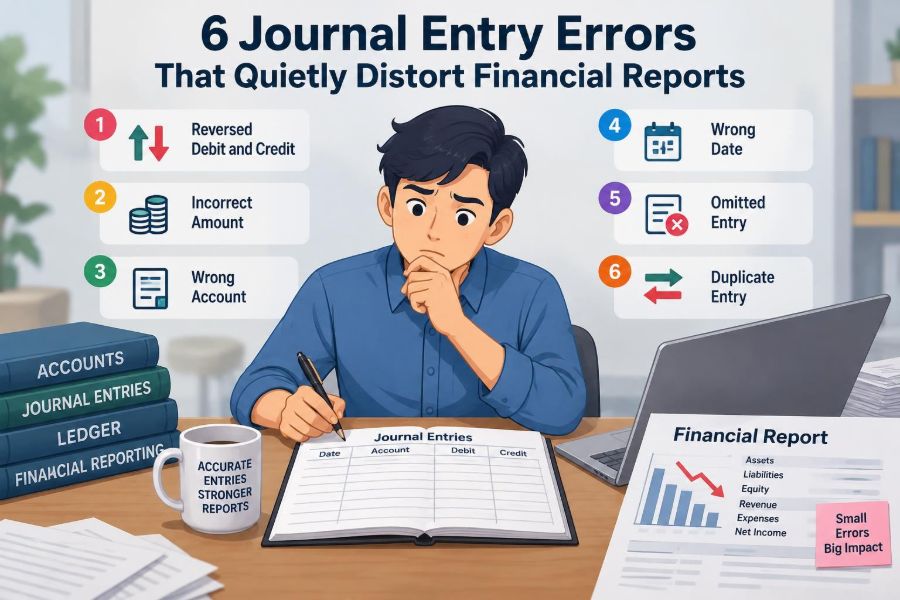
The six errors examined here—wrong amounts, reversed debits and credits, wrong account classifications, omissions, duplicates, and wrong entity or reporting-dimension postings—share one lesson. Financial reporting quality depends on whether journal entries faithfully represent the underlying business events.
Accuracy requires more than a balanced trial balance. It requires correct recognition, measurement, classification, timing, documentation, and review.
Every journal entry should tell the same true story as the transaction it records—clearly, completely, and in the right reporting period. 🧾🔍✅