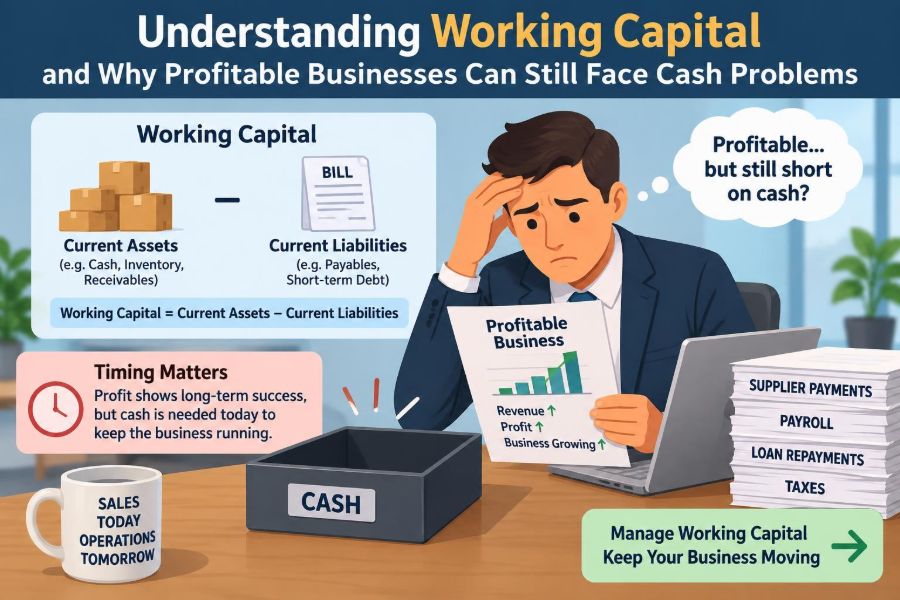

A growing business can look successful from the outside. Sales are rising, customers are placing larger orders, and the income statement shows a healthy profit.
Then payroll is due. A supplier wants payment before releasing the next shipment. The bank balance is lower than expected, and the owner suddenly has to delay a purchase, chase overdue invoices, or arrange short-term borrowing.
This is not necessarily a contradiction. Profit measures whether a business has earned more than it has consumed over a period. Cash measures whether it can meet obligations when they fall due.
Working capital sits at the intersection of those two realities. Understanding it helps explain why a profitable company can still be short of cash—and what managers, accountants, and analysts can do about it.
💡 Working Capital in Plain Language
Working capital is the money tied up in a company’s day-to-day operating cycle. It supports buying inventory or materials, paying employees, delivering products or services, invoicing customers, and waiting to collect payment.
In accounting terms, it is usually calculated as current assets minus current liabilities. Current items are expected to be converted into cash, used, or settled within roughly one operating cycle or one year, depending on the reporting framework and business.
🧮 The Basic Working Capital Formula
The standard formula is:
Working capital = Current assets − Current liabilities
Current assets commonly include cash, accounts receivable, inventory, and short-term prepayments. Current liabilities commonly include accounts payable, accrued expenses, short-term borrowings, and taxes payable.
A positive figure suggests current assets exceed short-term obligations. That can provide a cushion, but the number alone does not prove that the company has enough usable cash.
📦 What Counts as a Current Asset
Not all current assets are equally liquid. Cash can pay a bill immediately; inventory generally cannot until it is sold, delivered, and collected from the customer.
- Cash and cash equivalents: funds available for ordinary payments.
- Accounts receivable: amounts customers owe after goods or services have been supplied.
- Inventory: goods held for sale, raw materials, and work in progress.
- Prepaid expenses: payments made in advance, such as insurance or rent.
Prepayments help future operations but cannot normally be used to pay a supplier. This is one reason the total working capital figure needs interpretation.
🧾 What Counts as a Current Liability
Current liabilities are near-term claims on the business’s resources. They often arise naturally as the business buys, employs, borrows, and incurs obligations.
Accounts payable are amounts owed to suppliers. Accrued expenses are costs already incurred but not yet paid, such as wages or utilities. Current portions of loans and taxes payable may also require cash soon.
These obligations are not automatically a problem. Supplier credit, for example, can finance part of the operating cycle. The issue is whether payment dates arrive before sufficient cash does.
📈 Profit Is Not the Same as Cash
Profit is calculated under accrual accounting. Revenue is generally recognized when it is earned, and expenses are recognized when the related resources are consumed—not simply when money changes hands.
Suppose a consultant completes a project in March and invoices a client for $20,000 payable in 60 days. March may include the revenue and resulting profit, even though the cash may not arrive until May.
That timing difference is normal. It becomes dangerous when too much of the reported profit remains unpaid, while the business must pay staff, rent, tax, and suppliers now.
🔄 The Operating Cycle Explains the Gap
The operating cycle tracks the journey from spending cash to receiving cash back from customers. For a retailer, it may begin with buying goods, continue through holding and selling them, and end when the customer pays.
For a manufacturer, the path can be longer: buy raw materials, process them, hold finished goods, sell on credit, then collect the invoice. Every extra day in that cycle can consume funding.
Businesses with short cycles tend to need less financing for each unit of sales than businesses that must carry inventory or wait a long time for collection.
⏱️ The Cash Conversion Cycle
A useful related measure is the cash conversion cycle. It estimates how long cash is committed to operations before it returns through customer receipts.
Cash conversion cycle = Days inventory outstanding + Days sales outstanding − Days payables outstanding
Days inventory outstanding estimates how long stock sits before sale. Days sales outstanding estimates collection time. Days payables outstanding estimates how long the business takes to pay suppliers.
A shorter cycle often improves liquidity, but “shorter” is not always better if it is achieved by stockouts, overly aggressive collections, or damaged supplier relationships.
🏪 A Simple Retail Example
Consider a hypothetical shop that buys $30,000 of seasonal goods in April. It pays suppliers within 30 days, sells most goods in May, and allows corporate customers 45 days to pay.
The shop may record a profit once goods are sold, but it may still have paid for the stock before much customer cash arrives. If June payroll and rent are also due, a temporary cash squeeze is entirely possible.
Growth can intensify the squeeze. Larger sales may mean the shop must buy even more inventory before collecting from the earlier sales.
🏗️ Why Fast Growth Can Consume Cash
Rapid growth is often celebrated, yet it can increase working capital needs. More sales on credit produce more receivables. More expected sales may require more inventory, materials, employees, and deposits.
If operating inflows lag behind these commitments, the business needs cash from existing reserves, owners, lenders, or suppliers. Profit may be increasing at the same time.
Growth is cash-generative only after the business has financed the working capital needed to support it. This is particularly relevant for wholesalers, construction businesses, manufacturers, and project-based firms.
💳 Receivables: Sales That Have Not Yet Become Cash
Accounts receivable represent a promise to pay, not money in the bank. The older and more concentrated the receivables balance, the more carefully it should be examined.
A business can report strong revenue while facing weak collections because customers pay late, dispute invoices, encounter financial difficulty, or receive generous credit terms. Revenue recognition does not guarantee collectability.
Useful questions include: Which invoices are overdue? Are delays isolated or widespread? Does one customer represent an unusually large share of the balance? Is a credit loss allowance realistic?
📬 Improving Collections Without Alienating Customers
Good collection practices start before the sale. Clear credit approval, written payment terms, accurate invoices, and documented delivery reduce later disagreement.
- Invoice promptly after the obligation is fulfilled.
- Send polite reminders before and after the due date.
- Make payment methods simple for customers.
- Investigate disputes quickly rather than letting invoices age.
- Escalate persistent overdue balances under a consistent policy.
Demanding faster payment can protect cash, but overly rigid terms may deter valuable customers. The sensible approach depends on bargaining power, industry practice, customer risk, and margins.
📦 Inventory: Useful Asset, Hidden Cash Commitment
Inventory enables sales, but it ties up cash until sold. It also carries risks: obsolescence, damage, shrinkage, markdowns, storage costs, and forecasting errors.
A warehouse full of slow-moving goods may make current assets look substantial while providing little immediate ability to meet payroll. In some industries, old inventory may need to be discounted heavily or written down.
Inventory management is therefore a cash discipline as well as an operational discipline. The aim is not simply to hold less stock; it is to hold the right stock, in the right place, at the right time.
🚚 Supplier Terms as Operating Finance
Accounts payable can act as a source of short-term operating finance. When suppliers allow payment after delivery, the buyer can potentially sell goods or use materials before cash leaves the business.
Negotiating appropriate payment terms can improve cash timing. However, deliberately paying far beyond agreed terms can damage trust, interrupt supply, remove discounts, and signal financial stress.
A strong working-capital policy treats suppliers as commercial partners, not as an unlimited substitute for financing.
⚖️ Positive Working Capital Is Not Always Safe
A company may have positive working capital but still struggle to pay bills. Its assets might be mostly slow-moving inventory, disputed receivables, or prepayments, while its liabilities are due immediately.
Conversely, some businesses operate successfully with negative working capital. A supermarket, subscription platform, or retailer that collects cash quickly but pays suppliers later may receive cash before it settles many operating obligations.
The quality, timing, and predictability of the components matter more than a single balance-sheet total.
📏 The Current Ratio and Its Limits
The current ratio is calculated as current assets divided by current liabilities. It is a quick indication of near-term coverage.
Current ratio = Current assets ÷ Current liabilities
A higher ratio can indicate a larger buffer, but there is no universally “correct” ratio. Industries differ, accounting classifications differ, and a high ratio may reflect unproductive cash or obsolete stock.
Compare the ratio with the company’s history, operating model, seasonality, and relevant peers rather than relying on a generic benchmark.
🔍 The Quick Ratio Takes a Stricter View
The quick ratio focuses on more readily available assets, usually cash, short-term investments, and receivables. Inventory and prepayments are commonly excluded because they may not convert to cash quickly.
Quick ratio = (Cash + short-term investments + receivables) ÷ Current liabilities
This measure can reveal a risk hidden by a large inventory balance. Still, receivables may be overdue or doubtful, so even the quick ratio is a screening tool, not a cash forecast.
🗓️ Timing Matters More Than Year-End Balances
A balance sheet is a snapshot at one date. It may not capture a recurring cash dip that occurs before seasonal sales, tax payments, annual insurance premiums, or major supplier settlements.
For example, a business could show a comfortable December 31 cash balance after holiday sales but face pressure every August while building stock for the next season. Monthly or weekly cash forecasting exposes this timing.
Managers should look beyond year-end ratios and map when cash actually enters and leaves.
🌦️ Seasonality Changes the Funding Need
Seasonal businesses commonly invest cash well before peak revenue arrives. A tourism operator may pay deposits and hire staff before the main booking period; a retailer may build stock before a holiday season.
That pattern is not poor management by itself. It requires planning for the predictable low-cash period through reserves, agreed credit facilities, staged purchases, customer deposits, or other suitable arrangements.
The risk arises when a seasonal need is treated as a surprise every year.
🏦 Short-Term Borrowing Can Help—and Hurt
Lines of credit, overdrafts, invoice financing, and short-term loans can bridge a temporary working-capital gap. They may be appropriate when cash receipts are reliable but arrive later than essential payments.
Borrowing becomes more concerning when it repeatedly covers structural losses, permanently slow collections, excess inventory, or unrealistic growth plans. Interest, fees, covenants, and renewal risk can deepen pressure.
Finance should match the need where possible: short-term facilities for temporary timing gaps, and more durable funding for long-lived assets or sustained expansion.
🏭 Capital Expenditure Is a Different Decision
Buying machinery, vehicles, or software may affect cash immediately, but these are usually long-term investments rather than ordinary working-capital items. Confusing the two can obscure the cause of a cash problem.
A profitable manufacturer might be short of cash because it bought new equipment, built inventory, and extended customer credit in the same period. Each decision can be rational, but their combined cash impact matters.
Cash planning should separate operating needs from capital spending while showing how both draw on the same bank balance.
📊 Reading the Cash Flow Statement
The cash flow statement explains movements in cash through operating, investing, and financing activities. It complements the income statement and balance sheet.
Under the indirect method, operating cash flow often begins with profit and adjusts for non-cash items and working-capital movements. An increase in receivables or inventory generally reduces operating cash flow because cash has become tied up in those assets.
An increase in payables generally increases operating cash flow in the short term because payment has been deferred. This is useful context, not automatically good news.
🧠 A Practical Profit-to-Cash Bridge
Imagine a hypothetical company reports a $100,000 profit. During the period, receivables increase by $70,000 and inventory rises by $50,000, while payables increase by $20,000.
Ignoring taxes and other adjustments for simplicity, the working-capital effect is a cash outflow of $100,000: $70,000 plus $50,000 minus $20,000. The business can therefore report profit while generating little or no cash from operations.
This bridge is not a complete cash flow statement, but it shows why profit must be translated into cash movements before conclusions are drawn.
🚨 Early Warning Signs of Working-Capital Stress
Cash problems often show signals before a payment is missed. Monitoring these signals creates time to act.
- Receivables are aging or customer disputes are increasing.
- Inventory grows faster than sales without a clear seasonal reason.
- Supplier payments are routinely delayed beyond agreed terms.
- Credit limits or overdrafts are used continuously rather than occasionally.
- Management lacks a current cash forecast.
- Sales increase, but operating cash flow remains weak over time.
One indicator alone may have an innocent explanation. A pattern across several indicators deserves investigation.
🧾 Cash Forecasting Turns Anxiety into Decisions
A short-term cash forecast lists expected receipts and payments by week or month. It should include known payroll dates, supplier commitments, debt payments, taxes, rent, planned purchases, and realistic customer collection dates.
Forecasts are estimates, so they should be updated when facts change. Using optimistic invoice-payment assumptions defeats the purpose.
A rolling forecast helps management see a gap early enough to accelerate collections, delay nonessential spending, negotiate terms, arrange funding, or revise the sales plan.
🧱 Building a Working-Capital Policy
A working-capital policy sets practical rules for credit, collections, purchasing, stock, payment approvals, and minimum liquidity. It connects departments that may otherwise optimize their own goals separately.
Sales teams may seek flexible terms to win orders, purchasing may favor bulk discounts, and operations may seek high stock availability. Finance needs to make the cash trade-offs visible rather than simply rejecting those goals.
Effective policies usually specify authority levels, review frequency, exception handling, and the metrics used to monitor results.
🤝 Working Capital Is Cross-Functional
Finance cannot improve working capital alone. Inaccurate invoicing may begin in sales, inventory buildup may reflect poor demand planning, and delayed payments may come from inefficient approval processes.
Regular discussion between sales, operations, procurement, and finance can reveal the full chain behind a number. A receivable is not merely an accounting balance; it may reflect a contract term, delivery evidence, a customer complaint, or a billing error.
This broader view prevents simplistic solutions that shift a problem from one department to another.
🛠️ Improvement Levers and Their Trade-Offs
There are three main levers: collect cash sooner, reduce cash tied up in inventory, and manage payment timing responsibly. Each lever has operational and commercial consequences.
| Lever | Potential benefit | Key trade-off |
|---|---|---|
| Shorter customer terms | Faster cash collection | May reduce competitiveness or strain relationships |
| Lower inventory levels | Less cash committed to stock | Higher risk of stockouts or lost sales |
| Longer supplier terms | More time before cash leaves | May lose discounts or weaken supplier trust |
| Customer deposits | Funds work before delivery | May be unsuitable in some markets |
The objective is not to maximize any single metric. It is to support reliable operations with an affordable and resilient cash cycle.
❌ Common Mistakes to Avoid
A frequent mistake is treating revenue growth as proof that cash will improve. Another is relying on annual accounts while ignoring weekly payment commitments.
Businesses also sometimes offer credit without assessing customer risk, buy inventory to capture a discount without considering holding costs, or use late supplier payments as a routine financing strategy. These actions can improve one number temporarily while increasing broader risk.
Finally, do not assume a profitable business can always borrow its way through a gap. Lenders assess repayment capacity, collateral, conditions, and uncertainty—not just reported profit.
🧭 The Core Principle: Profit Must Be Funded
Working capital explains the funding required to turn operational activity into cash. A sale may create profit, but cash can remain tied up in receivables, inventory, and other operating assets for weeks or months.
Healthy management requires three views at once: profitability, liquidity, and timing. The income statement shows performance; the balance sheet shows resources and obligations; the cash forecast shows whether the business can meet commitments when due.
A profitable business can face cash problems when its cash is trapped in the operating cycle faster than it is released. Managing working capital means making that cycle visible, measurable, and deliberately financed.
Profit keeps a business economically viable, but cash keeps it operating from day to day. When leaders understand the timing behind receivables, inventory, payables, and planned spending, they can grow with far fewer surprises. 💰📈🧭