
A production manager is considering a new automated packaging line. A retailer is choosing between two store-refit plans. A small business owner is deciding whether to buy equipment, subscribe to software, or keep using a manual process.
Each decision may begin with an appealing promise: lower labor costs, faster output, fewer errors, or higher sales. But a major investment does not become sensible merely because it sounds useful. The timing, certainty, and size of its cash benefits all matter.
That is where return on investment (ROI), payback period, and net present value (NPV) become practical tools rather than textbook formulas. They turn a broad question—“Is this worth it?”—into a set of testable assumptions.
Used together, these measures help decision-makers compare alternatives, see where a proposal is fragile, and explain their recommendation clearly to people who approve budgets.
🧭 Start with the investment decision, not the formula
Define exactly what decision is being made before opening a spreadsheet. Is the organization choosing between two machines, deciding whether to replace an existing asset, or evaluating whether to launch a new service?
The scope affects every calculation. A replacement decision should focus on incremental cash flows: cash flows that change if the new asset is purchased. Existing costs that will continue either way are usually not relevant.
🎯 What these three measures answer
ROI, payback period, and NPV look at the same proposal from different angles.
| Measure | Primary question | Key limitation |
|---|---|---|
| ROI | How much profit or benefit is earned relative to cost? | May ignore when cash flows occur |
| Payback period | How quickly is the initial cash outlay recovered? | Usually ignores cash flows after payback |
| NPV | Does the investment add value after considering the time value of money? | Depends on forecast quality and discount rate |
No single metric captures every concern. A project with a fast payback may create little long-term value, while a high-NPV project may take longer to recover its cost.
💵 Use cash flow rather than accounting profit
Investment appraisal is generally built on cash flows, not accounting profit. Profit includes non-cash expenses such as depreciation, while cash flow tracks money paid and received.
For example, depreciation can reduce taxable profit and therefore affect tax payments, but depreciation itself is not a cash payment in the year it is recorded. A sound forecast separates the non-cash accounting charge from its possible tax effect.
🧾 Identify the full initial investment
The purchase price is rarely the whole day-zero cost. Include all cash needed to make the asset operational.
- Purchase price or implementation fee
- Shipping, installation, testing, and customization
- Training and process redesign
- Initial inventory or additional working capital
- Less proceeds from selling replaced equipment, where applicable
Leaving out setup costs can make a project appear to pay back months or years sooner than it actually will.
📈 Forecast incremental operating cash inflows
Cash benefits may come from additional sales, higher margins, fewer defects, lower energy use, reduced labor hours, or avoided maintenance. Estimate only benefits that are reasonably attributable to the proposal.
If a new system lets staff handle more orders without hiring another employee, the benefit may be an avoided future cost. If employees remain employed and no other productive work is created, calling all of their current wages “savings” would overstate the benefit.
📉 Include recurring costs and reinvestment needs
Many forecasts emphasize benefits and understate what it takes to sustain them. Add annual licenses, maintenance, insurance, consumables, extra utilities, support staff, and likely replacement components.
Also consider whether an investment has a major upgrade or overhaul during its useful life. A machine with low early maintenance may become expensive later, which matters especially for NPV.
🧮 Treat taxes carefully
Where taxes are relevant, use after-tax cash flows. New taxable income can create tax payments, while deductible operating costs and tax depreciation allowances may reduce them.
Tax rules vary by jurisdiction, entity, asset type, and timing. For a material decision, involve a qualified tax adviser or use the organization’s established tax model rather than assuming that book depreciation and tax deductions are identical.
🏦 Remember working capital
Working capital is cash tied up in short-term operating items, such as inventory and customer receivables, net of short-term supplier financing. Growth projects often require more of it before revenue is collected.
If a project requires an additional $40,000 of inventory at launch, that is an initial cash outflow. If the inventory is sold down at the end of the project, the working capital is typically released as a later cash inflow.
♻️ Add terminal value realistically
At the end of the forecast period, an asset may have resale value, scrap value, or removal costs. Include expected cash proceeds net of selling, disposal, and tax consequences where relevant.
Terminal value should not be a convenient plug number. If the equipment is specialized, old, or costly to dismantle, assume modest resale value unless there is a credible basis for more.
📊 Define ROI before calculating it
ROI is useful, but organizations use the term in different ways. One common version is:
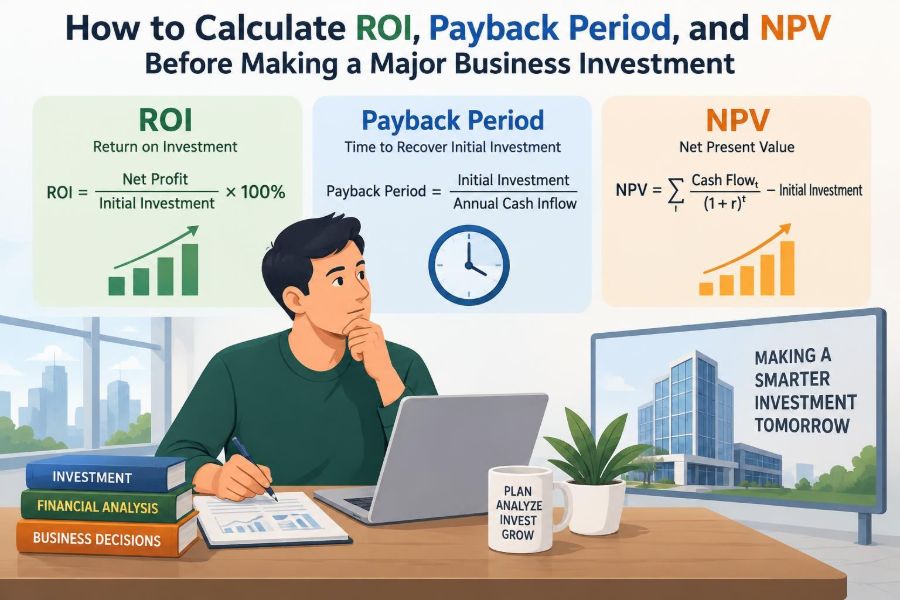
ROI = (Net benefit from investment ÷ Investment cost) × 100For a simple one-year decision, net benefit might equal annual cash benefit less annual cash costs. For a multi-year asset, some teams calculate cumulative net benefit over the project life, while others use average annual accounting profit divided by average investment.
State the definition beside the result. A percentage without its calculation basis can mislead a reader.
🔢 Calculate a simple ROI example
Suppose a business spends $100,000 on equipment. In the first year, it expects $45,000 of cash savings and $10,000 of extra maintenance and operating costs. The first-year net benefit is $35,000.
First-year ROI = ($35,000 ÷ $100,000) × 100 = 35%This is a clear snapshot, but it does not tell us whether savings continue, rise, or disappear in later years. It also treats a dollar received in year five as though it were received today.
⚠️ Know when ROI can mislead
A high ROI can result from a small investment with a short-lived benefit. Conversely, a strategically necessary system may have a modest measured ROI but protect service quality, compliance, or capacity.
ROI also becomes unreliable when teams mix accounting profit in the numerator with cash cost in the denominator, use different time periods for competing projects, or omit implementation costs. Consistency matters more than a polished percentage.
⏱️ Understand the payback period
The payback period is the time required for cumulative net cash inflows to recover the initial outlay. It is popular because liquidity matters: organizations with limited cash may reasonably prefer investments that return cash sooner.
It is best viewed as a risk and cash-recovery measure, not a complete measure of value.
🧱 Calculate payback with even annual cash flows
If the $100,000 equipment investment generates a steady $25,000 net cash inflow each year, the calculation is straightforward:
Payback period = $100,000 ÷ $25,000 = 4 yearsThis shortcut works only when annual net inflows are equal. Many real projects have uneven sales ramps, seasonal cash patterns, or rising maintenance costs.
📅 Calculate payback with uneven cash flows
Assume an initial outlay of $100,000 and annual net inflows of $20,000, $30,000, $35,000, and $40,000. Cumulative inflow reaches $85,000 by the end of year three, leaving $15,000 unrecovered.
In year four, $15,000 is recovered from a $40,000 inflow. The fraction of the year is 15,000 ÷ 40,000, or 0.375. Payback is therefore about 3.38 years.
🚦 Set a payback rule thoughtfully
A company may require projects to pay back within three years because it faces uncertain demand, costly borrowing, or rapid technology changes. That can be a sensible screen.
However, rejecting every project beyond an arbitrary cutoff can eliminate investments that generate substantial benefits later. Use a payback rule as one constraint, then examine NPV and strategic needs before deciding.
🕰️ Why timing changes value
A dollar available today can be invested, used to repay debt, or held for future needs. A dollar promised several years from now carries more uncertainty and gives up those alternative uses in the meantime.
This is the time value of money. NPV accounts for it by converting future cash flows into their present-day equivalents.
🏷️ Choose a defensible discount rate
The discount rate represents the required return for committing funds to a project, often reflecting the organization’s cost of capital and the risk of the cash flows. A higher rate reduces the present value of distant inflows.
Many organizations have an approved hurdle rate or project-specific policy. Do not select a low rate simply to make a proposal pass. If risk differs materially from the firm’s normal operations, the rate and assumptions may need review.
🧠 Understand the NPV formula
NPV adds the present values of all future net cash flows and subtracts the initial investment:
NPV = Σ [Cash flow in year t ÷ (1 + r)^t] − Initial investmentIn the formula, r is the discount rate and t is the year number. A positive NPV means projected returns exceed the required return embedded in the discount rate. A negative NPV means they do not, based on the assumptions used.
🧾 Work through a simple NPV example
Consider the $100,000 equipment purchase with expected net cash inflows of $30,000 at the end of each year for four years. Assume a 10% discount rate.
The present values are approximately $27,273, $24,793, $22,539, and $20,490. Their total is about $95,095. Subtracting the initial $100,000 gives an NPV of approximately negative $4,905.
Although total undiscounted inflows equal $120,000, the proposal does not meet a 10% required return in this hypothetical case. That difference is exactly why NPV is useful.
📱 Use spreadsheets without hiding assumptions
Spreadsheet functions can calculate NPV quickly, but check the timing convention. In many spreadsheet programs, an NPV function discounts a series of future flows beginning at the end of period one; the time-zero investment must be added separately.
Create a visible schedule with one row for each cash-flow category and one column for each period. A reviewer should be able to trace the final NPV back to sales, costs, tax, working-capital, and terminal-value assumptions.
🔍 Compare projects on a like-for-like basis
When alternatives serve the same purpose, compare them over the same economic life where practical. One machine may have a lower purchase cost but require replacement earlier; another may have higher upfront cost and lower operating expense.
If lives differ, a simple comparison can be misleading. Organizations may model a common planning horizon, replacement cycles, or equivalent annual cost depending on the decision and internal policy.
🧩 Separate independent from mutually exclusive projects
Independent projects can both be accepted if each meets the organization’s criteria and funding is available. For example, a safety upgrade and a separate warehouse energy project may each stand on their own.
Mutually exclusive projects compete for the same need: choosing one production line means not buying the other. For mutually exclusive alternatives, NPV commonly provides the strongest single value measure when the assumptions and risk treatment are comparable.
🎲 Test assumptions with sensitivity analysis
Forecasts are estimates, not promises. Sensitivity analysis changes one key input at a time to see how the result responds—for example, sales volume, price, implementation cost, useful life, or discount rate.
If a small reduction in expected volume turns NPV negative, the proposal is sensitive to demand. That does not automatically mean “reject”; it means management should investigate demand evidence, build contingencies, or require a larger margin of safety.
🌦️ Build scenarios, not just one forecast
A base case usually represents the most reasonable estimate. Add a downside case with slower adoption, higher costs, or delays, and an upside case with stronger performance.
Scenarios are most useful when assumptions change together in believable ways. For instance, a delayed launch might reduce first-year revenue while increasing implementation costs, rather than changing only one number in isolation.
🛠️ Account for implementation and operational risk
A financially attractive project can still fail operationally. New technology may require staff training, data conversion, supplier coordination, downtime, permits, or redesigned controls.
Translate significant risks into the forecast where reasonable: include training costs, phased implementation, contingency spending, or delayed benefits. Risks that cannot be quantified should still be described clearly in the decision paper.
🧯 Avoid sunk-cost errors
A sunk cost is money already spent that cannot be recovered, such as a prior feasibility study or early design work. It should not determine whether the organization spends additional money now.
The relevant question is forward-looking: from today onward, will the incremental benefits justify the incremental costs? This can be emotionally difficult when a project team has already invested effort, but it improves decisions.
🧑💼 Include strategic and nonfinancial effects
Not every benefit fits neatly into a cash-flow model. An investment may improve safety, cybersecurity, regulatory resilience, customer experience, environmental performance, or employee retention.
Do not invent a financial benefit merely to make the NPV larger. Instead, present measurable financial results alongside a candid discussion of nonfinancial consequences and any minimum requirements the project must meet.
🗂️ Create a decision-ready investment case
A useful business case is concise enough to review but detailed enough to challenge. It should show the recommendation, alternatives considered, key assumptions, cash-flow schedule, ROI definition, payback calculation, NPV, and major risks.
- State the decision requested and the amount of funding.
- Show the base case and the most decision-relevant downside case.
- Explain which benefits are cash savings, avoided costs, or revenue assumptions.
- Identify who owns delivery and how benefits will be measured after approval.
✅ Review results after the investment
Post-investment review closes the loop. Compare actual spending, timing, savings, revenue, and operating costs with the approved case after enough time has passed for benefits to emerge.
The goal is not simply to assign blame when estimates differ. It is to improve future forecasts, reveal recurring optimism or omission, and ensure promised benefits have an accountable owner.
🏁 Bring ROI, payback, and NPV together
Use ROI to communicate the scale of return, payback period to understand cash recovery and exposure, and NPV to assess value after timing and required return are considered. Each contributes information the others leave out.
The core discipline is not mechanical calculation. It is building a complete, realistic view of incremental cash flows, documenting uncertainty, and choosing a project that fits the organization’s financial capacity and strategic purpose.
A major investment deserves more than an attractive promise: it deserves transparent assumptions, cash-flow discipline, and a decision supported by more than one measure. 💰📊✅