
It is late in the month, and a finance team is still chasing spreadsheets. One manager has updated the sales forecast, another has posted a manual journal entry, and a third is trying to explain why the cash report does not match the bank balance.
None of these tasks is unusual. The problem is that each handoff creates delay, rework, and opportunities for a small error to travel into a large decision.
Automation is changing this pattern—not by making accounting judgment disappear, but by moving repeatable work into dependable systems. That shift affects how organizations forecast demand, close their books, monitor exceptions, and protect assets.
For students and professionals, the useful question is no longer whether financial systems will automate. It is how to design automation that produces faster information and stronger control.
⚙️ What Financial Automation Actually Means
Financial automation is the use of software, rules, integrations, and sometimes advanced analytical models to perform recurring finance tasks with limited manual intervention. Common examples include importing bank transactions, matching invoices to purchase orders, routing approvals, and producing scheduled reports.
It is broader than replacing typing. A well-designed automated process captures data, validates it, records or routes it, preserves evidence, and alerts people when an exception needs judgment.
Automation works best on structured, repeatable decisions. A system can flag an invoice without a purchase order; a finance professional must decide whether the missing documentation is acceptable.
🧩 Why Fragmented Processes Create Financial Friction
Many finance processes still move between email, spreadsheets, enterprise resource planning systems, banking portals, and departmental tools. Every transfer creates a reconciliation point: do the records still agree, and can someone explain the difference?
Manual work is not automatically poor work. It can be appropriate for unusual contracts, newly acquired businesses, or one-time analyses. But using it for high-volume, predictable activity makes the close slower and obscures where errors entered the process.
Automation reduces friction by connecting systems and standardizing handoffs. The goal is not fewer spreadsheets at any cost; it is a clearer, more traceable flow of financial information.
📥 Starting With Reliable Source Data
A forecast or report can only be as reliable as the information entering it. Source data may come from sales systems, payroll, procurement platforms, banks, inventory records, timekeeping tools, and the general ledger.
Before automating, teams need agreed definitions. If one system treats a booked order as revenue while another treats shipment as revenue, connecting the systems simply distributes inconsistency faster.
- Define owners for critical data fields.
- Standardize customer, supplier, account, and cost-center identifiers.
- Document when data is considered complete and when it may still change.
- Use validation rules for missing, duplicated, or implausible values.
This foundational work is often less visible than a new dashboard, but it is what makes later automation trustworthy.
🔌 Integration: The Plumbing Behind Faster Finance
Integration allows applications to exchange data without someone exporting, editing, and re-uploading files. This may occur through application programming interfaces, or APIs, which are structured methods for systems to request and share information.
For example, an approved purchase order can flow from procurement into accounts payable. When the supplier invoice arrives, the financial system can compare the documents and send only mismatches for review.
Integrations require monitoring. A failed connection, changed field, or duplicated transmission can create incomplete or double-posted records. Finance teams need controls around the interface itself, not just around the accounting entry it feeds.
🧾 Automating Transaction Capture
Transaction capture automation converts incoming evidence into usable accounting data. Invoice-reading tools may extract supplier names, dates, amounts, and tax information; bank feeds can import transactions; expense systems can apply policy checks before reimbursement.
Extraction is not the same as verification. Optical character recognition can read an invoice, but it may misinterpret a digit or select the wrong field when documents are poorly formatted.
A sensible design assigns confidence thresholds. Clear, routine items can continue through the workflow, while uncertain or unusual items are held for a person to inspect.
🔄 Matching and Reconciliation at Scale
Reconciliation compares related records to determine whether they agree. Bank reconciliation, for instance, compares the organization’s cash records with transactions reported by the bank.
Automated matching uses rules such as exact amount, date range, reference number, and counterparty. More advanced tools can suggest likely matches where dates or descriptions differ slightly, but suggested matches should not silently become accepted facts.
Matching improves speed because reviewers focus on exceptions. It also improves discipline: each unmatched item becomes visible rather than disappearing in a spreadsheet tab.
📚 The General Ledger Remains the Financial Core
The general ledger is the central record of an organization’s accounts and transactions. Automation around the ledger can generate recurring entries, allocate shared costs, post approved subledger transactions, and enforce accounting-period rules.
Recurring journal entries are good candidates when the calculation, support, and approval are stable. Depreciation, prepaid expense amortization, and certain routine allocations often fit this pattern.
However, automated postings need documented logic and review. If the underlying assumption changes—such as a new cost allocation basis—the old rule can keep producing formally correct but economically misleading entries.
🗓️ Redesigning the Financial Close
The financial close is the process of finalizing accounting records for a period, reconciling balances, reviewing results, and preparing reports. A rushed close often forces teams to choose between timeliness and confidence.
Automation can move work earlier. Continuous bank matching, automated accrual inputs, task workflows, and pre-close variance checks reduce the pileup at month-end.
That does not mean every account can close continuously. Some estimates depend on information available only after the period ends. The practical aim is to separate predictable work from judgment-heavy work so the latter receives proper attention.
📊 Reporting Shifts From Assembly to Interpretation
Traditional reporting often consumes time in assembling numbers: exporting balances, formatting tables, checking formulas, and distributing versions. Automated reporting can refresh approved data and apply a consistent reporting structure.
The greater value is what finance does with the recovered time. Rather than asking, “Which file is current?” leaders can ask, “What changed in margin, cash conversion, or operating cost, and why?”
A report should show both outcome and context. A revenue variance may reflect price, volume, product mix, timing, currency movement, or classification changes; a single headline number rarely explains the decision required.
🧭 Building a Useful Management Dashboard
A dashboard is not merely a collection of attractive charts. It is a compact view designed for recurring decisions, such as whether spending is tracking plan, whether collections are slowing, or whether inventory is building faster than demand.
Choose measures linked to an accountable action. If a metric rises or falls, someone should know who investigates, what evidence they need, and what decision may follow.
| Dashboard element | Useful question | Control consideration |
|---|---|---|
| Actual versus plan | Where is performance materially different? | Use an approved planning version. |
| Cash position | Can obligations be met on time? | Reconcile to bank data and ledger timing. |
| Receivables aging | Which collections need attention? | Review disputed and credit-held balances. |
| Exception queue | What needs human review now? | Track resolution and overdue items. |
Good dashboards make uncertainty visible. A late data feed or incomplete entity submission should be clearly labelled rather than hidden behind a polished visual.
🔮 Forecasting Is a Process, Not a Single Number
A forecast is an estimate of future financial outcomes based on available information and assumptions. It is useful because decisions must be made before outcomes are known—not because it predicts the future with certainty.
Automation can collect actual results, update drivers, and compare prior forecasts with what occurred. It can also reduce the administrative burden of gathering inputs from sales, operations, and department leaders.
The forecast still needs a business narrative. A projected rise in revenue is only meaningful when its drivers—pipeline, conversion, capacity, pricing, and delivery timing—are understood.
🧠 Driver-Based Forecasting Connects Operations to Finance
Driver-based forecasting models financial results through operational causes. Instead of entering a single sales total, a business might forecast units, average selling price, conversion rates, staffing levels, production hours, or utilization.
Consider a hypothetical service business. Revenue may be estimated from billable staff, expected utilization, billable hours, and average billing rates. Payroll then follows from staffing plans and compensation assumptions.
This structure makes assumptions easier to test. If utilization is lower than planned, managers can see the financial effect and discuss whether to improve scheduling, adjust hiring, or revise expectations.
🌦️ Scenario Planning Makes Uncertainty Visible
Scenario planning considers several plausible sets of assumptions rather than treating one forecast as inevitable. A base case may reflect current expectations; an upside case may assume stronger demand; a downside case may reflect delayed collections or reduced volume.
Automation makes scenarios easier to refresh, but it cannot decide which scenario is credible. Teams should define what changes in each case and identify the indicators that would signal movement toward it.
A scenario is not a promise or a prediction. It is a structured way to prepare choices before pressure makes those choices harder.
💧 Cash Forecasting Needs Different Discipline
Profit and cash are related but not identical. A sale may be recorded before cash is collected, and an expense may be recognized before or after payment. Cash forecasting must therefore focus on timing.
Automated feeds can provide current balances and recent transaction patterns. Accounts receivable and payable systems can contribute expected collection and payment dates, while payroll and debt schedules add major known outflows.
The risk is false precision. A cash forecast should distinguish contractual payments, likely receipts, and uncertain items instead of presenting all future dates as equally dependable.
🧮 Predictive Models Can Assist, Not Replace, Judgment
Some finance systems use statistical or machine-learning methods to identify patterns, classify transactions, forecast demand, or flag anomalies. These methods may improve efficiency when they are trained on relevant, sufficiently clean historical data.
They are less reliable when conditions have materially changed: a new product, changed credit policy, acquisition, supply disruption, or unusual economic event may make historical patterns a weak guide.
Finance should ask practical questions: What data did the model use? How are outputs tested? Who reviews overrides? Can the team explain why a recommendation was made? Explainability matters when results influence material decisions.
🚨 Continuous Controls Monitoring
Internal controls are processes designed to reduce risk and support reliable reporting, asset protection, and compliance with policy. Traditionally, some controls are performed periodically through samples and checklists.
Continuous controls monitoring uses automated tests to scan transactions more frequently. Examples include duplicate-payment checks, unusually high manual journals, changes to supplier bank details, or purchases split below an approval threshold.
An alert is not proof of wrongdoing. It is a signal that an item meets a risk rule and deserves investigation. Too many poorly tuned alerts can overwhelm reviewers and cause genuinely important issues to be missed.
🔐 Segregation of Duties Still Matters
Segregation of duties means separating incompatible responsibilities so one person cannot initiate, approve, record, and conceal an improper transaction. Automation does not remove this principle; it changes where it must be enforced.
For example, a workflow may prevent the requester of a purchase from approving it. Role-based access can limit who changes vendor master data, posts journals, or releases payments.
Access should be reviewed as jobs change. An automated control is ineffective if former employees retain credentials or if temporary access becomes permanent through neglect.
🧱 Audit Trails Turn Speed Into Accountability
An audit trail is a record of what happened, who did it, when it happened, and often what evidence supported it. In automated finance, it should cover system-generated actions as well as human actions.
Useful records include source documents, rule versions, approvals, exceptions, overrides, posting references, and changes to master data. These records help internal reviewers, external auditors, and operational managers understand a result without reconstructing events from email.
Traceability is especially valuable when automation acts quickly. The faster a process runs, the more essential it becomes to show how a transaction reached its final state.
🧑⚖️ Human Review Belongs at Decision Points
Human review should be designed around risk and judgment, not around rechecking every routine action. A reviewer adds most value when an item is unusual, high-value, policy-sensitive, or based on an uncertain estimate.
Examples include approving material forecast assumptions, resolving unmatched bank items, reviewing unusual revenue arrangements, and authorizing changes to payment details. These decisions need context that fixed rules may not capture.
Over-review has a cost. When people must approve every low-risk item, approvals become rubber stamps and important exceptions receive less attention.
🧪 Testing Before Production Prevents Expensive Surprises
Automation should be tested with representative data before it affects live records. Testing should include ordinary transactions, known exceptions, missing fields, duplicates, late inputs, boundary dates, and error messages.
Teams also need a plan for failed processing. Can a transaction be reversed? Who owns the incident? How will duplicate postings be identified? What manual process is available if a critical integration is unavailable?
Change control matters after launch as well. A small configuration edit can alter approvals, tax treatment, or account mapping, so changes need authorization, testing, and documentation.
🧹 Data Governance Is a Finance Responsibility
Data governance is the set of responsibilities, rules, and processes used to manage data quality, access, definitions, and lifecycle. Technology teams may operate platforms, but finance must help define the meaning of financial data.
For instance, finance should be able to explain which ledger, entity, currency rate, consolidation adjustment, and planning version produced a reported number. Without this lineage, debates about performance can become debates about whose data is correct.
Governance also includes retention and privacy. Financial data may contain payroll details, customer information, or bank records that require controlled access and careful handling.
🛡️ Cybersecurity Is Part of Financial Control
Connected financial systems create operational benefits, but they also expand the paths through which attackers or mistakes can affect money and data. Phishing, compromised credentials, fraudulent vendor changes, and excessive user privileges are practical risks.
Basic safeguards include multifactor authentication, least-privilege access, independent verification of bank-detail changes, secure integrations, and timely removal of access. Incident response procedures should specify how payment activity is paused and investigated if compromise is suspected.
Security is not solely an information technology concern. Finance staff are often the people who receive payment-change requests or notice unusual transaction patterns.
📏 Measuring Automation Beyond Hours Saved
Time saved is a valid measure, but it is incomplete. A process that runs faster while generating more unexplained exceptions or weakening review is not an improvement.
Balanced measures may include close-cycle timing, reconciliation completion, exception aging, correction rates, on-time reporting, forecast bias, forecast error by category, and user adoption. The right measures depend on the process and the decision it supports.
Compare performance before and after implementation, while recognizing that business conditions also change. Measurement should prompt learning, not become a reason to hide issues.
🚧 Common Automation Mistakes
One common mistake is automating a broken process. If approvals are unclear or account mappings are inconsistent, software can make the confusion move faster.
Another is treating every exception as a failure. Exceptions are often valuable because they reveal transactions that do not fit the normal pattern. The failure is leaving them unresolved or designing rules so broad that the queue becomes unusable.
- Buying a tool before defining the business problem.
- Ignoring data ownership and master-data maintenance.
- Giving implementation teams insufficient time with end users.
- Removing manual checks before automated controls are proven.
- Assuming a dashboard explains a result rather than merely displaying it.
🗺️ A Practical Automation Roadmap
Start with a process map. Identify inputs, owners, systems, approvals, outputs, pain points, risks, and the decisions the process supports. This makes it easier to distinguish a technology issue from a policy or staffing issue.
Select a focused use case with meaningful volume, clear rules, measurable friction, and manageable risk. Invoice matching, recurring reconciliations, close checklists, or report distribution can be stronger starting points than a broad promise to “automate finance.”
- Set the objective and baseline performance.
- Standardize data and document the control design.
- Configure and test using representative cases.
- Pilot with monitored human review.
- Measure outcomes, refine rules, then expand carefully.
🤝 Collaboration Between Finance, Technology, and Operations
Successful financial systems require different expertise. Finance understands accounting treatment, controls, and reporting needs. Technology teams understand architecture, security, integration, and support. Operations understands what actually happens at the source of a transaction.
Problems arise when any group is excluded. A technically elegant integration may overlook a month-end adjustment; a finance-led rule may be impossible to maintain; an operations process may create data that the model cannot interpret.
Shared ownership does not mean vague ownership. Each control, interface, data set, and exception queue should have a named business owner.
🎓 Skills Finance Professionals Need Next
Accounting fundamentals remain essential: understanding recognition, measurement, reconciliation, documentation, and internal control gives automation its structure. Software cannot compensate for weak accounting logic.
Professionals also benefit from data literacy—the ability to question data definitions, inspect trends, understand basic model limitations, and communicate requirements clearly. Familiarity with workflow design, system controls, and visualization is increasingly useful.
The goal is not for every accountant to become a programmer. It is to become a confident translator between financial questions, operational reality, and technical possibilities.
🌱 Responsible Automation Builds Trust
Automation changes work distribution. It can reduce repetitive entry and create capacity for analysis, but it can also shift workloads toward exception handling, system maintenance, and oversight. Leaders should plan training and role changes rather than presenting automation as a purely technical deployment.
Fairness and accountability matter when automated outputs affect credit decisions, employee expenses, supplier payments, or performance assessments. People need a route to challenge incorrect data or outcomes, especially when a rule or model cannot capture important context.
Trust grows when users understand what the system does, what it does not do, and when escalation is expected.
🏁 The Core Principle: Automate Evidence, Elevate Judgment
The strongest financial systems do not attempt to automate every decision. They automate the predictable movement and checking of information, preserve evidence, identify exceptions, and place people where judgment has the highest value.
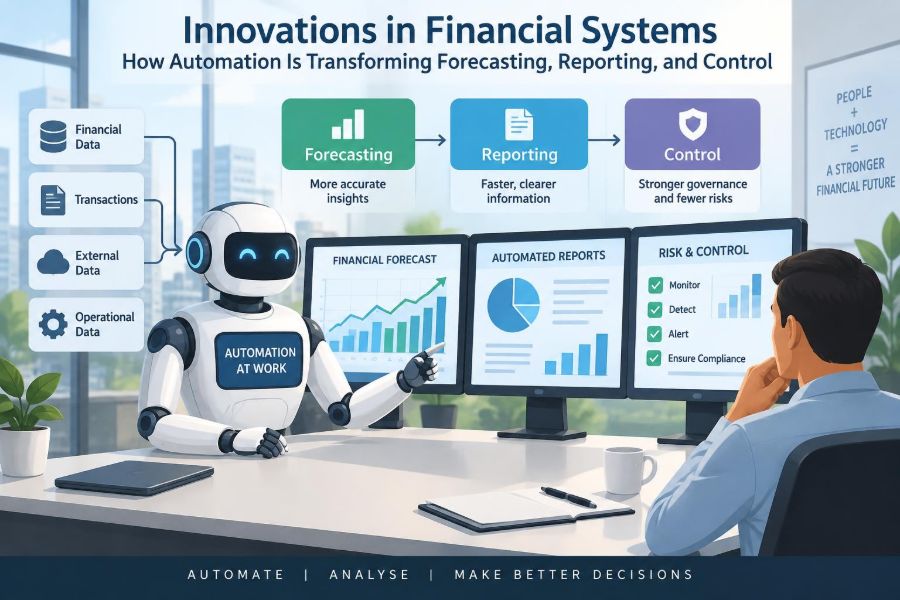
Forecasting becomes more responsive when operational drivers and actual results flow reliably into models. Reporting becomes more useful when teams spend less time compiling and more time explaining. Control becomes stronger when risks are monitored continuously and exceptions are owned.
The purpose of finance automation is not simply speed; it is dependable information that enables better decisions with clear accountability.
When process design, data governance, controls, and professional judgment advance together, automation becomes an engineering discipline for financial confidence—not just a faster way to process transactions. 💰⚙️📈