
A business can report a healthy profit and still struggle to pay suppliers, replace equipment, or reduce debt. That may seem contradictory at first: if the income statement says the company earned money, where did the cash go?
The answer often lies in the gap between accounting profit and the cash actually produced by operations. Revenue can be recorded before a customer pays. Expenses can be recognized before or after cash moves. Large investments may barely affect current profit while consuming substantial cash.
For students, this distinction turns the cash flow statement from a confusing appendix into a practical decision-making tool. For professionals, it helps explain why lenders, investors, managers, and business owners look beyond net income.
Free cash flow is not a perfect verdict on a company. But used carefully, it reveals whether a business is generating cash after funding the assets needed to keep operating and grow.
💡 The Basic Idea Behind Free Cash Flow
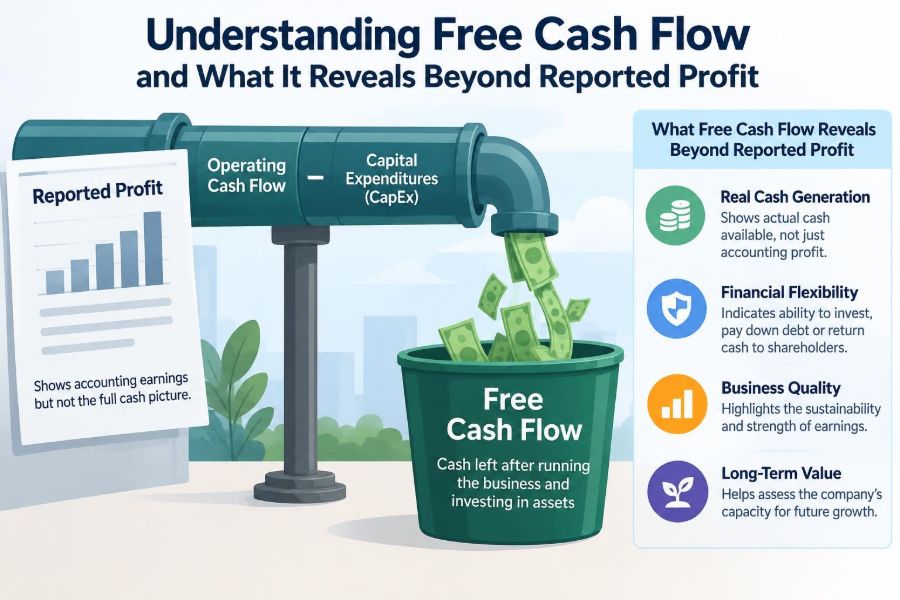
Free cash flow, often abbreviated as FCF, is the cash a business has left after paying for operating needs and capital investment. In its most common form, it starts with cash generated from operations and subtracts capital expenditures.
The basic calculation is:
Free Cash Flow = Cash Flow from Operations − Capital ExpendituresCash flow from operations comes from the operating activities section of the statement of cash flows. Capital expenditures, or capex, are cash investments in long-lived assets such as machinery, vehicles, buildings, technology infrastructure, or production equipment.
📊 Why Reported Profit Is Not the Same as Cash
Profit is usually calculated under accrual accounting. Under this system, a company records revenue when it earns it and expenses when it incurs them, rather than only when cash changes hands.
Suppose a consulting firm completes a project in December and invoices the customer for $100,000. It may report the revenue in December even if the customer pays in February. Profit rises immediately, but the cash has not yet arrived.
This timing difference is not automatically a problem. It becomes a concern when unpaid customer balances keep growing, cash collection slows, or reported earnings repeatedly fail to translate into operating cash flow.
🧾 Where Free Cash Flow Appears in Financial Analysis
Unlike net income, free cash flow is not a single standardized line item under generally accepted accounting principles or IFRS. Companies and analysts may define it differently, so the calculation should always be checked.
A commonly used approach is operating cash flow minus capex. Some analysts adjust further for asset-sale proceeds, lease payments, acquisitions, restructuring cash costs, or other factors. Those adjustments can be useful, but they can also make comparisons less reliable.
A sound habit is to begin with the unadjusted cash flow statement, then clearly label every additional adjustment and explain why it was made.
🔄 Following the Cash Conversion Path
A business creates free cash flow through a sequence: it sells goods or services, collects from customers, pays employees and suppliers, pays taxes and interest where applicable, and invests in the assets required to continue operating.
Profit measures performance across that sequence using accounting rules. Free cash flow asks a more immediate question: after the necessary cash commitments, is cash actually left over?
That makes FCF especially useful in businesses where invoices, inventory, and large equipment purchases create meaningful timing differences.
🏭 Understanding Capital Expenditures
Capital expenditures are purchases that create benefits over multiple periods. A manufacturer buying a new production line or a delivery company acquiring vehicles does not normally expense the full purchase immediately in profit.
Instead, accounting spreads the cost over the asset’s useful life through depreciation. The cash, however, is often paid upfront or through financing at the time of purchase. This is one reason a profitable company can have weak free cash flow in a given year.
Capex can include both maintenance capex, needed to sustain current operations, and growth capex, intended to expand capacity or enter new markets.
🛠️ Maintenance Capex Versus Growth Capex
The distinction between maintenance and growth investment matters because not every capital expenditure has the same economic meaning. Replacing worn-out machinery may simply preserve current output. Building a second factory may support future growth.
Financial statements rarely divide capex neatly into these categories. Management commentary, capital plans, and industry knowledge may help, but estimates remain uncertain.
A company with low free cash flow because it is investing in a promising expansion may be in a different position from one with low free cash flow because old assets constantly require replacement.
📦 Working Capital Can Move Cash Dramatically
Working capital generally refers to short-term operating assets and liabilities, including receivables, inventory, payables, and accrued expenses. Changes in these balances can cause operating cash flow to differ sharply from net income.
If inventory rises, cash is typically tied up in goods that have not yet been sold. If accounts receivable rise, sales may have been recorded but not collected. If accounts payable rise, the company may be delaying cash payments to suppliers.
These movements are often normal. The key is to understand whether they reflect a sustainable operating pattern or a growing strain on cash.
⏱️ Receivables Show Whether Sales Are Being Collected
Accounts receivable represent amounts customers owe. A growing receivables balance can accompany healthy sales growth, especially when a company extends credit to new customers.
But receivables growing much faster than revenue deserve investigation. Possible explanations include slower collections, less creditworthy customers, disputes over invoices, or revenue recorded near period-end before cash is likely to arrive.
Comparing revenue growth, receivable growth, and operating cash flow over several periods gives a more useful picture than judging one balance in isolation.
📚 Inventory Can Be an Asset and a Cash Burden
Inventory is necessary for many retailers, wholesalers, and manufacturers. Yet every additional unit on a shelf or in a warehouse represents cash that cannot be used elsewhere until the item is sold.
Inventory may increase because management expects demand, prepares for supply disruptions, or launches new products. It may also increase because goods are selling more slowly than planned.
For inventory-heavy businesses, free cash flow can decline even while profit looks stable. Analysts should ask whether inventory will convert into sales at acceptable margins rather than treating all inventory growth as either good or bad.
🤝 Payables Can Temporarily Support Cash Flow
Accounts payable are amounts owed to suppliers. When payables increase, a company has received goods or services without yet paying cash, which can temporarily lift operating cash flow.
This is not necessarily manipulation; normal supplier credit is part of commerce. However, an unusually large or repeated increase in payables may indicate that the company is conserving cash by paying suppliers more slowly.
Strong free cash flow driven mainly by delayed payments is less reassuring than free cash flow driven by durable collections and operating margins.
🧮 A Simple Hypothetical Calculation
Consider a hypothetical business with $500,000 in cash flow from operations. During the same year, it spends $180,000 on equipment and software that will support the business for several years.
Free Cash Flow = $500,000 − $180,000 = $320,000The business produced $320,000 of free cash flow under the basic definition. That amount could potentially support debt repayment, dividends, share repurchases, acquisitions, cash reserves, or future investment.
It does not mean every dollar is legally available for distribution. Debt agreements, taxes, seasonal cash needs, and management decisions may limit how much can actually be used.
📈 Why Positive Free Cash Flow Is Usually Attractive
Consistent positive free cash flow gives a business choices. It may reduce borrowing, fund product development, withstand a downturn, acquire another business, or return capital to owners without relying entirely on new financing.
It also reduces dependence on external capital markets. When credit is expensive or investors are cautious, internally generated cash becomes particularly valuable.
Still, positive FCF is not automatically evidence of a strong long-term business. A company can produce cash by cutting investment too deeply, selling working capital down temporarily, or delaying essential spending.
📉 When Negative Free Cash Flow Can Be Sensible
Negative free cash flow means operating cash flow was not enough to cover capital expenditures during the period. That result can be entirely reasonable for a growing company, a utility upgrading infrastructure, or a manufacturer adding capacity.
The more useful question is what the spending is expected to accomplish. Is the investment likely to produce future cash inflows? Can the company finance the gap safely? Does management have a credible path to sustainable cash generation?
Negative FCF becomes more concerning when it persists without clear operational progress, when debt rises rapidly, or when the business repeatedly needs emergency financing.
🏗️ Capital-Intensive Industries Need Different Expectations
Airlines, utilities, telecommunications networks, transportation businesses, manufacturers, and energy companies often require substantial ongoing investment in physical or network assets. Their FCF can be volatile because capex is large and sometimes cyclical.
Software or advisory businesses may need less physical investment, but they can still consume cash through customer acquisition, product development, or working-capital needs. Comparing raw FCF across unrelated industries can therefore mislead.
A better comparison uses peers with similar economics, investment cycles, and revenue models.
🧠 Free Cash Flow to the Firm and to Equity
Analysts may use more specialized versions of FCF depending on the question being answered. Free cash flow to the firm (FCFF) represents cash available to all providers of capital, including debt holders and shareholders, before certain financing cash flows.
Free cash flow to equity (FCFE) focuses on cash available to common shareholders after debt-related flows. These measures are frequently used in valuation models.
The formulas can involve earnings, non-cash charges, working-capital changes, capex, interest, and borrowing. Because conventions vary, it is essential to keep the definition consistent with the valuation method being used.
🔍 Reading the Statement of Cash Flows First
The statement of cash flows has three broad sections: operating, investing, and financing activities. Free cash flow usually draws primarily from operating cash flow and investing cash outflows for capital assets.
Start by locating cash flow from operations. Then identify purchases of property, plant, equipment, and sometimes capitalized software or other long-lived operating assets. Descriptions differ by company, so notes to the accounts may be needed.
Do not simply subtract every investing outflow. Acquisitions and marketable securities purchases may be strategically relevant, but they are not always included in a basic FCF calculation.
🧱 Depreciation Explains Part of the Difference
Depreciation reduces accounting profit because it allocates an asset’s historical cost over time. Yet depreciation is generally a non-cash expense in the current period; the cash purchase occurred when the asset was acquired.
Under the indirect method of presenting operating cash flows, depreciation is added back to net income. This does not make depreciation economically unimportant. Assets still wear out and eventually need replacement.
The practical insight is that depreciation is not the same thing as current capex. Over long periods, both must be considered when judging a business’s ability to maintain its productive capacity.
🧾 Non-Cash Charges Need Careful Interpretation
Other non-cash items can also widen the gap between profit and operating cash flow. Examples may include impairment charges, stock-based compensation, deferred tax movements, and unrealized gains or losses.
Adding back a non-cash expense in the cash flow statement is mechanically appropriate, but it does not erase its economic significance. Stock-based compensation, for example, may not require current cash, yet it can dilute existing shareholders.
Read the nature of each adjustment rather than assuming all add-backs represent extra value.
⚖️ Free Cash Flow Margin Adds Context
A free cash flow margin compares FCF with revenue:
Free Cash Flow Margin = Free Cash Flow ÷ RevenueThis ratio helps show how much of each sales dollar becomes free cash after operating needs and investment. It can be useful for comparing periods within the same company or similar companies in the same industry.
A rising margin may indicate improved collections, profitability, or lower investment needs. It may also reflect temporarily reduced capex, so the underlying drivers matter more than the ratio alone.
📏 Conversion From Net Income to Cash
Comparing operating cash flow or FCF with net income is often called assessing cash conversion. A company whose earnings regularly turn into operating cash may have more dependable underlying economics than one whose earnings do not.
There is no universal “good” conversion percentage. Seasonal businesses, rapidly growing businesses, and capital-intensive businesses can all show different patterns.
Look for explanations that fit the business model. A one-year mismatch may be timing; a multi-year mismatch without a clear explanation can be a warning sign.
🚩 Warning Signs Hidden Behind Profit Growth
Profit growth deserves more scrutiny when cash flow trends point in the opposite direction. No single item proves a problem, but several signals together can justify deeper review.
- Receivables rising persistently faster than revenue.
- Inventory increasing without a convincing sales rationale.
- Operating cash flow relying heavily on growing payables.
- Repeated “one-time” adjustments that exclude real cash costs.
- Large capex requirements that management does not explain clearly.
The objective is not to assume misconduct. It is to test whether reported earnings are supported by cash economics.
🧭 Look at Trends Rather Than One Period
Free cash flow can swing because of seasonality, a major equipment purchase, tax timing, or a large customer payment received just after year-end. A single quarter or year can therefore give a distorted impression.
Review several periods and place major changes in context. Has the company historically generated cash after investment? Are current outflows part of a stated expansion plan? Did working capital reverse in the following period?
Trend analysis is especially valuable because it separates recurring operating performance from timing noise.
🗓️ Seasonality Can Mislead Quarterly Analysis
Retailers may build inventory before holiday periods. Construction firms may experience uneven billing and collections. Subscription businesses may collect cash before recognizing all related revenue.
These normal patterns can make quarterly FCF look unusually strong or weak. Comparing the same quarter across years, as well as using trailing twelve-month figures, often provides a more balanced view.
When cash flow is seasonal, a full-year assessment is generally more informative than an isolated quarter.
💳 Debt Changes the Meaning of Available Cash
A company can have positive FCF and still face financial pressure if interest payments, debt maturities, or required principal repayments are substantial. Free cash flow is a useful starting point, not a complete measure of solvency.
Review the balance sheet alongside cash flow. Consider debt levels, repayment schedules, interest coverage, available liquidity, and any restrictions in borrowing agreements.
Likewise, negative FCF can be manageable when a company has conservative leverage and long-term funding for productive investment.
🎯 Management Allocation Is the Next Question
Once a business generates free cash flow, management must decide how to use it. Common options include reinvesting in operations, repaying debt, building cash reserves, paying dividends, repurchasing shares, or making acquisitions.
There is no universally best choice. A high-return internal project may deserve funding before a dividend increase. In another situation, reducing expensive debt may be the most prudent use of cash.
Evaluate allocation against the company’s opportunities, risks, balance-sheet position, and record of execution.
🔢 Free Cash Flow in Business Valuation
FCF is central to discounted cash flow valuation because a business is ultimately valuable for the cash it can generate for capital providers over time. Analysts forecast future free cash flows and discount them to reflect time and risk.
However, valuation results are highly sensitive to assumptions about growth, margins, tax, working capital, capital spending, discount rates, and terminal value. A precise-looking output can conceal uncertain inputs.
FCF-based valuation is most useful when assumptions are transparent, internally consistent, and tested through alternative scenarios.
🧪 A Practical Review Process
When reviewing a company, use a repeatable process rather than jumping straight to one headline number.
- Read the income statement to understand revenue, margins, and net income.
- Reconcile net income to operating cash flow on the cash flow statement.
- Identify major working-capital movements and non-cash adjustments.
- Identify capex and distinguish, where possible, maintenance needs from expansion.
- Calculate FCF consistently over several periods.
- Compare results with relevant peers and the company’s own strategy.
- Review debt, liquidity, and management’s use of available cash.
This sequence helps prevent the common mistake of treating FCF as a standalone score.
🧰 Common Calculation Mistakes
One common mistake is subtracting depreciation instead of capex. Depreciation is an accounting expense; capex is a cash investment. Another is treating all investing cash flows as capex without checking their nature.
Analysts also sometimes use a company-adjusted FCF measure without reading the reconciliation. Excluded costs may be unusual, but they may also be recurring features of the business.
Finally, avoid mixing annual operating cash flow with quarterly capex or comparing companies that use materially different definitions.
🗣️ Questions to Ask Management or Yourself
Whether you are an investor, manager, lender, or student analyzing a case, focused questions improve interpretation:
- What explains the difference between net income and operating cash flow?
- Are receivables, inventory, and payables changing in line with sales?
- How much capex is required just to sustain current operations?
- What return is expected from growth investment?
- How will debt obligations affect the cash available for other purposes?
- Which parts of the FCF calculation are estimates or management-defined adjustments?
Clear answers do not eliminate uncertainty, but vague answers often reveal where further work is needed.
🧩 The Core Principle: Cash Supports Economic Reality
Reported profit remains essential. It measures performance under a structured accounting system and captures expenses such as depreciation that should not be ignored simply because they are non-cash today.
Free cash flow adds another perspective: whether operations are producing cash after the investment needed to sustain and develop the business. Neither measure should replace the other.
The strongest analysis connects the income statement, balance sheet, and cash flow statement. It asks whether earnings are collectible, whether investment is adequate and productive, and whether the company can meet its obligations while pursuing its strategy.
Free cash flow is most revealing when it is treated as evidence to investigate, not a shortcut to a final judgment.
A profitable business needs cash discipline, and a cash-consuming business may still be building future capacity. Reading both sides of that story is what turns financial statements into useful insight. 💰📊🔍