
A manager is considering opening a second location. Sales look promising, but the lease is expensive, hiring will take time, and a small delay in permits could change the first-year result completely.
Another team is debating whether to cut prices, buy automated equipment, or bring a service in-house. Each proposal arrives with a forecast, often summarized in one neat number: expected profit.
That number can be useful, but it can also create false confidence. Business decisions are rarely driven by one fixed future; they are shaped by demand, timing, costs, capacity, financing, and events no spreadsheet can fully know in advance.
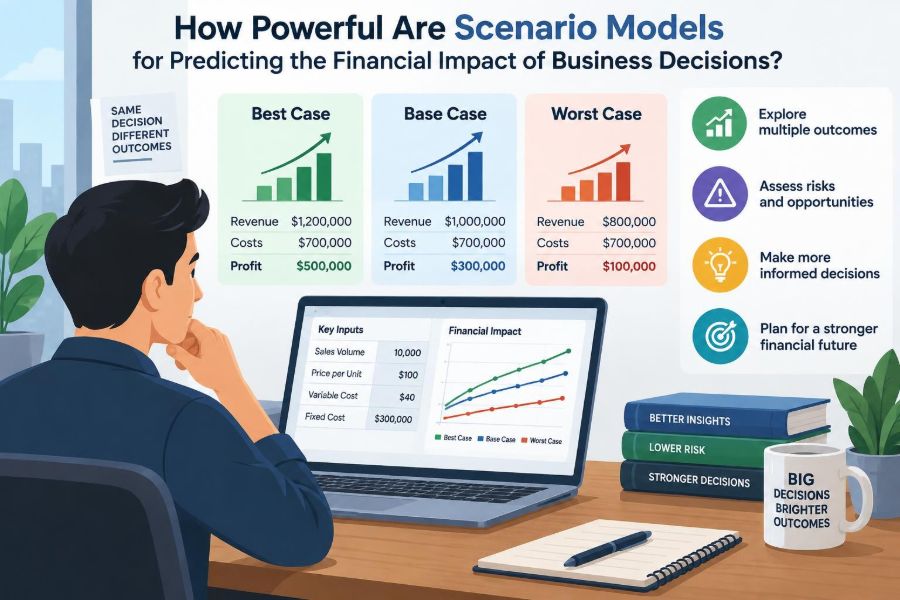
Scenario models help decision-makers examine several plausible futures before committing resources. Used well, they do not predict the future with certainty. They make uncertainty visible, test the resilience of a decision, and improve the questions a business asks.
🧭 What a Scenario Model Actually Does
A scenario model is a financial model that calculates outcomes under different sets of assumptions. Instead of asking, “What will happen?” it asks, “What would the financial result look like if these conditions occurred?”
For example, a new product launch model might combine unit sales, selling price, variable cost, payroll, marketing spend, and working-capital needs. A base scenario could assume a steady launch, while other scenarios test weaker demand or higher input costs.
The output may include revenue, gross margin, operating profit, cash flow, break-even timing, debt capacity, or return on investment. The model is a structured reasoning tool, not a crystal ball.
🔍 Why One Forecast Is Rarely Enough
A single forecast usually embeds one view of the future. It may be internally consistent, yet it hides the fact that many inputs could move in more than one direction.
Consider a retailer forecasting a holiday campaign. Revenue depends not only on customer demand but also on inventory availability, competitor pricing, delivery performance, returns, and the timing of advertising. Treating all of those as fixed makes the forecast look more precise than it is.
Scenario analysis broadens the conversation from “Is the forecast right?” to “What would make it wrong, and what happens then?”
🧱 The Building Blocks of a Useful Model
Every scenario model needs a clear financial structure before assumptions are changed. Starting with scenarios before building the core logic often produces a collection of disconnected guesses.
- Operational drivers: units sold, customers served, labor hours, production volume, or utilization.
- Revenue logic: prices, contract terms, discounts, mix, and collection timing.
- Cost logic: variable inputs, fixed overhead, staffing, commissions, and depreciation.
- Cash logic: payment terms, inventory, capital expenditure, taxes, and financing.
- Decision outputs: profit, cash balance, covenant headroom, payback period, or return measures.
When these pieces connect logically, a change in sales volume can flow through revenue, inventory, receivables, costs, and cash rather than affecting only one line.
🎯 Define the Decision Before Building the Spreadsheet
The strongest models begin with a specific decision. “Should we grow?” is too broad. “Should we add a production line next quarter or defer it for six months?” is decision-ready.
A precise question defines the time horizon, choices, constraints, and relevant measures of success. It also prevents analysts from building elaborate calculations that never affect an actual choice.
Before modeling, write down the decision owner, alternatives, deadline, and irreversible commitments. These details determine which risks deserve attention.
📌 Start With a Defensible Base Case
The base case is the central planning view, not necessarily the most optimistic or most cautious outcome. It should reflect assumptions management considers reasonably likely given current information.
For a subscription business, the base case might use recent customer acquisition trends, expected churn, contracted price changes, and known hiring plans. It should not quietly assume a major new partnership that has not been approved.
Documenting the source and rationale for each major input matters. A transparent base case can be challenged and updated; an unexplained one cannot.
🌤️ Use Scenarios, Not Just Optimism and Pessimism
Many models use “best,” “base,” and “worst” cases. That is a useful start, but those labels can encourage vague thinking. A meaningful scenario describes a coherent operating situation.
For instance, a downside case may reflect slower customer adoption, a longer sales cycle, and reduced utilization of fixed assets. Those assumptions belong together because they could arise from the same market conditions.
An upside case should also have a mechanism, such as faster adoption after a successful pilot or improved mix from a premium product. It should not simply raise every favorable input at once.
🔗 Preserve Relationships Between Assumptions
Inputs are often correlated: they move together because they share a cause. In a weak demand environment, sales volume may fall while discounting rises and receivable collections slow. Modeling only lower volume can understate the cash impact.
Likewise, strong demand can increase revenue but strain capacity, require overtime, accelerate inventory purchases, or produce service failures. More sales are not automatically more profitable or more cash-generative.
Scenario design is therefore about relationships, not merely selecting different numbers in separate cells.
🧪 Distinguish Scenario Analysis From Sensitivity Analysis
Scenario analysis changes a bundle of linked assumptions to represent a possible business environment. Sensitivity analysis changes one key variable at a time to show how strongly the result responds.
Both are valuable, but they answer different questions.
| Method | Typical question | Example |
|---|---|---|
| Scenario analysis | What if the market enters a slow-growth period? | Lower volume, more discounting, slower collections, delayed hiring |
| Sensitivity analysis | How much does profit change if volume is 10% lower? | Change unit sales while holding other inputs constant |
| Break-even analysis | What minimum level is required? | Find sales volume needed to cover fixed costs |
Sensitivities identify important levers. Scenarios show how several levers may interact in reality.
📈 Understand Operating Leverage
Operating leverage describes how fixed costs can magnify changes in profit. A business with substantial fixed rent, salaries, equipment, or platform costs may experience a large profit swing from a relatively modest sales change.
Imagine a factory with unused capacity. Additional units may contribute strongly to profit once fixed costs are covered. But if volume falls below a critical level, those fixed costs remain and margins can deteriorate quickly.
A scenario model makes this visible by separating variable costs from fixed commitments. That distinction is essential when evaluating expansion, pricing, or capacity decisions.
💵 Profit Is Not the Same as Cash
A proposal can look profitable on an income statement while creating a cash problem. Growth often requires inventory purchases, upfront marketing, deposits, equipment spending, or longer credit terms before customer cash arrives.
A hypothetical wholesaler may increase sales after winning a large contract. If customers pay in 60 days but suppliers require payment in 30 days, the company must finance the gap. The income statement may improve while the bank balance declines.
For decisions involving growth, always model the cash conversion cycle: the time between paying for resources and collecting cash from customers.
🧾 Include Working Capital Explicitly
Working capital generally includes operating current assets and liabilities, such as receivables, inventory, payables, and accrued expenses. Changes in these balances can materially affect funding needs.
A practical model may tie receivables to revenue and collection days, inventory to cost of sales and stock coverage, and payables to purchases and supplier terms. The exact method can be simple, provided it reflects how the business operates.
Ignoring working capital is particularly risky in seasonal businesses, project-based companies, and fast-growing firms, where timing differences can be large.
🏗️ Treat Capital Expenditure Differently From Operating Costs
Capital expenditure is spending on long-lived assets such as machinery, software implementation, vehicles, or facility improvements. It affects cash immediately, even though accounting expense may be recognized over time through depreciation or amortization.
This timing difference matters when comparing alternatives. Buying equipment may improve long-term margins but require a significant upfront cash outflow. Leasing may spread cash payments but create ongoing commitments.
A decision model should show both the accounting view and the cash view so that leaders do not mistake lower reported expense for lower near-term cash demand.
⏱️ Timing Can Matter More Than the Annual Total
Annual revenue and expense totals may hide a serious monthly liquidity issue. A business can be profitable for the year yet run short of cash in a specific month because payroll, inventory, debt payments, and tax obligations occur before collections.
Monthly or weekly modeling is especially useful for launches, construction projects, seasonal trading, and turnaround situations. The appropriate frequency depends on the decision, not on a universal rule.
When timing is uncertain, scenarios can test delayed openings, phased hiring, slow implementation, or late customer payments.
🪜 Model a Decision as a Sequence of Commitments
Not every decision must be treated as an all-or-nothing bet. A model can represent stages: research, pilot, limited rollout, and full deployment.
Each stage may require funding and reveal new information. If a pilot produces weak retention or poor unit economics, management may pause before taking on the full cost of expansion.
This approach is sometimes called preserving optionality: keeping the ability to adjust as evidence improves. It may reduce upside compared with an immediate large rollout, but it can limit exposure to an unfavorable outcome.
🚦 Focus on the Assumptions That Can Change the Decision
Not every input deserves equal effort. An analyst should identify the decision-critical assumptions: uncertainties that could cause management to choose a different path.
For a new service, demand volume, price realization, labor utilization, and launch timing may matter far more than a small office-supply expense. Sensitivity analysis can help reveal this by ranking which variables move cash flow or return most sharply.
Concentrating on material drivers improves both speed and quality. It is better to understand four uncertain assumptions deeply than to pretend that forty minor assumptions are precise.
🗣️ Turn Assumptions Into Questions for the Business
Models improve when finance does not invent operational assumptions alone. Each uncertain input should become a question for the people closest to the work.
- Sales teams can explain pipeline quality, conversion timing, and discount pressure.
- Operations teams can identify capacity limits, yield, supplier constraints, and implementation lead times.
- Human resources can clarify hiring availability, onboarding time, and compensation commitments.
- Commercial and legal teams can explain contract conditions, termination rights, and customer payment terms.
This process does more than collect data. It exposes where an apparent forecast rests on an untested belief.
🧮 Use Transparent Formula Logic
A model should allow a reviewer to trace a result back to assumptions and formulas. Hard-coded outputs, hidden overrides, and unexplained adjustments make scenario results difficult to trust.
Clear separation helps: inputs in one area, calculations in another, and outputs in a summary view. Labels should state units and periods, such as dollars per month, units per quarter, or days outstanding.
Good structure is not merely a spreadsheet preference. It reduces the risk that a seemingly small change produces an unintended financial result.
✅ Build Checks Into the Model
Financial models can contain formula errors, broken links, sign mistakes, and inconsistent timing. A scenario model should include simple checks that make these problems visible.
Useful checks include whether the balance sheet balances, cash flow reconciles to changes in cash, beginning balances match prior ending balances, and scenario selections are applied consistently.
Also test common-sense behavior. If selling price rises, does revenue increase? If payment terms lengthen, does cash collection slow? Logic checks catch errors that arithmetic checks may miss.
📊 Present Ranges and Thresholds, Not Just Outputs
Decision-makers usually need more than three profit figures. They need to see what conditions make a proposal acceptable, difficult, or unacceptable.
Useful outputs might include the minimum monthly sales needed to avoid a cash deficit, the latest permissible launch date, the maximum cost increase the project can absorb, or the point at which debt headroom becomes too narrow.
Thresholds translate financial analysis into operating action. They tell management what to monitor after the decision is made.
🛑 Recognize the Limits of Historical Data
Past performance is often a sensible starting point, but it may not represent the future decision. A new market, changed pricing model, unusual competitor action, or capacity expansion can make historical averages misleading.
Historical data also contains unusual periods. A temporary supply disruption or one large customer order should not automatically become the planning norm.
Use history to inform assumptions, then explain where the proposed situation differs. Scenario models are most honest when they state what data can and cannot support.
🌪️ Consider External Risks Without Pretending to Forecast Them
Interest rates, exchange rates, commodity prices, regulation, supplier disruption, and economic conditions may affect a decision. The model does not need to forecast each event precisely to be useful.
Instead, it can test exposures. A manufacturer importing components might model a range of purchase costs or exchange-rate outcomes. A borrower might test higher financing costs at refinancing.
The objective is preparedness: understanding which events would materially change the financial case and what response options exist.
🧯 Avoid the False Precision Trap
Long decimal places, complex formulas, and polished charts can make an estimate look certain. They do not make uncertain inputs reliable.
If demand assumptions are based on early conversations rather than signed orders, the presentation should say so. If timing depends on an approval outside the company’s control, show a range rather than a single exact date.
Precision in calculation is valuable; false precision in assumptions is dangerous. The model should communicate the difference.
⚠️ Common Scenario Modeling Mistakes
Several errors repeatedly weaken otherwise capable analysis:
- Using an upside case that assumes every favorable event happens together.
- Changing revenue assumptions without changing capacity, working capital, or variable costs.
- Calling a scenario “downside” without explaining its operational story.
- Measuring only annual profit and overlooking monthly cash needs.
- Leaving assumptions undocumented, so no one can review or update them.
- Presenting outputs without a recommended action or monitoring plan.
These mistakes do not mean scenario modeling is ineffective. They show why model design and business judgment must work together.
🧠 Separate Forecasting From Decision Support
A forecast usually aims to estimate what management currently expects to happen. A decision-support model evaluates choices, trade-offs, and consequences if assumptions differ.
The two may share data, but they should not be confused. A decision model can reasonably include an unfavorable but plausible case even if it is not the official forecast.
This distinction protects candor. Teams can discuss risk without appearing to reject the organization’s planning view.
🤝 Use Scenarios to Improve Cross-Functional Decisions
Scenario models work best as a shared language between finance and operating teams. Sales may see opportunity, operations may see capacity strain, and finance may see a funding gap. The model helps connect those perspectives.
A useful review asks: What must be true for this plan to work? What signals would tell us early that the assumptions are failing? Who owns each response?
That conversation is often as valuable as the final spreadsheet because it turns a financial projection into an operating plan.
🔄 Update the Model as Evidence Arrives
A model should not disappear after approval. Actual volumes, conversion rates, project milestones, costs, and cash collections provide evidence about whether the original assumptions remain suitable.
Regular updates can compare actual results with the base case and relevant scenarios. Significant variances should trigger investigation: was the assumption wrong, did execution differ, or did conditions change?
Updating is not an admission that the original model failed. It is how a model remains useful in a changing business environment.
📏 Choose Metrics That Match the Decision
No single metric can evaluate every business decision. Operating profit may suit a pricing decision, while cash runway may be central to an early-stage investment. A long-lived asset purchase may require payback, net present value, or internal rate of return analysis alongside liquidity measures.
Net present value estimates the value today of expected future cash flows after discounting them for the time value of money and a chosen required return. Its result depends heavily on the quality of expected cash flows and the discount-rate assumption.
Use metrics as complementary lenses. A project with an attractive long-term return may still be unsuitable if it creates a near-term cash risk the business cannot finance.
🧩 A Practical Workflow for Building Scenarios
A disciplined process can remain simple:
- State the decision, alternatives, time horizon, and success measures.
- Build a transparent base-case operating and financial model.
- Identify the few uncertainties that could change the decision.
- Create coherent scenarios with linked operational assumptions.
- Test cash timing, capacity, funding, and key thresholds.
- Review assumptions with relevant business owners.
- Document the recommendation, risks, triggers, and next actions.
For a small business, this may fit in a carefully designed spreadsheet. For a larger organization, it may connect to planning systems and detailed operational data. The principle is the same.
🏁 The Core Principle: Test Resilience, Not Certainty
The real power of scenario modeling is not that it delivers a perfect financial prediction. No model can remove uncertainty, especially when a decision depends on customer behavior, competitive actions, execution quality, or external conditions.
Its power is to reveal how a decision behaves across plausible conditions. Does it still protect cash in a slower launch? Does it require an unacceptable level of demand to break even? Which assumptions deserve monitoring, and where can management act early?
A strong scenario model combines sound financial mechanics with honest assumptions, coherent stories, and clear decision thresholds. It gives leaders a better basis for choosing, adapting, and explaining why a course of action is worth taking.
Scenario models are most powerful when they turn uncertainty from a hidden weakness in a forecast into a visible, manageable part of the decision. That is better financial thinking—and better business preparation. 💰📊🧭