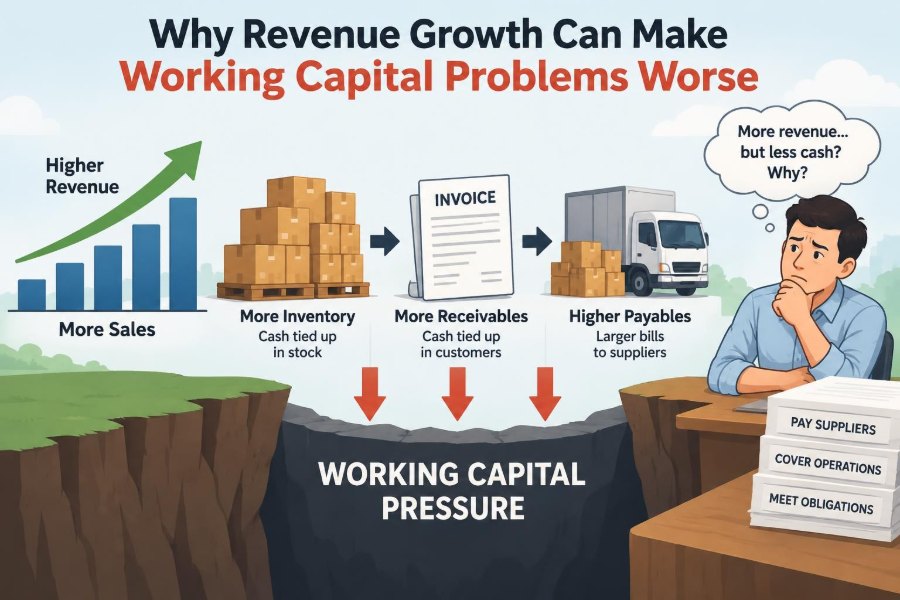

A business lands a major customer, sales forecasts rise, and the team celebrates. Yet a few months later, the finance manager is delaying supplier payments, the bank balance is tight, and payroll feels uncomfortably close.
This is not necessarily a sign that the new sales were unprofitable. It is often a sign that the business grew faster than cash could move through its operating cycle.
Revenue appears in the income statement when it is earned under the applicable accounting rules. Cash appears in the bank only when customers actually pay. Between those two moments, growing businesses can accumulate receivables, inventory, and commitments that demand funding.
Understanding this gap is essential for students, managers, founders, and accountants. Growth can create value over time while creating a cash problem right now.
📦 The apparent contradiction
Revenue growth is usually good news: it can improve market position, spread fixed costs, and create opportunities for profit. But it also commonly requires the company to buy more materials, carry more stock, hire more people, and extend more credit before it collects from customers.
That means the cash cost of growth often arrives before the cash benefit. A company can be busy, profitable on paper, and short of money at the same time.
🧭 Start with working capital
Working capital is the difference between current assets and current liabilities. Current assets include cash, trade receivables, and inventory expected to turn into cash or be used within the normal operating period. Current liabilities include obligations due soon, such as trade payables, accrued expenses, and short-term debt.
A basic calculation is:
Working capital = Current assets − Current liabilities
The number is a useful starting point, but it does not tell the whole story. A positive balance can still contain slow-moving inventory or overdue receivables that cannot meet tomorrow’s payment.
💵 Profit and cash are different measures
Profit measures performance over a period after matching revenue with related expenses. Cash flow measures money entering and leaving the business. Accrual accounting deliberately separates these concepts so that a sale is not ignored merely because the customer will pay later.
Suppose a company delivers equipment for $100,000 on 60-day credit. It may record revenue and profit today, but it has no customer cash from that sale until collection. If it already paid suppliers and staff, the gap must be financed somehow.
🔄 The operating cycle explains the pressure
The operating cycle follows cash from purchase to collection. A manufacturer may pay for components, hold work in progress, finish goods, sell them on credit, and wait for customers to pay. A retailer may pay for inventory well before the item is sold.
Growth enlarges each stage unless the company improves its terms or speed. More sales can therefore mean more money trapped in normal operations.
⏱️ Cash conversion cycle in plain language
The cash conversion cycle estimates how long the company’s cash is committed to operating activity. It combines the time inventory is held and receivables remain unpaid, then subtracts the time the company can wait before paying suppliers.
Cash conversion cycle = Inventory days + Receivable days − Payable days
A shorter cycle generally means cash returns sooner. It is not automatically best to minimize every component, however: very low inventory can cause stockouts, and overly aggressive supplier terms can damage supply relationships.
📈 Why a larger sales base needs more funding
Consider a hypothetical wholesaler that doubles monthly sales. If customers continue to pay 45 days after invoice, receivables will tend to rise with sales. If the business must stock enough goods to support those orders, inventory will rise too.
Supplier credit may rise as well, but often not by the same amount or at the same speed. The difference is the additional operating investment that growth demands.
🧾 Credit sales create receivables
A trade receivable is an asset because the customer owes money. It is not cash. When a sales team wins larger orders by offering 60- or 90-day terms, it may improve reported revenue while increasing the amount the company must fund.
Credit should be viewed as part of the commercial offer, not as an invisible administrative detail. The price, payment terms, customer quality, dispute process, and collection effort all affect the real economics of a sale.
🏭 Inventory absorbs cash before revenue arrives
Inventory is often the first major cash requirement in a growing product business. Forecast demand rises, purchasing places larger orders, and cash leaves before a customer has bought the finished goods.
Long lead times amplify the effect. A business that must order seasonal products months ahead can face a severe funding need even when its sales forecast is sensible.
🧱 Work in progress can be especially demanding
Manufacturers, construction firms, and project businesses may hold work in progress: labor, materials, and overhead invested in partly completed work. This balance can grow quickly when projects are larger or when approvals and milestones are delayed.
It is risky to assume that recorded project revenue equals available cash. Contract terms, billable milestones, retention clauses, change-order approval, and customer acceptance can all determine when cash is actually collectible.
🤝 Supplier terms do not always scale with sales
Trade payables provide short-term financing because suppliers are paid after goods or services are received. But suppliers may demand deposits from a young business, impose credit limits, shorten terms when orders rise, or require quicker payment during periods of uncertainty.
A company cannot safely assume it can fund unlimited growth by simply paying suppliers later. That approach can lead to supply interruptions, lost early-payment discounts, or a damaged reputation.
🚚 Faster growth can expose supply-chain timing gaps
Imagine a distributor receiving a large order for goods that must be imported. It may pay a deposit, freight, duties, and local handling before invoicing the buyer. Even if the buyer is reliable, the cash gap can span several months.
This is why operational details matter to finance. Shipping delays, customs holds, minimum order quantities, and supplier production schedules can alter working-capital needs without changing the sales forecast.
👥 Payroll keeps running
Employees, rent, utilities, sales commissions, and software subscriptions often require payment on fixed schedules. Those outflows do not wait for a customer’s accounts-payable process to finish.
Growth frequently requires hiring before revenue has been collected. A new sales team, warehouse shift, or implementation group may be necessary to serve demand, but it increases the near-term cash burn.
🧮 A simple growth example
Assume a hypothetical business increases annual credit sales from $1.2 million to $1.8 million. Its average collection period remains roughly 60 days. The average receivable balance needed to support the higher sales rate will generally increase, even though customers are paying according to agreed terms.
If inventory must also expand and suppliers offer only modest credit, the company may need external cash despite improving gross profit. The problem is not that customers are late; it is that the business has more cash tied up at every point in the cycle.
📊 Growth rate matters, not only sales volume
A stable large company may have predictable working-capital needs because collections, purchases, and payments move at a relatively steady pace. A rapidly growing company is different: each month’s operating balances are being built on a larger base than the month before.
For that reason, a business can cope at 5% growth but strain at 40% growth with the same margins and payment terms. The speed of expansion changes the financing requirement.
🪙 Gross margin does not solve timing by itself
Healthy gross margin helps because each completed sale creates more economic value. But margin is not a substitute for liquidity. A high-margin company can still run out of cash if it collects slowly or has to prepay substantial costs.
Conversely, some low-margin, high-volume businesses operate successfully because they turn inventory quickly, collect immediately, and pay suppliers later. Timing and turnover can be as consequential as margin.
🛒 Business models carry different risks
| Business model | Common working-capital pattern | Growth risk |
|---|---|---|
| Cash retailer | Customers pay at purchase; inventory is the main investment | Stock purchases outrun sales |
| Wholesaler | Inventory plus receivables; supplier terms matter | Large customer orders extend the funding gap |
| Service firm | Lower inventory; payroll and receivables dominate | Staff costs arise before milestone collection |
| Subscription business | Upfront customer billing can support cash flow | Acquisition and delivery costs may precede renewal value |
No model is inherently safe. The useful question is where cash is committed and when it is released.
🧾 Revenue recognition can obscure collection risk
Accounting standards set rules for when revenue is recognized, often based on transfer of control or performance obligations rather than receipt of payment. This improves reporting consistency, but readers must still inspect cash-flow information and receivable balances.
Revenue that is properly recognized can nevertheless be difficult to collect. Disputes, customer financial distress, incomplete documentation, or contractual conditions can make an accounting asset less liquid than expected.
🔍 Watch receivables aging, not only the total
An accounts receivable aging report groups invoices by how long they have been outstanding. A stable total receivable balance may hide a deterioration if a larger share has moved into older categories.
Useful questions include:
- Which customers account for the largest overdue amounts?
- Are invoices delayed by disputes, missing purchase orders, or approval bottlenecks?
- Is sales growth concentrated in customers with weaker payment behavior?
- Are credit notes and returns rising after invoices are issued?
Collection problems are easier to address when identified invoice by invoice rather than after a cash shortfall occurs.
📦 Inventory quality matters as much as quantity
A warehouse can look full while cash is scarce. Some inventory may be obsolete, seasonal, damaged, difficult to sell, or held in the wrong location. Accounting may require write-downs when inventory cannot be recovered at its recorded cost, but the operational cash issue begins earlier.
Segment inventory by velocity, margin, reliability of demand, and replenishment lead time. More stock is not automatically more resilience; it may be an expensive forecast error.
⚖️ The current ratio has limits
The current ratio divides current assets by current liabilities. It is commonly used as a broad liquidity indicator, but it can be misleading when current assets are slow to convert to cash.
A company with cash and highly collectible receivables is in a different position from one with the same ratio built largely from aging inventory. Ratios should prompt investigation, not replace it.
🗓️ Build a rolling cash forecast
A rolling cash forecast estimates expected cash receipts and payments over upcoming weeks or months, then updates as facts change. It should reflect actual invoice due dates, payroll dates, tax obligations, loan payments, purchase commitments, and realistic rather than hopeful collection assumptions.
Short-horizon forecasts are especially useful during fast growth because timing matters. A profitable quarter does not help if a payment gap occurs next Friday.
🧪 Use scenarios instead of one forecast
A single forecast often embeds one quiet assumption: that customers pay, inventory arrives, and sales occur exactly as expected. Scenario planning tests what happens if one or more of those assumptions changes.
Practical scenarios to test
- A major customer pays 30 days late.
- Sales rise but the product mix shifts toward slower-moving items.
- A supplier requires a deposit or reduces the credit limit.
- A large project milestone is delayed or disputed.
The purpose is not to predict every event. It is to identify the point at which the business needs action, financing, or a slower pace of commitment.
🎯 Price the cost of credit into the sale
Long payment terms have a cost: the business finances the customer for longer and takes greater exposure to nonpayment. Pricing, minimum order size, deposits, progress billing, and early-payment incentives can be designed with that cost in mind.
This does not mean every customer should face rigid terms. Strategic accounts may justify tailored arrangements, but exceptions should be deliberate, approved, and visible in the cash forecast.
🛡️ Credit control starts before invoicing
Strong collections are not just about chasing overdue invoices. They begin with customer onboarding: credit checks where appropriate, clear terms, approved credit limits, accurate legal details, purchase-order requirements, and a shared understanding of acceptance criteria.
Invoices should be accurate and sent promptly. Many late payments arise from preventable errors such as incorrect quantities, missing documentation, or invoices sent to the wrong portal.
📐 Align commercial promises with finance capacity
Sales incentives can unintentionally reward revenue without considering cash quality. If representatives are paid solely for booked sales, they may favor extended terms, low deposits, or customers whose credit profile creates disproportionate risk.
Better coordination does not require finance to block growth. It requires commercial teams to understand that a sale has terms, delivery costs, and a collection path—not just a headline value.
🏦 Match funding to the need
Working-capital needs are often short term and fluctuate with activity. Financing should be assessed in light of that pattern. A revolving credit facility, trade-finance arrangement, invoice financing, or seasonal line may fit some businesses better than using long-term funds for every temporary swing.
Each option has costs, covenants, operational requirements, and risks. Invoice financing may release cash from receivables, for example, but it does not eliminate underlying customer-credit risk. Professional advice is appropriate for material financing decisions.
🚫 Do not finance permanent losses as “growth”
Borrowing can bridge a timing gap when the underlying unit economics are sound. It is much less helpful when each additional sale consumes cash because pricing is below full cost, returns are excessive, or customers routinely do not pay.
Separate a temporary investment in receivables and inventory from a structural loss. The first may unwind through collection and turnover; the second can deepen with every new order.
🧯 Avoid the common emergency responses
When cash tightens, managers may stop purchasing indiscriminately, postpone all supplier payments, or accept any sale regardless of terms. These moves can preserve cash briefly but can also cause stockouts, penalties, supplier distrust, and more uncollectible receivables.
A better response prioritizes facts: identify the immediate gap, accelerate legitimate collections, defer nonessential spending thoughtfully, discuss issues early with key suppliers, and revise the operating plan.
🗣️ Communicate early with suppliers and lenders
Surprises damage trust. Suppliers and lenders are generally better able to respond when they receive a credible explanation before a promised date is missed.
A useful discussion includes the cause of the pressure, the expected timing of receipts, actions already taken, and a realistic payment or financing plan. Optimism without evidence can make a difficult situation worse.
🧩 Treat operations as part of the solution
Finance cannot improve working capital alone. Procurement can negotiate lead times and order quantities. Operations can reduce rework and shorten production cycles. Billing teams can issue clean invoices promptly. Sales can protect terms and qualify customers.
The best improvements often come from removing friction across the process rather than demanding that one department “collect faster.”
📏 Choose a small set of actionable measures
Dashboards should connect measures to decisions. Common measures include receivable days, overdue receivables by customer, inventory days, stock aging, payable days, forecast cash minimum, and the cash conversion cycle.
Definitions must be consistent. A measure based on average balances may be useful for trends, while a week-by-week cash forecast is more useful for immediate decisions. Neither should be treated as a complete picture alone.
🧠 The core principle: growth consumes cash before it releases cash
Revenue growth becomes dangerous when management sees only the income statement and not the operating investment required to produce and collect that revenue. Every increase in sales should trigger questions about inventory, staffing, customer terms, supplier terms, and collection timing.
Sustainable growth is not merely the ability to sell more; it is the ability to finance the time between paying to serve customers and receiving their cash. Good working-capital management protects that bridge without choking off valuable opportunities.
When revenue rises, celebrate the demand—but follow the cash through the full cycle. The healthiest growth plan pairs sales ambition with a realistic plan for receivables, inventory, payables, and liquidity. 💰📈🔄