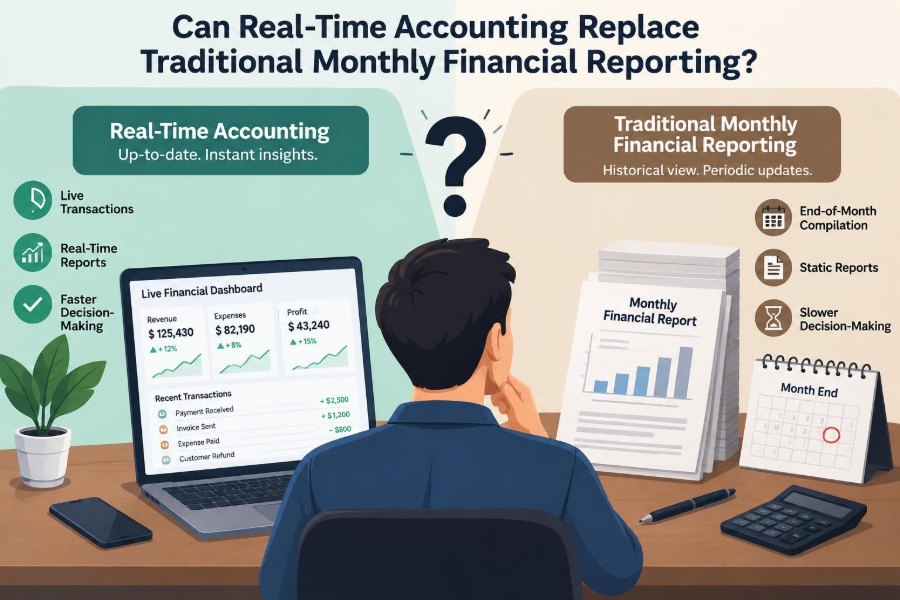

It is the third business day of the month. The finance team is still matching bank activity, chasing expense reports, reviewing unusual balances, and explaining why a dashboard changed after the books were supposedly closed.
Meanwhile, an operations manager is asking whether a project is profitable, a sales leader wants to know how much commission has been earned, and the chief executive wants a current cash forecast. They do not mean “current” as of last month-end.
Modern accounting systems can import transactions quickly, connect to banks, apply rules, and update dashboards throughout the day. That makes real-time accounting sound like an obvious replacement for the monthly close.
But a fast data feed is not automatically a complete financial statement. The central question is not whether accounting can become more immediate. It is whether immediate information can carry the same level of accuracy, judgment, control, and accountability as traditional monthly reporting.
🧭 The Question Behind the Question
Real-time accounting asks whether an organization can maintain a continuously updated view of its financial position rather than waiting for a periodic close. Traditional monthly financial reporting organizes records into a defined accounting period, performs checks and adjustments, and then produces reports for management, lenders, owners, or other users.
These approaches solve different problems. Real-time reporting improves speed of awareness. The monthly close creates a controlled and supportable reporting point. Treating them as direct substitutes can lead to poor design decisions.
⚡ What Real-Time Accounting Actually Means
Real-time accounting does not mean every economic event is fully recorded and verified the instant it occurs. In practice, it usually means systems update operational and financial data frequently enough to support timely decisions.
A card transaction may appear immediately, an invoice may post when issued, and inventory may update when scanned. Some entries, however, require later calculation, evidence, or professional judgment. “Real time” is therefore a spectrum, not a single technical state.
📅 What Monthly Reporting Is Designed to Do
Monthly reporting turns a moving stream of activity into a coherent picture for a specific period. The team confirms balances, records adjusting entries, investigates exceptions, and applies accounting policies consistently.
Its purpose is not merely to produce a profit-and-loss statement. A disciplined close establishes whether revenue, expenses, assets, liabilities, and cash have been recorded in the right period and supported by reasonable evidence.
🔄 The Difference Between Live Data and Closed Data
A live dashboard can change whenever new information arrives. A closed monthly report is intentionally more stable: it reflects a defined cutoff and a documented process for later corrections.
Consider a retailer that receives a supplier invoice several days after goods arrive. A live system may show cash paid only when payment occurs. A month-end process may accrue the cost when the goods were received, producing a more faithful view of that month’s margin.
🧾 Why the Accounting Period Still Matters
Businesses need comparable periods. Managers want to compare April with March, budgets with actuals, and one location with another. This requires clear rules about when activity belongs in the accounts.
Period boundaries also support accountability. Once a month is closed, users can analyze results without every late invoice or revised estimate silently rewriting the historical record. Corrections can still occur, but they should be visible and controlled.
📥 Automation Has Changed the Starting Point
Cloud ledgers, bank feeds, point-of-sale integrations, payroll connections, and invoice capture tools have removed much manual data entry. These tools can make routine transactions available far earlier than they were in spreadsheet-driven environments.
Automation is especially effective when transactions are repetitive, data is structured, and rules are clear. A recurring software subscription, for example, can be categorized and allocated consistently with limited human intervention.
🧠 Classification Is Not the Same as Understanding
Software can suggest an account code based on a vendor name or prior behavior. That may be useful, but it does not establish the correct accounting treatment in every case.
A payment to a technology provider could be a routine expense, a prepaid service, a capitalizable implementation cost, or part of a larger contract. The correct answer depends on facts that may not appear in the bank description. Human review remains valuable where substance matters more than transaction labels.
🧮 Accrual Accounting Creates Timing Challenges
Accrual accounting records economic activity when it is earned or incurred, rather than only when cash moves. This principle makes performance reporting more meaningful, but it also means some amounts are not observable from a live bank feed.
Payroll earned before payday, utilities used before billing, and services received before invoicing may all require accruals. A continuously updated system can estimate these amounts, but an estimate is not identical to confirmed source evidence.
📈 Revenue Recognition Rarely Runs on Autopilot
Revenue may be straightforward when a customer buys a product and receives it immediately. It becomes more complex when contracts include subscriptions, milestones, future services, refunds, discounts, returns, or variable consideration.
For example, a hypothetical consulting firm may invoice a client at the beginning of a project. Recording the entire invoice as current revenue could overstate current performance if much of the work remains to be delivered. The invoice is real-time data; the revenue pattern requires judgment.
📦 Inventory Needs Physical Reality Checks
Inventory systems can update rapidly as goods are purchased, moved, produced, and sold. Yet recorded quantities can differ from physical quantities because of damage, theft, scanning errors, unrecorded movements, or incorrect units of measure.
Periodic counts, cycle counts, and investigation of variances still matter. A live inventory valuation is only as reliable as the underlying movement data and costing assumptions.
🏦 Bank Feeds Do Not Equal Cash Reconciliation
Bank feeds provide useful transaction visibility, but reconciliation means proving that the ledger and bank records agree after considering timing differences and unidentified items. Deposits in transit, outstanding payments, fees, and duplicated postings can distort a cash figure.
Real-time bank connections can shorten this work. They do not eliminate the need to investigate exceptions, particularly when cash balances guide urgent decisions.
🧩 Estimates Are Part of Financial Reporting
Many reported numbers are estimates rather than direct transaction totals. Examples include expected credit losses, warranty obligations, depreciation methods, useful lives, inventory provisions, and certain tax balances.
A system can calculate an estimate using a model, but management must decide whether the model remains appropriate. When customer behavior, product quality, or business conditions change, an old rule can produce a current-looking but misleading number.
🛡️ Controls Matter More When Data Moves Faster
Speed can reduce the time available to catch errors. A well-designed real-time environment needs controls built into workflows rather than relying solely on a large review at month-end.
- Role-based access limits who can create, approve, or change transactions.
- Approval rules flag payments, journal entries, or discounts outside defined thresholds.
- Exception reports identify duplicate invoices, unusual margins, missing documents, and unexpected account movements.
- Audit trails record who changed what, when, and why.
Controls should reduce preventable mistakes without forcing every low-risk transaction through a slow manual queue.
🔐 Faster Systems Can Introduce New Control Risks
Integrations spread data across payment platforms, sales tools, payroll systems, inventory applications, and the general ledger. A failed connection, altered mapping, or duplicated import can propagate an error quickly.
There is also a governance risk: users may trust a polished dashboard more than the quality of its inputs. A visually current report should disclose material data gaps, pending reconciliations, and significant estimates where relevant.
👀 Continuous Close Is a Better Goal Than Instant Close
Many organizations are pursuing a continuous close. Instead of waiting until month-end to perform every task, they reconcile high-volume accounts frequently, automate routine entries, and resolve issues close to when they occur.
This approach reduces the month-end surge while preserving a formal period close. It is more realistic than promising that every accounting judgment can be finalized at every moment of every day.
🧱 A Useful Three-Layer Reporting Model
A practical design separates information by its purpose and confidence level. This prevents operational decisions from waiting unnecessarily while protecting formal reporting from premature certainty.
| Layer | Main purpose | Typical characteristics |
|---|---|---|
| Live operational view | Manage activity today | Frequent updates, preliminary classifications, visible exceptions |
| Management flash view | Monitor trends and make near-term decisions | Selected accruals and reconciliations, clearly labeled estimates |
| Closed financial report | Evaluate a completed period | Cutoff procedures, review, support, adjustments, documented controls |
The layers should use connected data where possible, but they should not be presented as having identical assurance.
🚦 Not Every Metric Needs the Same Precision
A warehouse manager may need same-day order volume and stock alerts. A treasury team may need an up-to-date view of available bank balances. A board reviewing results may need a controlled measure of monthly operating income.
The appropriate reporting cadence depends on the decision. Demanding monthly-close precision for every operational metric wastes effort. Using preliminary data for commitments that require high confidence creates avoidable risk.
💵 Cash Management Is Often the Strongest Use Case
Real-time or near-real-time data can be especially valuable for cash management. Businesses can monitor incoming receipts, upcoming payment runs, card settlements, and available bank balances more frequently than once a month.
Still, available cash is not the same as free cash. Restrictions, payroll obligations, taxes, debt terms, and expected supplier payments may limit what can safely be spent. A useful cash view combines current balances with near-term commitments.
🏷️ Margin Monitoring Benefits From Timely Signals
Rapid reporting can reveal a sudden decline in gross margin, an increase in refunds, or an unusual discount pattern before month-end. That gives operations and sales teams time to investigate pricing, supplier costs, or fulfillment problems.
Early signals should be treated as prompts for inquiry. If cost allocations, returns, or inventory adjustments are incomplete, a provisional margin figure may point in the right direction without representing a final result.
👥 The Finance Team’s Work Changes Rather Than Disappears
When systems handle repetitive posting, accountants can spend less time moving data and more time evaluating it. The work shifts toward control design, exception analysis, policy interpretation, forecasting, and explaining performance.
This is not a reduction in professional responsibility. In some ways, it increases it: finance professionals must understand data flows, system logic, and the limits of automated outputs.
🗂️ Data Architecture Becomes an Accounting Issue
Real-time reporting depends on consistent master data: customer identifiers, product codes, chart-of-account mappings, legal entities, locations, and contract references. If two systems use different definitions for the same customer or product, fast reporting can create fast confusion.
Accounting teams should participate in data governance. They understand how operational fields ultimately affect revenue, costs, taxes, intercompany balances, and financial statement presentation.
🔍 Reconciliations Are Diagnostic Tools, Not Old-Fashioned Delays
Some teams treat reconciliation as a bottleneck to eliminate. In reality, reconciliation is a comparison designed to reveal differences between records that should align.
A daily reconciliation of payment processor settlements can uncover missing transactions quickly. A monthly reconciliation of a complex balance-sheet account may require more analysis. The frequency should reflect transaction volume, risk, and decision value.
🧷 Auditability Requires an Evidence Trail
A number is more trustworthy when someone can trace it back through source records, approvals, calculations, and changes. This is the essence of auditability, whether or not an organization is subject to an external audit.
Real-time systems should retain source documents, timestamps, workflow history, and journal-entry support. Without that trail, a fast answer may be difficult to defend when questioned later.
⚖️ External Reporting Has Different Requirements
External financial statements, tax filings, lender reports, and regulatory submissions may have prescribed rules, deadlines, and documentation expectations. Their requirements vary by jurisdiction, entity type, contract, and reporting framework.
Real-time data can accelerate preparation, but it does not remove the need to apply the relevant requirements. Organizations should obtain appropriate professional advice for their own reporting obligations rather than assuming an internal dashboard is suitable for external use.
🏢 Smaller Businesses and Large Enterprises Face Different Trade-Offs
A small service business may gain substantial value from automated bank feeds, frequent invoice review, and a weekly cash forecast. It may not need sophisticated real-time inventory costing or multi-entity consolidations.
A large enterprise may have more automation resources but also more complexity: multiple currencies, entities, systems, approval layers, and contractual arrangements. The right solution is proportionate to risk and complexity, not a race toward the most elaborate technology.
🧪 Start With a Decision, Not a Software Purchase
The most useful first question is: what decision would improve if information arrived sooner? “We want real-time reporting” is too broad to guide process design.
For example, a business might need to identify overdue customer balances twice a week, monitor daily cash exposure, or spot unprofitable jobs before completion. Each need has different data sources, controls, update frequencies, and acceptable error tolerances.
🛠️ Build a Practical Implementation Path
A phased approach is safer than trying to automate every account at once. Begin with processes that are high-volume, rules-based, and materially useful to decision-makers.
- Map the transaction flow from source system to ledger and report.
- Define data owners, account mappings, approvals, and exception handling.
- Automate and test one process, such as bank matching or recurring invoices.
- Measure error patterns and investigate why exceptions occur.
- Expand only after controls and reporting definitions are working reliably.
Keep the traditional close during the transition. It provides a benchmark for testing whether quicker outputs are sufficiently complete and consistent.
🚫 Common Mistakes in Real-Time Reporting Projects
A common mistake is measuring success by dashboard speed alone. If definitions are unclear or source data is incomplete, a faster dashboard simply spreads uncertainty faster.
Other frequent errors include automating flawed processes, hiding manual adjustments, allowing too many users to change rules, and failing to label estimates as estimates. Good implementation makes uncertainty visible rather than pretending it has disappeared.
📏 Define Materiality and Tolerances Up Front
No system catches every minor discrepancy immediately, and not every discrepancy deserves the same response. Organizations should define thresholds for investigation based on the nature of the account, potential impact, and decision risk.
A small timing difference in a low-risk expense account may be tolerable in a daily management view. An unexplained cash difference or a large revenue anomaly usually deserves prompt attention. Clear tolerances prevent both neglect and unproductive overchecking.
🗣️ Label Preliminary Information Honestly
Management can use preliminary numbers effectively when they understand what the figures represent. Labels such as “unreconciled,” “estimated,” “through 3 p.m.,” or “subject to close adjustments” are not weaknesses; they are useful context.
Clear communication protects credibility. It also helps decision-makers distinguish a directional signal from a finalized financial result.
🎯 When Monthly Reporting Remains Essential
Monthly reporting remains essential when users need a complete period view, formal review, stable comparisons, documented adjustments, and accountability for results. It is particularly valuable for performance evaluation, covenant monitoring, financial statement preparation, and governance.
The process can become shorter and less painful through continuous reconciliation and automation. Its underlying purpose, however, does not vanish simply because transactions now arrive more quickly.
🤝 The Best Answer Is Usually Both
Real-time accounting can replace parts of the old monthly routine: manual transaction entry, delayed visibility, repetitive matching, and some late discovery of problems. It can also make the monthly close more accurate by resolving issues earlier.
It cannot fully replace period-end reporting where accounting depends on cutoff, estimates, evidence, review, and judgment. The strongest model combines live operational intelligence with a disciplined monthly close.
🏁 The Core Principle: Speed Must Match Confidence
Financial information should be delivered at the speed required by the decision, with the level of assurance required by the consequences. This principle helps avoid two extremes: waiting too long for useful insight and acting too confidently on unfinished data.
For students, the lesson is that accounting is more than recording transactions. For professionals, it is a reminder that technology changes the workflow, while the need for reliable measurement, controls, and clear explanation remains.
Real-time accounting is most powerful not as a replacement for monthly reporting, but as the operating layer that makes monthly reporting more timely, informed, and dependable. 💰📊⚙️