
A café owner proudly reports that sales rose sharply this year. The dining room is busier, delivery orders are flowing, and the monthly revenue dashboard looks better than ever.
Yet the owner is working longer hours, suppliers are demanding faster payment, and the bank balance seems permanently strained. A larger business, at least on paper, has somehow become a more stressful one.
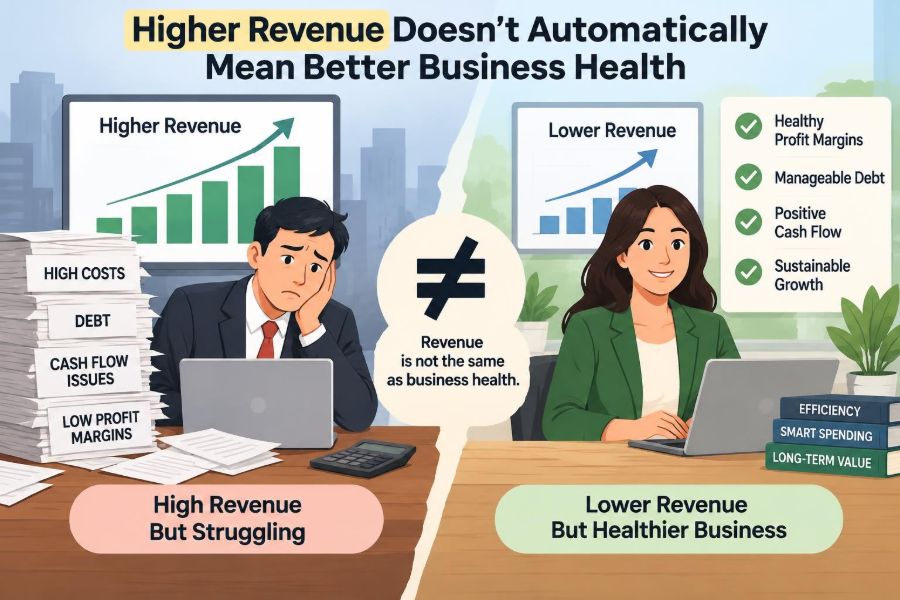
This situation is not unusual. Revenue is visible, easy to celebrate, and frequently treated as a shorthand for success. But it records money earned from customers before showing what the business had to spend, borrow, delay, or risk to earn it.
For students learning financial statements and professionals making operating decisions, separating growth from health is essential. A company can have rising revenue and still be unprofitable, illiquid, overextended, or heading toward a cash crisis.
📈 Revenue Is an Activity Measure, Not a Health Diagnosis
Revenue is the value of goods delivered or services performed for customers during a period. It answers a useful question: how much commercial activity did the business generate?
It does not, by itself, answer whether the activity created profit, produced cash, strengthened the balance sheet, or can continue safely. Treating a single line on the income statement as a full diagnosis is like judging a vehicle only by how fast its odometer increases.
Higher revenue can be good news. It may indicate stronger demand, successful marketing, effective sales execution, or a larger market. The mistake is assuming that it must be good news before examining the conditions attached to the growth.
🧾 The Income Statement Starts With Revenue for a Reason
Revenue appears near the top of the income statement because many other measures are calculated from it. Cost of sales is subtracted to determine gross profit, operating expenses are then considered, and eventually the statement reaches net income or loss.
That order can create a psychological trap. Readers see a large top-line number first and give it more weight than the smaller, later figures. But a business keeps only what remains after meeting its costs, financing obligations, tax obligations, and other commitments.
A growing top line is therefore a starting point for analysis, not a conclusion.
💡 Sales, Profit, and Cash Are Three Different Things
These terms are often used casually as if they mean the same thing. In accounting and management, they describe distinct realities.
| Measure | What it captures | What it can miss |
|---|---|---|
| Revenue | Sales earned in a period | Costs, collection timing, and financing needs |
| Profit | Revenue remaining after recognized expenses | Whether customers have paid and whether cash is available now |
| Cash flow | Actual cash moving in and out | Some longer-term economic effects and noncash accounting items |
A company can record revenue when it has fulfilled its performance obligation, even if the customer pays later. It can also report accounting profit while cash is tied up in receivables or inventory. Healthy businesses monitor all three measures together.
🧮 Gross Margin Reveals the Quality of Each Sale
Gross margin is the portion of revenue left after direct costs of providing the product or service. For a retailer, those costs commonly include inventory purchases. For a manufacturer, they may include materials and production labor.
If revenue increases 20% but direct costs increase 30%, the business may be doing more work for less return per sales dollar. This can happen when a company discounts heavily, faces supplier price increases, or shifts toward lower-margin products.
Revenue growth with stable or improving gross margin is usually more promising than growth bought at the expense of unit economics. Unit economics means the revenue, direct cost, and contribution generated by one sale, one customer, or one service engagement.
📉 More Volume Can Create Less Profit
Imagine a hypothetical online retailer that sells a product for $100. Its direct product cost, packaging, payment fees, and shipping total $72, leaving $28 before fixed operating costs.
To accelerate sales, it cuts the price to $82 and offers free expedited shipping. Orders rise substantially, but the direct cost per order remains close to $72. Each sale now contributes only $10 toward rent, salaries, software, and other overhead.
The business may report impressive revenue growth, but it must process almost three times as many orders to generate the same contribution. Volume is valuable only when each additional sale contributes enough to cover the resources it consumes.
🏷️ Discounts Can Make Growth Look Better Than It Feels
Discounting is not automatically poor strategy. A temporary promotion can introduce a product, clear seasonal stock, or help a company use unused capacity. The concern arises when discounts become the main engine of reported growth.
Persistent discounting can train customers to wait for lower prices. It may also make it difficult to restore prices without losing volume. Meanwhile, the business absorbs the same fulfillment, support, and administrative effort for less revenue per unit.
When reviewing a sales increase, ask whether it came from more customers, higher prices, a favorable product mix, or unusually generous commercial terms. Those sources have very different implications.
🛒 Product Mix Can Change the Meaning of Growth
Not every dollar of revenue carries the same margin, cash requirement, or risk. A technology reseller, for example, may grow quickly by selling third-party hardware with thin margins, while its own maintenance contracts offer slower but much stronger margins.
A shift toward low-margin revenue can make the company look larger while reducing its ability to fund payroll, innovation, and unexpected disruptions. Conversely, a smaller revenue increase in a high-margin service line may materially improve business health.
Management should examine revenue by product, service, channel, customer segment, and geography when those distinctions affect economics. The total alone can conceal a costly mix shift.
👥 Customer Concentration Turns Revenue Into Exposure
A company can have strong revenue growth because one large customer dramatically increased purchases. That may be commercially positive, but it also creates concentration risk if the customer can renegotiate terms, reduce orders, or leave.
Revenue concentration matters particularly when the customer represents a large share of sales, requires customized operations, or pays slowly. The business may become dependent on a relationship it has limited power to control.
A diversified customer base is not always possible or necessary, especially in specialized industries. But concentration should be measured, disclosed internally, and considered alongside the revenue figure.
⏳ Revenue Does Not Mean the Customer Has Paid
Under accrual accounting, revenue is generally recognized when it is earned according to the applicable accounting framework, rather than only when cash arrives. The unpaid amount is commonly recorded as accounts receivable.
Receivables are assets, but they are not the same as spendable cash. If a business extends increasingly long payment terms to win sales, revenue can rise while cash collection weakens.
A useful question is simple: are receivables rising in line with sales, or are they rising faster? A growing gap may reflect slower collections, billing issues, disputed invoices, or customers under financial pressure.
💧 Cash Flow Pays the Bills
Employees, landlords, lenders, tax authorities, and suppliers generally need payment in cash, not in revenue or accounting profit. This is why operating cash flow deserves attention even in a growing company.
Growth often absorbs cash before it produces it. The business may need to buy inventory, hire staff, pay commissions, manufacture goods, or invest in systems before customers pay their invoices.
A cash shortfall does not prove that the underlying business is bad. It does mean leaders need a credible plan for timing, financing, and working capital. Ignoring the gap because sales are rising is dangerous.
🔄 Working Capital Is Where Growth Often Gets Stuck
Working capital broadly refers to the short-term resources a company uses to run daily operations, including receivables, inventory, cash, and payables. Its management determines how quickly sales become usable cash.
Consider a wholesaler that must purchase stock today, hold it for several weeks, sell it on credit, and wait another month for payment. Every new sale can require more capital to travel through that cycle.
Fast growth can therefore create a funding need even when sales are profitable. The company is not necessarily failing; it is financing a larger operating machine.
📦 Inventory Growth Can Consume Liquidity
Inventory is necessary for many businesses, but excess inventory locks cash into goods that have not yet been sold. It also carries risks of damage, obsolescence, shrinkage, and eventual markdowns.
A retailer might increase purchasing in anticipation of sales growth. If customer demand does not arrive as expected, reported revenue may still look acceptable for a period while inventory builds quietly on the balance sheet.
Monitor inventory turnover, stock aging, and markdown trends alongside revenue. Selling more while accumulating slower-moving stock can indicate that purchasing and demand are out of balance.
🏦 Debt Can Fund Growth but Also Raise the Stakes
Borrowing can help a viable business bridge the cash demands of expansion. A loan, line of credit, or other financing may allow the company to purchase inventory, open a location, or serve customers before collections arrive.
However, debt adds interest costs, scheduled repayments, and sometimes contractual conditions called covenants. If margins narrow or customers pay late, a business with rising revenue may find its financing burden increasingly difficult to carry.
Debt should be evaluated in relation to reliable cash generation, not merely sales. Lenders and managers care whether the business can service obligations through normal operations.
🧱 Fixed Costs Can Outrun the Revenue They Were Meant to Support
Expansion often requires commitments before revenue is certain: additional premises, management hires, new software subscriptions, sales teams, equipment leases, or compliance infrastructure. These are commonly fixed or semi-fixed costs because they do not fall immediately when sales slow.
A business may hire for a projected level of demand and then experience a delayed launch, weak conversion, or seasonal slowdown. Revenue can still be higher than last year while operating profit deteriorates because the cost base expanded even faster.
Growth plans should distinguish between costs that vary with each sale and commitments that remain if the forecast misses.
⚙️ Capacity Constraints Make Some Revenue Expensive
When a company approaches operational capacity, the next sales can be unusually costly. Staff may work overtime, error rates may rise, expedited freight may be needed, and customer service may become overloaded.
This is common in service businesses. A consulting firm that accepts more work than its team can handle may use expensive contractors or burn out employees. Revenue rises, but quality, retention, and future delivery capacity can suffer.
Capacity planning asks whether the organization can fulfill new demand at its expected cost and quality level. It is an operational question with direct accounting consequences.
🧾 Revenue Recognition Requires Careful Judgment
Revenue recognition is governed by accounting rules and depends on the nature of the contract and promised goods or services. Complex arrangements may involve multiple deliverables, variable consideration, refunds, returns, milestones, or services delivered over time.
Recognizing revenue too early can overstate current performance and create later reversals. Recognizing it correctly does not eliminate cash risk, but it does make performance reporting more faithful to what the company has actually delivered.
For decision-makers, unusually large period-end sales, rising contract assets, or frequent credits deserve investigation. These items are not automatically improper; they may simply require a clearer explanation of timing and terms.
↩️ Returns, Refunds, and Cancellations Reduce the Headline Number
Gross sales can sound impressive, but net revenue is more informative when customers may return goods, receive rebates, or cancel contracts. A promotional campaign that generates many orders and many returns is not equivalent to durable demand.
Businesses should track return rates by product and channel, reasons for returns, warranty claims, and post-sale credits. A spike can point to product quality issues, misleading product information, poor fulfillment, or customers attracted mainly by discounts.
The healthiest revenue is revenue that is earned, retained, collected, and repeatable.
🔁 Recurring Revenue Needs a Retention Check
Subscription and contract revenue can improve predictability, but the label “recurring” should not end the analysis. A business can add many new subscribers while losing existing ones at an unsustainable rate.
Look at renewals, cancellations, downgrades, customer support burden, and the cost of acquiring replacement customers. A high-growth subscription business may be spending heavily merely to replace customers who do not stay.
Retention is especially meaningful when considered by customer cohort, meaning groups of customers who began in the same period. Cohort analysis can reveal whether newer customers behave differently from earlier ones.
🎯 Acquisition Costs Can Erase the Value of New Sales
Revenue growth often requires marketing spend, sales commissions, introductory offers, channel incentives, or business development staff. These costs can be worthwhile investments, but they must be compared with the margin and expected duration of the customer relationship.
A company that spends heavily to acquire customers with low order values, short lifetimes, or high support needs may increase revenue while destroying value. The problem is not marketing itself; it is acquiring revenue that never pays back its acquisition cost.
Managers should ask how long it takes for a typical customer’s contribution margin to recover the cost of winning that customer. The answer will vary by industry and business model, so it should guide judgment rather than serve as a universal benchmark.
🧭 Growth Can Be Organic or Purchased
Organic growth comes from expanding sales through the company’s existing operations, such as selling more to current customers, entering a new market, or improving the product. Growth through acquisition occurs when a business buys another company and consolidates its revenue.
Both can be strategically sensible. But acquisition-driven revenue growth may bring integration costs, duplicated functions, incompatible systems, debt, and customer attrition that are not obvious in the first headline number.
When comparing periods, identify whether revenue increased because the core business performed better or because the reporting entity became larger through a transaction.
🌍 Inflation Can Inflate Sales Without Improving Performance
When prices rise across an economy, a company may report higher revenue even if it sells the same number of units—or fewer units. The increase may reflect pricing necessary to cover higher wages, materials, utilities, or logistics costs.
Price increases can preserve margins, but they can also reduce customer demand over time. Volume trends, margin trends, and competitive conditions help distinguish genuine expansion from a nominal increase caused primarily by inflation.
Revenue should therefore be read in context. A larger currency amount is not automatically a larger economic gain.
📊 Compare Revenue With the Right Companion Metrics
No single dashboard fits every industry, but several measures make revenue more interpretable. The goal is not to collect every possible metric; it is to connect sales activity to profitability, liquidity, efficiency, and risk.
- Gross and operating margin: whether sales leave enough after direct and operating costs.
- Operating cash flow: whether core operations are generating cash.
- Receivable collection patterns: whether billed revenue is converting to cash promptly.
- Inventory turnover: whether cash is moving efficiently through stock.
- Customer retention and concentration: whether sales are durable and diversified.
- Debt service capacity: whether financing obligations are manageable.
A dashboard should lead to questions, not replace judgment. A ratio can identify where to look; it cannot explain the business on its own.
🔍 Trend Analysis Is Stronger Than a Single Period
A single quarter or year can be affected by timing, seasonality, a large contract, a product launch, or a temporary supply disruption. Comparing trends over several periods often provides a more reliable picture.
For example, revenue may rise steadily while gross margin falls, receivables stretch, and operating cash flow weakens. Viewed separately, each change might seem manageable. Viewed together, they tell a coherent story about growth pressure.
Also compare actual results with the assumptions that supported the plan. Did volume, price, cost, collection timing, and staffing behave as expected? Variances are learning tools, not merely performance judgments.
🚩 Warning Signs Behind Impressive Revenue Growth
None of these signs proves that a business is unhealthy. Together, however, they justify closer review.
- Revenue grows while gross profit or gross margin declines.
- Accounts receivable rise faster than sales or overdue invoices accumulate.
- Inventory expands faster than demand or requires increasing markdowns.
- Operating cash flow remains weak despite reported profit.
- Discounts, extended payment terms, or rebates become more aggressive.
- One customer, product, or channel accounts for most new revenue.
- Borrowing rises mainly to fund ordinary operating needs.
The practical response is investigation, not panic: trace the change to its underlying contracts, costs, operating process, and timing.
🛠️ Build a Revenue Quality Review
A monthly or quarterly revenue-quality review helps teams move beyond celebration of the total. Finance, sales, operations, and leadership should look at the same commercial reality from different angles.
- Break revenue down by product, customer, channel, and geography where meaningful.
- Compare price, volume, direct cost, and margin against prior periods and plan.
- Review collections, aging receivables, returns, credits, and disputed invoices.
- Assess inventory, staffing, and capacity required to support the sales level.
- Identify financing needs and test whether cash forecasts remain realistic.
- Document actions: adjust prices, revise terms, slow spending, improve collections, or protect capacity.
This process is most effective when it is routine. Waiting until cash is tight turns analysis into crisis management.
🤝 Finance and Operations Need the Same Definition of Success
Sales teams may be rewarded for bookings or revenue, while operations is measured on delivery and finance is measured on cash and profit. If these incentives conflict, a company can unintentionally encourage deals that look successful to one department but harm the whole business.
Balanced scorecards can help. A sales leader should understand margin and collection quality; finance should understand why a strategic customer or market investment may temporarily reduce margins; operations should communicate the true cost of service levels.
Shared measures do not eliminate trade-offs. They make trade-offs visible early enough to manage them.
⚖️ Healthy Growth Sometimes Looks Less Dramatic
Management may choose to decline a low-margin contract, require a deposit, limit credit terms, raise prices, or delay expansion until systems and staff are ready. These choices can reduce short-term reported revenue.
They may also protect cash, quality, employee workload, and long-term profitability. A smaller but dependable revenue base can be healthier than a rapidly expanding base that must be subsidized with discounts and debt.
The right decision depends on strategy, market position, available financing, and the company’s ability to execute. Prudence is not the same as avoiding growth; it is matching growth to economic capacity.
🧠 The Core Principle: Revenue Must Create Durable Value
Higher revenue is neither meaningless nor automatically admirable. It is evidence that customers are buying something, which is a necessary condition for most commercial businesses. But it is only one part of a larger financial and operating system.
Good growth is revenue that produces adequate margin, converts to cash on workable terms, fits available capacity, does not create unacceptable concentration or debt risk, and can continue without damaging customer relationships or the organization itself.
The question is not simply “Did sales increase?” but “Did each additional sale make the business stronger?” That question turns a headline metric into a disciplined assessment of business health.
Revenue becomes a sign of health only when it is profitable, collectible, sustainable, and appropriately financed. Looking beyond the top line helps students interpret financial statements and helps professionals build businesses that can endure, not merely grow. 💰📊🌱