
Every business generates a continuous stream of financial activity. A customer pays an invoice. The company buys inventory. Employees receive salaries. Rent is paid. Equipment is purchased. A bank loan is received. A supplier sends a bill.
Individually, these events may seem like ordinary business activities. But together, they form the raw material from which a company’s financial statements are created.
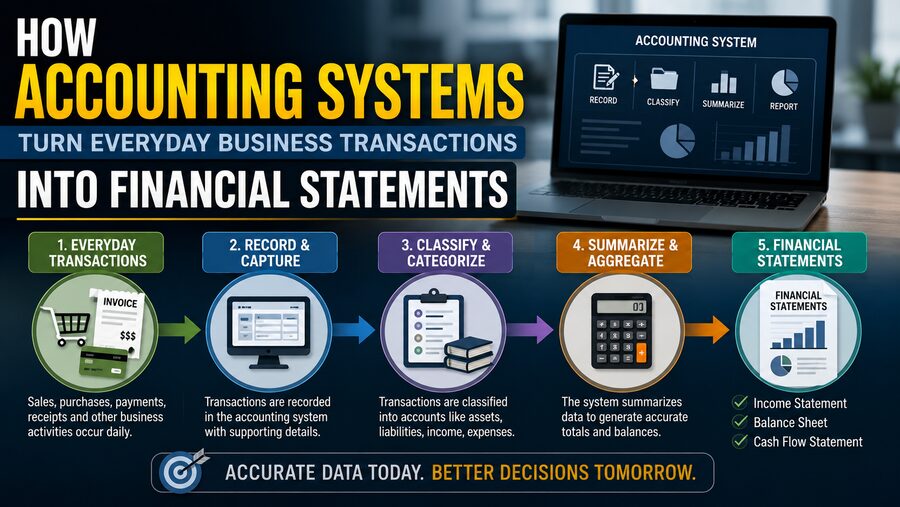
An accounting system takes thousands—or even millions—of everyday transactions and organizes them into a structured financial record. It classifies each transaction, records its effect on the company’s accounts, summarizes the results, makes necessary adjustments, and finally produces reports such as the income statement, balance sheet, and cash flow statement.
The process is not simply about adding up receipts. It is based on a carefully designed framework called double-entry accounting, where every transaction affects at least two accounts.
Understanding this process reveals how accountants transform daily business activity into the financial information used by managers, investors, lenders, regulators, and business owners. 📈🧠
🧾 Everything Starts With a Transaction
An accounting transaction is an economic event that changes the financial position of a business.
Examples include:
- 💵 Receiving cash from a customer
- 📦 Buying inventory
- 🏢 Paying rent
- 👩💼 Paying employee salaries
- 🚚 Purchasing equipment
- 🏦 Borrowing money
- 🧾 Receiving a supplier invoice
- 💳 Paying a credit-card bill
Not every event is recorded immediately in accounting.
For example, discussing a possible future purchase does not create a transaction.
But once the company actually buys the equipment or becomes legally obligated to pay for it, the accounting system has something to record.
📄 Source Documents Provide Evidence
Before a transaction enters the accounting system, it is usually supported by a source document.
Examples include:
- Sales invoices
- Purchase invoices
- Receipts
- Bank statements
- Payroll records
- Purchase orders
- Contracts
- Credit-card statements
These documents provide evidence that the transaction occurred.
They also provide details such as:
- Date
- Amount
- Customer
- Supplier
- Tax
- Payment terms
- Description
Modern accounting software often imports this information automatically from bank feeds, payment systems, payroll software, and e-commerce platforms.
🧠 The Chart of Accounts Organizes Financial Activity
The accounting system needs a consistent way to classify transactions.
This is done using the chart of accounts.
A chart of accounts is a structured list of financial categories used by the business.
Typical account groups include:
💰 Assets
Resources the company owns or controls.
Examples:
- Cash
- Accounts receivable
- Inventory
- Equipment
🧾 Liabilities
Amounts the company owes.
Examples:
- Accounts payable
- Bank loans
- Taxes payable
- Accrued expenses
🏢 Equity
The owners’ financial interest in the company.
Examples:
- Share capital
- Retained earnings
📈 Revenue
Income generated from business activities.
Examples:
- Product sales
- Service revenue
📉 Expenses
Costs incurred while operating the business.
Examples:
- Rent
- Salaries
- Advertising
- Utilities
- Insurance
Every recorded transaction is assigned to one or more of these accounts.
⚖️ Double-Entry Accounting Keeps the System Balanced
The foundation of modern accounting is double-entry bookkeeping.
Every transaction affects at least two accounts.
The system is built around the accounting equation:
Assets = Liabilities + Equity
This equation must remain balanced after every transaction.
Suppose a business borrows $20,000 from a bank.
Cash increases by $20,000.
But the company also owes the bank $20,000.
The transaction therefore produces:
Cash +$20,000
and
Loan Payable +$20,000
Assets increase by the same amount as liabilities.
The accounting equation remains balanced.
➕ Debits and Credits
Double-entry accounting uses debits and credits.
These terms do not simply mean increase and decrease.
Their effect depends on the type of account.
A simplified guide is:
- Assets generally increase with debits.
- Expenses generally increase with debits.
- Liabilities generally increase with credits.
- Equity generally increases with credits.
- Revenue generally increases with credits.
Suppose a company makes a $1,000 cash sale.
The accounting entry could be:
Debit Cash: $1,000
Credit Sales Revenue: $1,000
Cash increases, and revenue increases.
The total debits equal total credits.
📚 Transactions Are Recorded as Journal Entries
The formal accounting record of a transaction is called a journal entry.
A journal entry typically includes:
- Transaction date
- Accounts affected
- Debit amounts
- Credit amounts
- Description
Imagine a company pays $2,500 monthly rent.
The journal entry might be:
Debit Rent Expense: $2,500
Credit Cash: $2,500
This records both sides of the event.
The business incurred an expense and also reduced its cash balance.
🔄 The General Ledger Collects Account Activity
After transactions are recorded, they are organized in the general ledger.
The general ledger contains the complete activity and balance of every account.
For example, the Cash account may include:
- Customer payments
- Loan receipts
- Supplier payments
- Payroll
- Rent
- Equipment purchases
The Sales Revenue account contains revenue transactions.
The Rent Expense account contains rent charges.
The Accounts Payable account tracks amounts owed to suppliers.
The ledger turns a chronological stream of journal entries into organized account histories.
🧮 Example: Buying Inventory on Credit
Suppose a retailer buys $8,000 of inventory from a supplier but does not pay immediately.
The entry might be:
Debit Inventory: $8,000
Credit Accounts Payable: $8,000
Inventory, an asset, increases.
Accounts Payable, a liability, also increases.
Later, when the business pays the supplier:
Debit Accounts Payable: $8,000
Credit Cash: $8,000
The liability disappears, and cash decreases.
Accounting systems use these relationships to track not only what happened but also what the company owns and owes.
👥 Accounts Receivable Tracks Customer Debts
Many businesses sell products or services before receiving payment.
Suppose a consulting company invoices a client $5,000.
The accounting entry may be:
Debit Accounts Receivable: $5,000
Credit Service Revenue: $5,000
Revenue is recognized, but cash has not yet arrived.
Later, when the customer pays:
Debit Cash: $5,000
Credit Accounts Receivable: $5,000
The receivable is converted into cash.
This distinction is essential in accrual accounting, where revenue and expenses are recorded based on economic activity rather than only cash movement.
🧾 Accounts Payable Tracks Supplier Obligations
Accounts payable performs a similar function for money the company owes suppliers.
Suppose a business receives a $1,200 electricity bill.
Even if it will not pay until next month, the expense may need to be recognized now.
The entry could be:
Debit Utilities Expense: $1,200
Credit Accounts Payable: $1,200
When payment occurs later:
Debit Accounts Payable: $1,200
Credit Cash: $1,200
This ensures the financial statements show the expense in the period when the electricity was actually consumed.
⏳ Why Timing Matters in Accounting
Financial statements divide business activity into periods such as:
- Month
- Quarter
- Year
But business transactions do not always fit neatly into those periods.
A company may receive cash before earning revenue.
It may incur an expense before receiving an invoice.
It may purchase equipment that provides value for many years.
Therefore, accountants perform adjusting entries before producing final financial statements.
📅 Accrued Expenses
An accrued expense is an expense that has been incurred but not yet paid or possibly not yet invoiced.
Suppose employees have earned $10,000 in wages by December 31, but payroll will not be paid until January.
The company may record:
Debit Salary Expense: $10,000
Credit Salaries Payable: $10,000
This ensures the December income statement includes the cost of work performed in December.
💳 Prepaid Expenses
Sometimes a business pays before receiving the full benefit.
Suppose a company pays $12,000 for one year of insurance.
Initially:
Debit Prepaid Insurance: $12,000
Credit Cash: $12,000
The payment creates an asset because the company has purchased future insurance coverage.
Each month, part of that asset becomes an expense.
For one month:
Debit Insurance Expense: $1,000
Credit Prepaid Insurance: $1,000
This spreads the cost across the periods that receive the benefit.
🏭 Depreciation Spreads Equipment Cost Over Time
Suppose a business purchases machinery for $100,000.
Recording the full $100,000 as an expense immediately would often misrepresent the economics if the machine will be used for many years.
Instead, accounting uses depreciation.
The machine is initially recorded as an asset.
Over time, part of its cost is recognized as expense.
A simplified annual entry might be:
Debit Depreciation Expense
Credit Accumulated Depreciation
This matches the cost of the asset with the periods in which it helps generate revenue.
💰 Deferred Revenue
A business may sometimes receive money before earning it.
Imagine a software company receives $12,000 in advance for a one-year subscription.
Initially, the cash is received, but the company has not yet provided all 12 months of service.
The entry might be:
Debit Cash: $12,000
Credit Deferred Revenue: $12,000
Deferred Revenue is a liability because the company still owes service to the customer.
As each month passes, part of the liability becomes earned revenue.
🧪 The Trial Balance Checks the Ledger
After journal entries have been posted, accountants create a trial balance.
The trial balance lists all account balances.
The total debits should equal total credits.
If they do not, something has gone wrong.
Possible causes include:
- Missing entries
- Incorrect posting
- One-sided entries
- Data-entry errors
However, a balanced trial balance does not prove that every transaction is correct.
If the same wrong amount is entered as both debit and credit, the books may still balance.
The trial balance is therefore an important control, but not a complete guarantee of accuracy.
🔍 Reconciliations Provide Additional Verification
Accountants also perform reconciliations.
A reconciliation compares accounting records with independent evidence.
For example, a bank reconciliation compares:
Cash balance in accounting system
with
Cash balance reported by the bank
Differences may come from:
- Outstanding checks
- Deposits in transit
- Bank fees
- Interest
- Errors
Other common reconciliations involve:
- Credit cards
- Accounts receivable
- Accounts payable
- Inventory
- Payroll taxes
Reconciliations help detect missing or incorrect transactions.
📊 From Trial Balance to Financial Statements
Once transactions are recorded, adjustments are made, and accounts are reconciled, the accounting system can produce financial statements.
Three of the most important are:
- Income statement
- Balance sheet
- Cash flow statement
These reports summarize the financial effects of all the underlying transactions.
📈 The Income Statement
The income statement explains the company’s financial performance over a period.
Its basic structure is:
Revenue − Expenses = Profit
Suppose a business reports:
- Revenue: $500,000
- Cost of goods sold: $250,000
- Salaries: $100,000
- Rent: $30,000
- Other expenses: $50,000
Profit would be:
$70,000
The income statement answers questions such as:
- Is the business profitable?
- Are expenses rising?
- Which activities generate revenue?
- How have results changed over time?
🏦 The Balance Sheet
The balance sheet shows the company’s financial position at a specific date.
It follows:
Assets = Liabilities + Equity
Assets might include:
- Cash
- Receivables
- Inventory
- Equipment
Liabilities might include:
- Supplier bills
- Loans
- Taxes payable
Equity represents the owners’ residual interest.
Unlike the income statement, which covers a period, the balance sheet is a snapshot at one specific moment.
💵 The Cash Flow Statement
Profit and cash are not the same thing.
A company can report profit while experiencing cash shortages.
The cash flow statement explains how cash changed during the period.
Cash flows are generally grouped into:
🏭 Operating Activities
Cash related to normal operations.
Examples:
- Customer collections
- Supplier payments
- Employee wages
🏗️ Investing Activities
Cash related to long-term assets.
Examples:
- Equipment purchases
- Investments
🏦 Financing Activities
Cash related to funding.
Examples:
- Bank loans
- Share issuance
- Dividends
This statement helps users understand where cash came from and how it was used.
🔗 The Financial Statements Are Connected
The financial statements are not independent reports.
They are connected through the same accounting system.
For example, net income from the income statement can eventually affect retained earnings on the balance sheet.
Cash shown on the balance sheet must reconcile with the ending cash on the cash flow statement.
This interconnected structure helps maintain consistency.
🔁 The Accounting Cycle
The overall process is often called the accounting cycle.
A simplified accounting cycle is:
- Identify transactions.
- Collect source documents.
- Record journal entries.
- Post entries to the general ledger.
- Prepare a trial balance.
- Record adjusting entries.
- Reconcile accounts.
- Prepare financial statements.
- Close temporary accounts.
- Begin the next accounting period.
Modern software automates much of this process, but the underlying accounting logic remains the same.
🤖 Modern Accounting Systems Automate Data Entry
Cloud accounting systems can connect directly to:
- Bank accounts
- Credit cards
- E-commerce platforms
- Payroll systems
- Payment processors
- Expense applications
Instead of manually typing every transaction, the software can import data automatically.
It may suggest classifications based on historical behavior.
For example, a payment to the same electricity provider every month might automatically be categorized as Utilities Expense.
Automation reduces repetitive work, but human review remains important.
🧠 Rules and AI Can Suggest Classifications
Modern accounting platforms may use rules or machine learning to recognize transaction patterns.
For example:
Payments to Vendor A → Office Supplies
or:
Monthly payment to Landlord B → Rent Expense
This can greatly speed up bookkeeping.
However, incorrect classifications can still occur.
A payment to a supplier might represent equipment rather than an ordinary expense.
Accountants therefore review unusual or material transactions carefully.
🧾 Subledgers Handle Detailed Information
Large companies often use specialized subledgers.
Examples include:
- Accounts receivable subledger
- Accounts payable subledger
- Inventory subledger
- Fixed asset register
- Payroll system
The general ledger contains summarized balances, while the subledgers contain detailed supporting records.
For example, the Accounts Receivable account may show:
$500,000 total
while the subledger shows exactly how much each customer owes.
📦 Inventory Accounting Can Be Complex
For companies that sell physical products, inventory accounting is especially important.
When inventory is purchased, it is recorded as an asset.
When the product is sold, its cost becomes Cost of Goods Sold.
Suppose a retailer buys an item for $60 and sells it for $100.
When purchased:
Inventory increases by $60
When sold:
Revenue increases by $100
and
Cost of Goods Sold increases by $60
The difference contributes to gross profit.
This allows the accounting system to measure not only sales but also the cost associated with generating those sales.
🏭 Cost Accounting Adds Operational Detail
Manufacturing companies need even more detailed accounting.
The cost of producing a product may include:
- Raw materials
- Direct labor
- Factory overhead
Accounting systems track these costs as they move through production stages.
A manufacturer may use accounts such as:
- Raw Materials
- Work in Process
- Finished Goods
- Cost of Goods Sold
This turns operational activity into measurable financial information.
🔐 Internal Controls Protect Accounting Data
Because financial records influence major decisions, accounting systems require strong controls.
Internal controls may include:
- Approval limits
- User permissions
- Separation of duties
- Audit logs
- Reconciliations
- Period locking
For example, the employee who approves a supplier may not also be allowed to approve payments to that supplier.
These controls reduce the risk of errors and fraud.
👣 Audit Trails Show Who Changed What
Modern accounting software often maintains an audit trail.
This can record:
- Who entered a transaction
- When it was created
- What was changed
- When it was approved
- Whether it was reversed
Audit trails are valuable when investigating discrepancies.
They also help external auditors understand how transactions moved through the accounting system.
🧑⚖️ Accounting Standards Shape the Final Reports
Financial statements are not prepared using arbitrary rules.
Companies generally follow accounting frameworks such as:
- IFRS
- GAAP or other national standards
These frameworks influence areas such as:
- Revenue recognition
- Asset valuation
- Depreciation
- Leases
- Inventory
- Financial instruments
The accounting system can automate calculations, but accountants still need to determine which accounting treatment is appropriate.
📅 Closing the Accounting Period
At the end of a month, quarter, or year, companies perform a financial close.
The process may include:
- Recording missing invoices
- Accruing expenses
- Reconciling bank accounts
- Reviewing receivables
- Counting or reconciling inventory
- Calculating depreciation
- Reviewing unusual transactions
Once the records are considered complete, the period may be locked to prevent unauthorized changes.
Financial statements can then be finalized.
🔄 Closing Entries Prepare for the Next Period
Revenue and expense accounts are temporary accounts used to measure performance for a specific period.
At the end of the accounting period, their balances are transferred into equity, usually through retained earnings.
The new period then begins with revenue and expense accounts reset to zero.
Balance-sheet accounts such as cash, inventory, loans, and equity continue carrying their balances forward.
📊 Example: One Month of Business Activity
Imagine a new consulting company begins the month with $20,000 contributed by its owner.
It records:
- Owner investment: $20,000
- Customer revenue earned: $15,000
- Rent paid: $3,000
- Salaries paid: $5,000
- Computer equipment purchased: $4,000
The accounting system classifies every event.
At month-end, the income statement might show:
Revenue: $15,000
Expenses: $8,000
Profit: $7,000
The balance sheet would show remaining cash, equipment, and owner’s equity.
One short month of ordinary transactions has now been transformed into structured financial reports.
🎯 Why Financial Statements Matter
Financial statements help different users answer different questions.
Managers may ask:
- Are we profitable?
- Which expenses are growing?
- Can we afford expansion?
Investors may ask:
- Is the company financially healthy?
- Is revenue growing?
- How much debt does it have?
Banks may ask:
- Can the company repay a loan?
- Does it generate enough cash?
The quality of these decisions depends on the quality of the underlying accounting data.
⚠️ Bad Transaction Data Creates Bad Financial Statements
Financial statements are only as reliable as the records behind them.
If transactions are:
- Missing
- Duplicated
- Misclassified
- Recorded in the wrong period
- Entered with incorrect values
then the financial statements may also be wrong.
That is why accounting systems emphasize documentation, reconciliation, controls, and review.
Automation can reduce routine errors, but it does not eliminate the need for careful accounting judgment.
🌟 Final Thoughts
Accounting systems transform ordinary business activity into financial statements by creating a structured chain from transaction to report.
The process begins when the business sells something, pays an employee, purchases inventory, borrows money, receives a customer payment, or incurs another measurable financial event.
Each transaction is supported by source documents and classified using the chart of accounts. Double-entry bookkeeping records at least two sides of every event, keeping the fundamental equation:
Assets = Liabilities + Equity
in balance.
Journal entries flow into the general ledger. Adjusting entries make sure revenue and expenses are recognized in the correct periods. Reconciliations verify balances against independent records. The adjusted ledger is then summarized into the income statement, balance sheet, and cash flow statement. 📊
Modern software makes this process faster by importing transactions, applying rules, connecting subledgers, automating calculations, and maintaining audit trails.
But beneath the automation, the logic remains remarkably consistent.
Every number appearing on a financial statement can ultimately be traced back to individual economic events.
A single line labeled Sales Revenue may summarize thousands of customer invoices. A balance called Accounts Payable may represent hundreds of unpaid supplier bills. A cash balance may reflect thousands of deposits and payments.
That is the central purpose of an accounting system: to take the complexity of everyday business activity and convert it into a coherent financial story.
From a simple receipt to a complete annual report, accounting provides the framework that allows managers, investors, lenders, and regulators to understand what happened financially—and what the business looks like today. 💼🧾📈