
Modern businesses may process thousands—or millions—of financial events every day. 💼💻 A customer pays an invoice, an employee submits an expense report, a supplier is paid, a refund is issued, payroll is processed, inventory is purchased, or money moves between internal accounts.
For accountants, auditors, managers, regulators, and fraud investigators, simply knowing the final balance is not enough.
They also need to know:
Who created the transaction?
Who approved it?
When was it entered?
Was it changed later?
Which account did it affect?
What document supported it?
Did anyone try to delete or override it?
This is where a digital audit trail becomes essential. 🔍📊
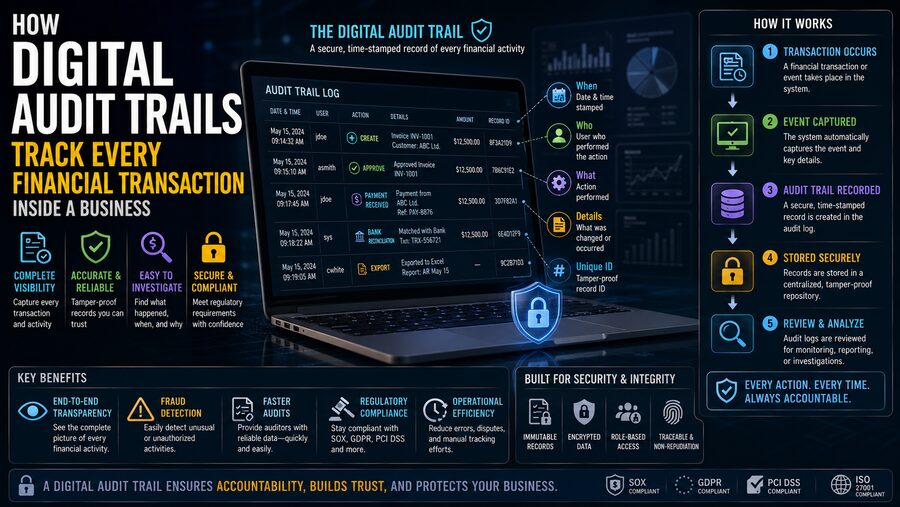
A digital audit trail is a chronological record of financial activity and system events that allows a business to reconstruct what happened from the beginning of a transaction to its final posting, approval, payment, adjustment, or reversal.
Instead of relying only on paper receipts or human memory, modern accounting and enterprise software automatically records a large amount of transaction history behind the scenes.
The result is a traceable chain such as:
Purchase request → Approval → Purchase order → Supplier invoice → Payment → General ledger entry → Bank reconciliation
Each step leaves digital evidence.
🧾 What Is an Audit Trail?
An audit trail is a record that allows someone to follow a transaction through a system.
In accounting, it connects the original business event to the financial records created from that event.
For example, imagine a business buys a new office computer for $2,000.
A complete audit trail might contain:
- Purchase request
- Manager approval
- Purchase order
- Supplier invoice
- Goods-received record
- Payment authorization
- Bank payment
- Accounting entry
- Asset record
An auditor could follow the entire sequence and verify that the transaction was legitimate, properly approved, accurately recorded, and actually paid.
Digital systems automate much of this tracking.
🖥️ Accounting Software Records More Than Just Amounts
When someone enters a transaction into modern accounting or enterprise software, the system may record far more than:
Amount: $2,000
It may also store:
- Transaction ID
- User ID
- Date and time
- Source system
- Account number
- Department
- Cost center
- Currency
- Tax treatment
- Approval status
- Attached invoice
- Change history
Together, these details make the transaction much easier to investigate later.
A unique transaction identifier is especially important because it allows multiple systems and documents to refer to the same financial event.
🆔 Unique IDs Make Transactions Traceable
Suppose a company creates purchase order:
PO-84721
That identifier may appear in:
- Procurement software
- Supplier invoice
- Receiving record
- Accounts payable system
- Payment system
- Accounting ledger
An auditor can search for PO-84721 and follow the transaction across multiple stages.
Without consistent identifiers, employees might need to manually compare:
- Supplier names
- Dates
- Amounts
- Product descriptions
Unique IDs dramatically improve traceability.
⏱️ Timestamps Show Exactly When Events Happened
Digital audit trails commonly contain timestamps.
A timestamp may show:
Invoice created: 09:14:32
Manager approved: 10:08:17
Payment released: 15:42:05
This creates a chronological sequence.
Timestamps can help answer questions such as:
- Was an invoice approved before payment?
- Was a transaction entered after the accounting period closed?
- Did someone modify a payment just before it was processed?
- How long did the approval process take?
Precise timing can become extremely important during investigations.
👤 User IDs Show Who Performed Each Action
Most financial software requires individual user accounts.
When an employee performs an action, the system associates that activity with their authenticated identity.
For example:
Created by: Employee 1842
Approved by: Manager 301
Modified by: Accountant 722
This creates accountability.
If several employees share one login, the audit trail becomes much less useful because it becomes difficult to know who actually performed an action.
This is why organizations often prohibit shared credentials for financial systems. 🔐
📝 Audit Trails Record Changes, Not Just Final Values
Suppose an employee enters an invoice amount as:
$1,250
Later someone changes it to:
$12,500
If the system stored only the final value, the original amount would disappear.
A strong audit trail may instead record:
Original value: $1,250
Changed to: $12,500
Changed by: User 722
Time: 14:37
Reason: Invoice correction
This type of change history is crucial.
It prevents important financial records from quietly changing without evidence.
❌ Deleting a Transaction Should Leave Evidence
In well-controlled systems, deleting a financial record does not necessarily make its history disappear.
The system may record:
- Original transaction
- Deletion request
- User who deleted it
- Date and time
- Reason
- Approval
Some systems avoid physical deletion entirely.
Instead, a transaction may be marked:
Voided
or:
Reversed
This preserves historical integrity.
For example, rather than erasing an incorrect $5,000 payment entry, the accounting system might create an opposite entry:
Original payment: -$5,000
Reversal: +$5,000
The audit trail remains intact.
🔄 Reversals Are Better Than Silent Editing
Accounting systems often prefer reversal entries because they make corrections transparent.
Imagine an invoice was accidentally recorded twice.
Instead of deleting the second entry without explanation, the system may record a correcting reversal.
This creates:
Transaction entered → Error identified → Reversal posted → Correct balance restored
An auditor can see exactly what happened.
This approach supports one of the core principles of accounting control:
Corrections should be visible and explainable.
📚 The General Ledger Is a Central Financial Record
Most businesses maintain a general ledger.
The general ledger contains financial accounts such as:
- Cash
- Accounts receivable
- Accounts payable
- Revenue
- Expenses
- Inventory
- Fixed assets
Each business transaction eventually affects one or more ledger accounts.
For example, when a customer pays an invoice:
Cash increases
and:
Accounts receivable decreases
The audit trail links this accounting entry back to the original customer invoice and payment.
🔗 Source Documents Provide Evidence
Financial transactions should generally be supported by source documents.
Examples include:
- Receipts
- Supplier invoices
- Customer invoices
- Contracts
- Purchase orders
- Bank statements
- Expense reports
Modern accounting systems often allow these documents to be uploaded and attached directly to transactions. 📎
An auditor can click on a ledger entry and immediately view the supporting invoice.
This is much faster than searching through filing cabinets.
🏷️ Metadata Adds Context
Digital documents usually contain additional descriptive information called metadata.
For a supplier invoice, metadata might include:
- Supplier name
- Invoice number
- Date
- Purchase order
- Department
- Project
- Payment status
Metadata improves searching and reporting.
Instead of manually opening thousands of files, an auditor can filter:
All payments over $50,000 approved by Manager X during March
This ability makes digital audits dramatically more powerful.
✅ Approval Workflows Become Part of the Audit Trail
Many financial transactions require approval.
For example:
Employee submits expense → Supervisor approves → Finance reviews → Payment issued
The software records every stage.
An audit history might show:
Submitted: 08:43
Supervisor approved: 10:16
Finance rejected: 11:22
Employee corrected receipt: 13:05
Finance approved: 14:30
This creates evidence that internal procedures were followed.
💰 Different Amounts May Require Different Approvals
Businesses often use approval limits.
For example:
Below $1,000 → Department manager
$1,000–$10,000 → Director
Above $10,000 → Finance executive
The system can automatically route transactions according to these rules.
The audit trail then proves which approval level was used.
This reduces the risk of employees bypassing authorization policies.
🛡️ Segregation of Duties Reduces Fraud Risk
A strong financial system avoids giving one person complete control over a transaction.
Imagine one employee could:
Create supplier → Enter invoice → Approve invoice → Send payment
That would create a serious fraud risk.
Instead, responsibilities may be separated:
Employee A creates supplier
Employee B enters invoice
Manager C approves payment
Treasury releases funds
The audit trail records each participant.
This is known as segregation of duties.
It makes unauthorized transactions more difficult to conceal.
🏦 Bank Transactions Are Reconciled With Accounting Records
A company’s accounting system may say:
Cash balance = $450,000
The bank independently maintains its own record.
Businesses regularly perform bank reconciliation to compare the two.
Differences may result from:
- Outstanding checks
- Bank fees
- Deposits in transit
- Errors
- Unauthorized transactions
Digital systems can automatically match bank transactions with accounting entries.
The audit trail can then show:
Bank transaction XYZ matched to payment transaction ABC
This improves accuracy and fraud detection.
🤖 Automated Matching Can Process Thousands of Transactions
Large companies may process huge numbers of transactions.
Manually matching each one would be slow.
Modern financial software can compare:
- Amount
- Date
- Reference number
- Supplier
- Bank account
and automatically identify likely matches.
Unmatched transactions are flagged for human review.
This allows employees to focus on exceptions rather than repetitive verification. ⚙️
🚨 Exceptions Are Extremely Important
A good audit system does not only record normal transactions.
It also highlights unusual events.
Examples include:
- Duplicate invoices
- Payments just below approval limits
- Transactions posted late at night
- Unexpected vendor bank-account changes
- Large manual journal entries
- Repeated failed login attempts
These events may be harmless, but they deserve attention.
Audit analytics systems can detect patterns that might indicate mistakes or fraud.
🔍 Continuous Auditing Is Becoming More Common
Traditional audits often examined historical transactions periodically.
Digital systems allow more continuous monitoring.
Software can automatically scan transactions every day.
For example:
If payment > $100,000 → Flag for review
If supplier bank account changes → Alert finance
If same invoice number appears twice → Block payment
This turns auditing from a purely retrospective activity into an ongoing control system.
📊 Logs Track System Activity Beyond Accounting Entries
Financial software often generates system logs.
These logs may record:
- User login
- Failed login
- Password reset
- Permission change
- Data export
- Report generation
- Configuration modification
Suppose a suspicious payment occurs.
Investigators may examine not only the transaction itself but also:
Who logged in?
From which device?
Were permissions changed first?
Was data exported afterward?
System logs expand the audit trail beyond pure accounting.
🔐 Access Controls Determine What Employees Can Do
Financial systems use permissions to limit actions.
For example:
Accounts payable clerk: Can enter invoices.
Manager: Can approve invoices.
Treasury: Can release payments.
Auditor: Can view records but cannot modify them.
This is called role-based access control.
The audit trail records both activity and, often, changes to those permissions.
If an employee suddenly receives administrator access, that change should itself be traceable.
🧾 Journal Entries Receive Special Attention
Not every financial event begins with an invoice or payment.
Accountants also create journal entries.
These can record:
- Accruals
- Depreciation
- Corrections
- Reclassifications
Because manual journal entries can directly affect financial statements, companies often require detailed controls.
The audit trail may record:
- Entry creator
- Supporting explanation
- Attached documentation
- Approver
- Posting time
- Reversal date
Large or unusual manual entries may receive extra review.
📅 Accounting Periods Can Be Locked
At the end of a month, quarter, or year, financial records are often closed.
Once reports are finalized, businesses may lock the accounting period.
This prevents ordinary users from quietly entering old transactions after reports have been produced.
If a late adjustment is necessary, special authorization may be required.
The audit trail records the override.
This helps preserve the integrity of historical financial statements.
🔒 Immutable Logs Make Tampering Harder
Some audit systems are designed so historical logs are difficult or impossible for ordinary users to modify.
This concept is often called immutability.
An immutable log may allow:
New event → Append to history
but not:
Old event → Secretly rewrite
This is valuable because an audit trail is useless if someone can easily alter the evidence.
Organizations may use restricted databases, write-once storage, cryptographic methods, or other controls to protect logs.
🔗 Cryptographic Hashes Can Reveal Changes
A cryptographic hash produces a digital fingerprint of data.
If even a small part of the underlying record changes, the hash usually changes dramatically.
Systems can use hashes to help detect tampering.
For example:
Original invoice → Hash ABC123
If someone secretly modifies the file:
Modified invoice → Hash XYZ789
The mismatch indicates that the document changed.
Hashes do not automatically prove that a transaction is legitimate, but they can help preserve data integrity.
⛓️ Blockchain Is One Possible Audit Technology
Blockchain systems are sometimes discussed as audit-trail technology because they create linked records that are difficult to alter retroactively.
However, most business audit trails do not require blockchain.
Traditional databases with strong access control, logging, backups, and integrity protections can provide excellent auditability.
The appropriate technology depends on the business problem.
The important objective is not using a fashionable tool.
It is maintaining trustworthy, traceable records.
☁️ Cloud Accounting Systems Still Need Audit Controls
Many businesses now use cloud-based financial platforms.
The accounting system may run in a vendor’s data center rather than on company-owned servers.
Cloud systems can provide advantages such as:
- Centralized updates
- Automated backups
- Remote access
- Integrated logging
But businesses still need controls around:
- User permissions
- Authentication
- Data exports
- Configuration
- Integrations
Moving software to the cloud does not eliminate financial-control responsibilities.
🔌 Integrations Create More Audit Complexity
Modern businesses connect many systems.
A transaction may travel through:
Online store → Payment processor → ERP → Accounting system → Bank
Every system may generate its own transaction ID.
A strong audit architecture maintains links between them.
For example:
E-commerce order: ORD-4421
Payment ID: PAY-9938
Invoice ID: INV-8812
Ledger ID: GL-22874
Cross-references allow investigators to reconstruct the complete journey.
💳 Credit-Card Transactions Generate Multiple Records
Imagine a customer buys a product online.
The audit trail might include:
1. Order placed.
2. Card authorization requested.
3. Payment processor approves.
4. Customer invoice created.
5. Revenue recorded.
6. Payment settles to business bank account.
7. Bank deposit reconciled.
If the customer later requests a refund, additional records appear.
The original transaction remains part of the history.
↩️ Refunds Should Link Back to Original Transactions
A refund should not appear as a mysterious standalone payment.
Ideally, the system links:
Refund → Original customer order → Original payment
This allows auditors to verify:
- Why the refund occurred
- Who approved it
- Whether the customer actually paid originally
- Whether the refund amount was correct
Unusual refund activity can also be a fraud indicator.
👻 “Ghost Vendors” Are a Classic Fraud Risk
A dishonest employee might attempt to create a fake supplier and send company money to an account they control.
Digital audit trails make this more difficult.
Investigators can examine:
- Who created the vendor
- Who changed bank details
- Which invoices were submitted
- Who approved payments
- Whether addresses or accounts match employees
Analytics can identify suspicious relationships.
For example:
Supplier bank account = Employee bank account
would generate a serious warning.
🤖 AI Can Help Analyze Audit Trails
Large businesses generate more financial events than humans can manually inspect.
Machine learning and analytics systems can help identify unusual patterns.
For example, they may detect:
- Abnormal payment sizes
- Unexpected timing
- New supplier behavior
- Duplicate invoices
- Suspicious approval patterns
These tools do not replace auditors.
Instead, they help prioritize transactions that deserve human investigation. 🤖🔍
🧮 Benford’s Law Can Sometimes Support Fraud Analysis
Auditors sometimes use statistical techniques to identify unusual datasets.
One famous example is Benford’s Law, which describes expected patterns in the leading digits of many naturally occurring numerical datasets.
If a financial dataset deviates strongly from expected patterns, it may justify additional investigation.
However, Benford’s Law is not proof of fraud.
Many legitimate datasets do not follow it well.
It is best understood as one possible analytical screening tool.
🧑⚖️ External Auditors Rely on Audit Trails
Independent auditors examine financial records to determine whether financial statements are fairly presented under applicable standards.
Digital audit trails can help them:
- Select transaction samples
- Inspect approvals
- Verify invoices
- Reconcile balances
- Review changes
- Test controls
Instead of tracing paper through multiple departments, auditors can access structured digital evidence.
This can make audits more efficient.
🏛️ Regulators May Require Record Retention
Businesses often need to retain financial records for specified periods.
Requirements vary according to:
- Country
- Industry
- Tax rules
- Corporate laws
- Regulatory obligations
Digital audit systems therefore need retention policies.
Deleting logs too early can create compliance problems.
Keeping everything forever can also create unnecessary storage and privacy risks.
Organizations balance legal, operational, and security requirements.
🗂️ Backups Protect Audit History
An audit trail provides little value if a system failure destroys it.
Businesses therefore maintain backups and disaster-recovery arrangements.
Important financial records may be replicated across multiple storage systems.
A strong design might use:
Primary database → Replica → Backup archive
This helps protect against:
- Hardware failure
- Accidental deletion
- Software corruption
- Ransomware
Auditability depends on availability as well as integrity.
🕵️ Investigators Can Reconstruct a Suspicious Transaction
Imagine a company discovers an unexplained $75,000 payment.
An investigator might follow this sequence:
1. Find the ledger entry.
2. Identify payment ID.
3. Open the supplier invoice.
4. Check purchase order.
5. Review approval history.
6. Identify who created the supplier.
7. Examine recent bank-account changes.
8. Check system login logs.
9. Compare bank settlement data.
Within minutes, a well-designed digital system may reconstruct events that would have taken days using paper records.
📈 Audit Trails Improve Operations, Not Just Compliance
Audit data is also valuable for improving business processes.
Managers can analyze:
- Average invoice approval time
- Number of rejected expenses
- Late supplier payments
- Frequency of corrections
Suppose invoices consistently wait three days for one department’s approval.
The company can redesign the workflow.
Audit trails therefore support both:
Control and process improvement.
⚠️ Logging Everything Creates Its Own Challenges
More logging is not automatically better.
A large organization may generate billions of log events.
If records are poorly structured, investigators can still struggle to find useful information.
Effective audit systems need:
- Clear event types
- Consistent identifiers
- Search tools
- Retention policies
- Access restrictions
The objective is meaningful traceability rather than endless data accumulation.
🔐 Audit Logs Are Sensitive Data
Audit trails can reveal:
- Employee activity
- Financial transactions
- Customer details
- Supplier information
Therefore, access must be controlled.
Ironically, the audit trail itself can become a security target.
Only authorized users should be able to view or export sensitive logs.
Access to the audit system may itself be logged.
🧩 A Simplified Digital Audit-Trail Example
Imagine a company purchases $25,000 of manufacturing equipment.
The digital trail might look like:
1. Engineer submits purchase request. 📝
2. Department manager approves. ✅
3. Procurement creates purchase order. 📄
4. Supplier ships equipment. 🚚
5. Warehouse confirms receipt. 📦
6. Supplier invoice enters accounts payable. 💳
7. Software matches invoice with purchase order and receipt. 🔗
8. Finance approves payment.
9. Bank transfer is released. 🏦
10. Accounting system posts the asset and payable entries. 📊
11. Bank reconciliation confirms settlement.
Every step receives identifiers, timestamps, user records, and supporting documentation.
An auditor can move backward or forward through the chain.
🔄 Three-Way Matching Is a Powerful Control
Many purchasing systems use three-way matching.
The system compares:
Purchase order
Goods-received record
Supplier invoice
Suppose the purchase order says:
100 units × $50 = $5,000
The warehouse confirms:
100 units received
The supplier invoice says:
$5,000
Everything matches.
The invoice may proceed automatically.
If the supplier invoice says:
$8,000
the system flags the discrepancy.
This automated control prevents many errors before payment occurs.
🚨 Audit Trails Do Not Automatically Prevent Fraud
A common misconception is that logging activity makes fraud impossible.
It does not.
A dishonest person may still manipulate transactions.
The purpose of an audit trail is to make activity:
- More visible
- More traceable
- Harder to conceal
Strong financial control therefore combines:
Audit trail + Permissions + Approval workflows + Segregation of duties + Reconciliation + Monitoring
No single layer is sufficient by itself.
🧠 Good Audit Trails Answer Five Basic Questions
A strong digital audit trail should make it possible to answer:
Who? 👤
Who performed the action?
What? 📝
What changed or occurred?
When? ⏱️
When did it happen?
Where? 💻
Which system, account, or device was involved?
Why? 📄
What business reason or supporting document justified it?
When these questions can be answered reliably, financial activity becomes much easier to verify.
🛡️ Internal Controls and Audit Trails Work Together
An internal control defines what should happen.
The audit trail proves what actually happened.
For example:
Control: Payments above $50,000 require two approvals.
Audit trail: Payment $75,000 approved by Manager A and Director B at recorded times.
This distinction is important.
Policies alone provide intention.
Audit trails provide evidence.
📊 Digital Auditing Enables Much Larger Samples
Historically, auditors often examined samples because manually reviewing every transaction was impractical.
Modern digital systems make it possible to analyze much larger portions of a company’s data.
Automated systems can scan every transaction for rules such as:
Duplicate payment?
Missing approval?
Unusual amount?
Suspicious supplier?
This does not eliminate sampling entirely, but it allows much broader automated screening.
✅ Final Thoughts
Digital audit trails track financial transactions by creating a detailed, chronological record of what happens as money, documents, approvals, and accounting entries move through a business. 💳📊
Instead of storing only a final number, modern financial systems may record:
Transaction IDs, timestamps, user identities, approval history, document attachments, account changes, reversals, login activity, and system events.
This creates a chain of evidence connecting an original business event to the company’s financial statements.
A supplier payment can be traced back to its invoice, purchase order, approval, receiving record, bank transfer, and general ledger entry.
If something changes later, the system can preserve the previous value and record who made the modification.
Strong audit trails work together with role-based access control, segregation of duties, approval workflows, bank reconciliation, immutable logging, backups, and automated fraud monitoring. 🔐🛡️
They help businesses detect mistakes, investigate suspicious activity, prove compliance, improve internal processes, and give auditors confidence that financial records reflect real events.
The central principle is simple:
Every important financial action should leave a trustworthy digital footprint.
When this principle is implemented well, a business does not have to rely on memory or scattered paperwork to understand what happened.
It can reconstruct the complete story of a transaction—from the moment someone requested money to the moment that money appeared in the accounting system and bank records.
That is what makes digital audit trails such an important foundation of modern financial control: they transform complex financial activity into a traceable history that can be searched, verified, and investigated whenever necessary. 🔍💼✨