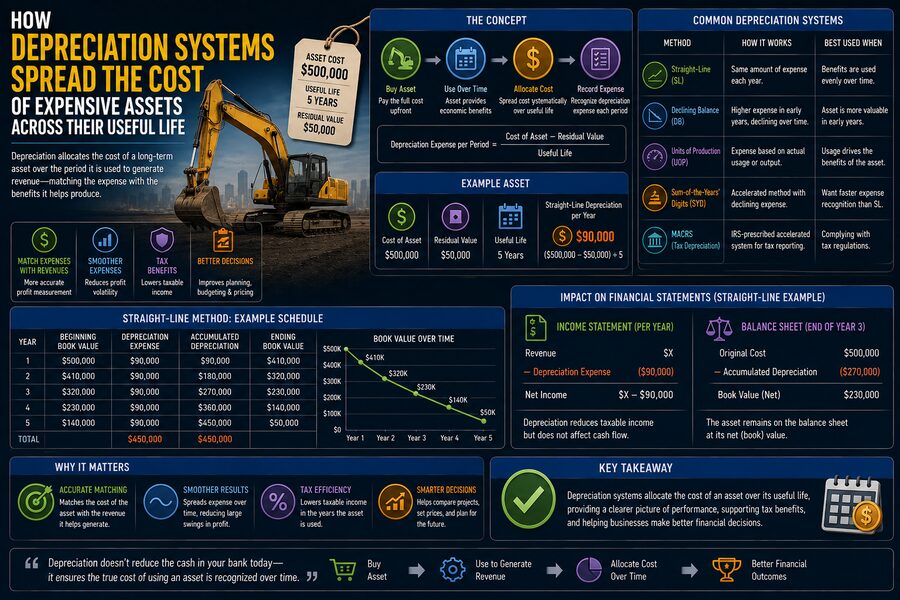

When a company buys an expensive asset—such as a truck, factory machine, computer server, office building, or piece of manufacturing equipment—it usually does not treat the entire purchase price as an expense in the year the asset was bought.
Instead, accounting systems generally spread the cost across the years in which the asset is expected to help the business generate revenue.
This process is called depreciation. 📉
Depreciation helps financial statements reflect the economic reality that long-term assets provide benefits over multiple accounting periods. Rather than making one year look extremely unprofitable because of a major equipment purchase and later years look artificially profitable, depreciation allocates the asset’s cost gradually over its useful life.
The core idea is:
Buy a long-term asset today → use it for several years → recognize its cost gradually over those years.
Depreciation is one of the most important concepts in financial accounting because it affects profit, asset values, taxes, budgeting, and investment analysis.
🏭 Why Companies Do Not Expense Major Assets Immediately
Imagine a manufacturing company buys a machine for $500,000.
The machine is expected to operate for 10 years.
If the company recorded the entire $500,000 as an expense in the first year, that year’s profit would fall sharply.
But the machine would continue producing goods for another nine years.
Economically, the cost belongs to more than just the first year.
Accounting therefore normally treats the machine as a capital asset.
When it is purchased, the company records it on the balance sheet as an asset rather than immediately recognizing the full amount as an operating expense.
Then, over time, a portion of its cost is recognized as depreciation expense. ⚙️
📊 The Matching Principle Behind Depreciation
One of the traditional ideas behind depreciation is the accounting concept of matching expenses with the periods that benefit from them.
Suppose a delivery truck helps a company make deliveries for six years.
Those six years benefit from the truck.
It therefore makes more sense to allocate the truck’s depreciable cost across those six years than to charge everything against profit in the year it was purchased.
This produces financial statements that better represent the relationship between:
Revenue earned
and
resources consumed to generate that revenue.
Depreciation is therefore not simply about estimating how much an asset’s market price falls each year. It is primarily an accounting allocation process. 📚
🧮 The Three Key Inputs in Depreciation
Most depreciation calculations depend on three fundamental estimates:
1. 💵 Asset Cost
This is generally the amount required to acquire the asset and prepare it for use.
Depending on accounting rules and circumstances, this may include:
- Purchase price
- Delivery costs
- Installation
- Testing
- Certain professional fees
- Other directly attributable costs
For example, if a machine costs $90,000 and installation costs $10,000, its capitalized cost might be:
$100,000
2. ⏳ Useful Life
The useful life represents how long the company expects the asset to provide economic benefit.
It may be measured in:
- Years
- Production units
- Operating hours
- Kilometers traveled
Useful life is an accounting estimate, not necessarily the maximum physical life of the asset.
A computer may still function after eight years but be considered to have a useful life of four years because technology changes rapidly.
3. ♻️ Residual or Salvage Value
Residual value is the amount the company expects to recover when the asset reaches the end of its useful life.
For example, a vehicle purchased for $60,000 might be expected to sell for $10,000 after five years.
Its depreciable amount would therefore be:
$60,000 – $10,000 = $50,000
📉 Straight-Line Depreciation
The simplest and one of the most common depreciation methods is straight-line depreciation.
The formula is:
Annual Depreciation = (Cost – Residual Value) ÷ Useful Life
Suppose a company purchases equipment for:
$120,000
Estimated residual value:
$20,000
Useful life:
5 years
The depreciable amount is:
$120,000 – $20,000 = $100,000
Annual depreciation is:
$100,000 ÷ 5 = $20,000
So the company records:
$20,000 of depreciation expense each year.
The carrying value of the asset gradually decreases:
Beginning Cost:        $120,000
After Year 1:          $100,000
After Year 2:           $80,000
After Year 3:           $60,000
After Year 4:           $40,000
After Year 5:           $20,000
The final $20,000 equals the estimated residual value. 📊
📚 What Is Accumulated Depreciation?
Companies do not normally reduce the historical cost account directly each time depreciation is recorded.
Instead, they often use a separate account called accumulated depreciation.
Suppose a machine originally cost:
$100,000
After three years, accumulated depreciation is:
$45,000
The balance sheet might effectively show:
Machine at Cost:                 $100,000
Less: Accumulated Depreciation:  $45,000
Net Book Value:                   $55,000
The net book value, also called carrying amount, is:
Original Cost – Accumulated Depreciation
Accumulated depreciation keeps track of how much of the asset’s depreciable cost has already been recognized as expense. 🧾
⚡ Accelerated Depreciation
Some assets provide more economic benefit—or lose usefulness more rapidly—during their early years.
For those assets, companies may use an accelerated depreciation method.
Accelerated depreciation recognizes:
More depreciation in earlier years
and
Less depreciation in later years.
One common example is the declining-balance method.
Instead of applying depreciation evenly to the original depreciable amount, a fixed rate is applied to the asset’s declining book value.
This can better reflect assets such as:
- Vehicles
- Computers
- Technology equipment
- Certain machinery
These assets may experience rapid obsolescence or higher productivity early in their useful lives. 💻🚗
📉 Double-Declining Balance Example
Suppose an asset costs:
$100,000
and has a useful life of:
5 years
The straight-line rate would be:
1 ÷ 5 = 20% per year
Under a double-declining-balance method, the rate might be:
40% per year
In the first year:
$100,000 × 40% = $40,000 depreciation
The remaining book value becomes:
$60,000
In the second year:
$60,000 × 40% = $24,000 depreciation
The book value then falls to:
$36,000
This produces much higher depreciation expense in the early years compared with straight-line depreciation.
However, depreciation generally cannot reduce the asset below its applicable residual value. ⚠️
🏗️ Units-of-Production Depreciation
Some assets wear out based more on usage than on time.
A mining machine, for example, may deteriorate according to the amount of material it processes.
In these cases, a company may use the units-of-production method.
A simplified formula is:
Depreciation per Unit = (Cost – Residual Value) ÷ Estimated Total Units
Then:
Annual Depreciation = Depreciation per Unit × Units Produced During the Year
Suppose a machine costs:
$210,000
Residual value:
$10,000
Expected lifetime production:
1,000,000 units
Depreciable amount:
$200,000
Depreciation per unit:
$200,000 ÷ 1,000,000 = $0.20 per unit
If the machine produces 150,000 units during the year:
150,000 × $0.20 = $30,000 depreciation
This approach aligns depreciation with actual asset use. 🏭
🚚 Usage-Based Depreciation Can Match Physical Wear
The same logic can apply to vehicles and equipment.
A truck might be depreciated based on expected kilometers traveled.
An aircraft component might be evaluated based on flight cycles.
Industrial equipment might be allocated based on operating hours.
This can be useful when activity varies substantially from one period to another.
A machine operating 20 hours per day may consume its economic usefulness more quickly than an identical machine operating only two hours per day.
Usage-based depreciation attempts to capture that difference. ⏱️
💵 Depreciation Expense Reduces Accounting Profit
Depreciation appears as an expense in the income statement.
Suppose a company has:
Revenue: $1,000,000
Other expenses:
$700,000
Depreciation:
$100,000
Accounting profit before other items would be:
$1,000,000 – $700,000 – $100,000 = $200,000
Without depreciation, reported profit would have been $300,000.
This means depreciation can significantly affect profitability measures.
However, one important distinction must be understood:
Depreciation expense does not usually represent a new cash payment each year. 💡
The cash was generally spent when the asset was purchased.
💸 Depreciation Is a Non-Cash Expense
Suppose a company paid $500,000 in cash for machinery in Year 1.
That is when the cash leaves the company.
If the machine is depreciated over 10 years, the company might record:
$50,000 of depreciation expense each year
But it is not paying another $50,000 every year simply because depreciation is recorded.
This is why depreciation is called a non-cash expense.
It reduces accounting profit without directly causing an equivalent current-period cash outflow.
This distinction is critical when analyzing financial statements. 📊
💰 Why Depreciation Appears in Cash-Flow Analysis
Because depreciation reduces net income but does not itself consume cash in the current period, it is often added back when calculating operating cash flow under the indirect method.
A simplified cash-flow adjustment might look like:
Net Income                           $200,000
Add Back: Depreciation                $50,000
Adjusted for Depreciation             $250,000
Other working-capital and non-cash adjustments would also be included.
This does not mean depreciation creates cash.
It simply reverses an accounting expense that reduced reported profit without representing a current cash payment.
🧾 Book Depreciation and Tax Depreciation Can Be Different
Companies may calculate depreciation differently for financial reporting and taxation.
Book depreciation follows the accounting framework used for financial statements.
Tax depreciation follows rules established by the relevant tax authority.
Tax systems may allow:
- Accelerated depreciation
- Special allowances
- Immediate deductions for qualifying assets
- Prescribed asset classes
- Different useful lives
As a result, the depreciation expense shown in financial statements may differ from the deduction used when calculating taxable income.
This can create temporary differences and may lead to deferred tax assets or liabilities under applicable accounting standards. ⚖️
🏢 Buildings Are Depreciated Differently From Land
Land and buildings are often purchased together, but accounting typically treats them differently.
A building generally has a finite useful life and may therefore be depreciated.
Land, in many accounting circumstances, is not depreciated because it is usually considered to have an indefinite useful life.
For example:
Land:      $300,000
Building:  $700,000
Total:   $1,000,000
The company might depreciate the $700,000 building component but not the $300,000 land component.
This illustrates why accountants may need to separate a purchase price among different asset components. 🏢
🧩 Component Depreciation
Some expensive assets consist of major components with different useful lives.
Consider a commercial aircraft.
Its:
- Airframe
- Engines
- Interior
- Major inspection components
may not all have the same economic life.
Similarly, a building may contain:
- Roof
- Elevators
- HVAC systems
- Structural shell
Certain accounting frameworks may require or encourage significant components to be depreciated separately when they have materially different useful lives.
This is called component depreciation.
It can produce a more accurate representation of how the asset’s economic benefits are consumed. ✈️
🔧 Repairs and Improvements Are Not Always Treated the Same
A business spends money on assets after purchasing them.
But not every later expense is capitalized.
Ordinary repairs and maintenance are often expensed as incurred because they simply keep the asset operating in its existing condition.
For example:
Routine oil change → expense
A major upgrade that significantly extends useful life or increases capacity may qualify for capitalization, depending on accounting rules.
For example:
Major production-line upgrade → potentially capitalized
If capitalized, the cost may itself be depreciated over an appropriate useful life.
The distinction can materially affect profit in the current year. 🔩
⏳ Useful Life Is an Estimate
Companies do not know with certainty how long an asset will remain useful.
An asset may become obsolete earlier than expected.
Another may remain productive for much longer.
Accountants therefore periodically review assumptions such as:
- Useful life
- Residual value
- Expected usage
If new information shows that the original estimate is no longer reasonable, future depreciation may need to be adjusted.
For example, a machine originally expected to last 10 years may, after several years of operation, be expected to last 15 years.
The remaining book value can then be allocated over the revised remaining useful life, subject to the applicable accounting framework. 🔄
🚨 Depreciation Is Not the Same as Impairment
Depreciation gradually allocates cost over time.
Impairment is different.
An impairment may occur when an asset’s recoverable economic value falls unexpectedly.
Potential causes include:
- Physical damage
- Technological obsolescence
- Loss of a major customer
- Market collapse
- Regulatory changes
Suppose a machine has a book value of $400,000, but a major technological change makes its expected recoverable value much lower.
The company may need to recognize an impairment loss in addition to normal depreciation.
Depreciation is planned allocation.
Impairment responds to unexpected loss in value or recoverability. ⚠️
📉 Book Value Is Not Necessarily Market Value
Another common misconception is that an asset’s net book value represents what it could be sold for.
Not necessarily.
A machine may have a book value of:
$50,000
but could sell for:
$80,000
Or it might be worth only:
$20,000
Depreciation is based on accounting allocation and estimates.
Market value depends on actual buyer demand, condition, technology, location, and other factors.
This is why accounting book value and economic market value can differ significantly. 💵
🏭 Depreciation Helps Calculate Product Costs
In manufacturing, depreciation can become part of product cost.
Suppose a factory machine is used to produce thousands of units.
Its depreciation may be treated as part of manufacturing overhead.
That cost is then allocated to the goods being produced.
This helps companies estimate the real economic cost of production.
Without considering depreciation, management might underestimate how much it actually costs to use expensive machinery.
That could lead to poor pricing and investment decisions. 📦
📊 Depreciation Affects Financial Ratios
Depreciation influences many financial metrics.
Because it reduces earnings, it can affect:
- Operating profit
- Net income
- Return on assets
- Asset turnover
- Profit margins
Analysts also use measures such as EBITDA, which stands for earnings before interest, taxes, depreciation, and amortization.
EBITDA adds depreciation back when evaluating certain aspects of operating performance.
However, ignoring depreciation entirely can be misleading for capital-intensive businesses.
A railway, airline, utility, or factory must eventually replace expensive assets.
Even though depreciation is non-cash in the current period, the economic consumption of equipment is very real. 🚆✈️🏭
🧠 Depreciation Influences Investment Decisions
Managers use depreciation when evaluating the economics of capital projects.
Suppose a business is deciding whether to purchase an automated production machine.
The analysis may consider:
- Purchase cost
- Expected useful life
- Maintenance
- Energy savings
- Labor savings
- Residual value
- Tax depreciation
- Expected cash flows
Depreciation itself is not a cash outflow after purchase, but tax depreciation can influence cash flow by reducing taxable income.
Therefore, depreciation can affect measures such as:
- Net present value
- Internal rate of return
- Project payback
- After-tax cash flow
This makes depreciation relevant not just to accountants but also to financial managers and engineers evaluating capital investments. 🧮
💻 Software Often Automates Depreciation Schedules
Large organizations may own thousands or millions of depreciable assets.
Tracking them manually would be difficult.
Fixed-asset management systems can automatically maintain information such as:
- Asset identification number
- Acquisition date
- Original cost
- Useful life
- Depreciation method
- Residual value
- Current book value
- Accumulated depreciation
- Department
- Physical location
Each accounting period, the software calculates depreciation automatically.
This allows organizations to maintain consistent records across large asset portfolios. 🖥️
🧾 Example: Comparing Two Depreciation Methods
Consider a machine with:
Cost = $100,000
Residual value = $0
Useful life = 5 years
Under straight-line depreciation:
Year 1: $20,000
Year 2: $20,000
Year 3: $20,000
Year 4: $20,000
Year 5: $20,000
Total depreciation:
$100,000
An accelerated method might instead produce something like:
Year 1: $40,000
Year 2: $24,000
Year 3: $14,400
Year 4: Remaining permitted amount
Year 5: Remaining permitted amount
Both methods ultimately allocate the asset’s depreciable amount.
The difference is when the expense is recognized.
This timing difference affects reported profit in individual years. 📅
🔍 Why Depreciation Methods Matter to Investors
Investors comparing companies should pay attention to depreciation policies.
Two companies could own similar assets but report different depreciation expenses because they use:
- Different useful-life estimates
- Different residual values
- Different depreciation methods
A company using longer useful lives will generally recognize less depreciation each year, which can increase short-term reported profit.
That does not automatically mean the company is more profitable economically.
Financial analysts therefore examine accounting policies, footnotes, capital expenditures, asset age, and depreciation trends when evaluating capital-intensive businesses. 🔎
🔄 Depreciation Ends When the Depreciable Amount Is Allocated
Once an asset has been fully depreciated to its residual value, normal depreciation generally stops.
But the asset may continue operating.
Imagine a machine that has a five-year accounting life but remains productive for eight years.
After Year 5, its book value may already equal its residual value.
The company may continue using it without recording further depreciation beyond that amount.
This situation shows again that useful life is an estimate of economic allocation—not necessarily the exact date on which an asset physically stops functioning. ⚙️
🗑️ What Happens When an Asset Is Sold or Retired?
Eventually, the company may sell, scrap, or retire the asset.
At that point, the asset’s original cost and accumulated depreciation are removed from the accounting records.
The company compares the proceeds received with the asset’s carrying amount.
Suppose:
Original cost = $100,000
Accumulated depreciation = $80,000
Therefore:
Book value = $20,000
If the asset is sold for:
$30,000
the company may recognize a:
$10,000 gain
If it is sold for:
$15,000
the company may recognize a:
$5,000 loss
This final adjustment closes the asset’s accounting life. 🧾
⚖️ Why Depreciation Improves Financial Comparability
Imagine two companies that each purchase identical $1 million machines expected to last 10 years.
If both immediately expensed the entire purchase, Year 1 profit would collapse while later years would show no expense associated with consuming the machine.
Depreciation smooths that cost across the periods receiving the benefit.
It therefore helps users of financial statements compare:
- Operating performance
- Asset utilization
- Period-to-period profitability
Depreciation does not make earnings perfectly smooth, nor is smoothing its objective.
Its purpose is to systematically allocate depreciable cost using an accounting method appropriate to the asset’s pattern of consumption. 📘
🎯 Final Takeaway
Depreciation systems spread the cost of expensive long-term assets across the periods in which those assets help a business operate and generate economic benefits.
Instead of recording a major machine, vehicle, or building entirely as an expense on the purchase date, companies generally capitalize the asset and recognize depreciation gradually. 💰📉
The main calculation depends on:
Asset cost → residual value → useful life → depreciation method
Straight-line depreciation spreads cost evenly.
Accelerated methods recognize more expense earlier.
Units-of-production methods link depreciation to actual usage.
Regardless of the method, depreciation helps financial statements reflect the gradual consumption of long-lived assets.
It also affects:
- Reported profit
- Asset book values
- Product costs
- Financial ratios
- Taxes
- Investment analysis
Most importantly, depreciation should not be confused with cash spending or market value.
The cash purchase usually occurs when the asset is acquired, while depreciation is an accounting expense recorded over time. And the asset’s book value may differ substantially from what someone would actually pay for it.
The underlying principle is simple:
If an asset provides value for many years, its accounting cost should generally be recognized across those years rather than concentrated entirely in the year it was purchased. 📊🏭💼