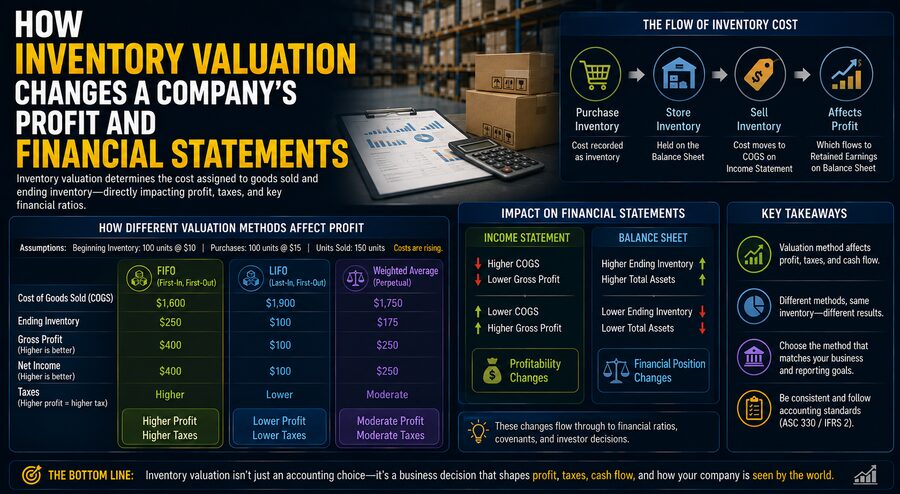

Inventory may look like a simple collection of products sitting in a warehouse, store, factory, or distribution center. From an accounting perspective, however, inventory has a major influence on a company’s reported profit, assets, taxes, and financial ratios.
The reason is straightforward: when inventory is sold, part of its recorded cost moves from the balance sheet to the income statement as Cost of Goods Sold (COGS). The accounting method used to determine which inventory costs are treated as sold can therefore change both reported expenses and the value of inventory remaining on the balance sheet. 📊💰
This process is known as inventory valuation.
Common methods include FIFO, LIFO, weighted-average cost, and specific identification. Even when two companies purchase and sell exactly the same quantities of physical goods, they can sometimes report different gross profits and inventory balances because they use different permitted accounting methods.
Understanding inventory valuation is therefore essential for investors, managers, accountants, business owners, and financial analysts.
🧠 What Is Inventory Valuation?
Inventory valuation is the accounting process used to assign monetary costs to:
- Raw materials
- Work in progress
- Finished goods
- Merchandise held for resale
Suppose a retailer purchases identical products at different prices throughout the year:
100 units at $10 each
100 units at $12 each
100 units at $15 each
The retailer now has 300 physical units that cost a total of:
$1,000 + $1,200 + $1,500 = $3,700
If the company later sells 150 units, accounting must determine:
Which costs should be assigned to the 150 units sold, and which costs should remain in inventory?
That decision changes COGS and ending inventory.
📊 The Fundamental Accounting Relationship
For many merchandising and manufacturing businesses, the inventory relationship can be expressed as:
Beginning Inventory + Purchases − Ending Inventory = Cost of Goods Sold
Or equivalently:
COGS = Beginning Inventory + Purchases − Ending Inventory
This formula reveals why inventory valuation matters.
If ending inventory is valued higher, COGS becomes lower.
If ending inventory is valued lower, COGS becomes higher.
Because gross profit is:
Gross Profit = Revenue − COGS
a change in inventory valuation can directly affect reported profit.
🛒 A Simple Example
Suppose a business buys:
- 100 units at $10
- 100 units at $12
It then sells 100 units for $20 each.
Sales revenue is:
100 × $20 = $2,000
But what is COGS?
That depends on the inventory-costing method.
If the company assigns the older $10 units to the sale:
COGS = $1,000
Gross profit becomes:
$2,000 − $1,000 = $1,000
If it instead assigns the newer $12 units:
COGS = $1,200
Gross profit becomes:
$2,000 − $1,200 = $800
Nothing changed about the selling price or number of units sold.
Only the accounting cost assigned to those units changed.
That $200 difference also affects ending inventory.
📥 FIFO: First In, First Out
FIFO means First In, First Out.
Under FIFO, the oldest inventory costs are assigned to COGS first.
In the previous example:
- First 100 units purchased: $10 each
- Second 100 units purchased: $12 each
- 100 units sold
FIFO assumes the $10 units are sold first.
Therefore:
COGS = $1,000
The remaining inventory consists of the newer $12 units:
Ending Inventory = $1,200
FIFO often resembles the physical flow of goods in industries where older products are sold first, especially for perishable items.
However, FIFO is primarily an accounting cost-flow assumption; physical units do not always have to move in exactly the same sequence.
📤 LIFO: Last In, First Out
LIFO means Last In, First Out.
Under LIFO, the most recently acquired inventory costs are assigned to COGS first.
Using the same example, the latest units cost $12 each.
Therefore:
COGS = $1,200
The older $10 units remain in ending inventory:
Ending Inventory = $1,000
When purchase prices are rising, LIFO often produces:
- Higher COGS
- Lower gross profit
- Lower ending inventory
compared with FIFO.
However, accounting rules matter greatly here. LIFO is permitted under U.S. GAAP in qualifying circumstances but is prohibited under IFRS. 🌍
Therefore, companies reporting under IFRS cannot choose LIFO simply because it would produce a desirable financial result.
⚖️ Weighted-Average Cost
The weighted-average cost method blends inventory costs together.
Using our example:
100 units at $10 = $1,000
100 units at $12 = $1,200
Total:
200 units costing $2,200
Average cost per unit:
$2,200 ÷ 200 = $11
If 100 units are sold:
COGS = 100 × $11 = $1,100
Ending inventory:
100 × $11 = $1,100
The weighted-average method smooths the effect of changing purchase prices.
Depending on whether a company uses a periodic or perpetual inventory system, the detailed calculation may differ. A perpetual system commonly uses a moving average after new purchases.
🏷️ Specific Identification
Specific identification assigns the actual cost of a specific physical item to COGS when that exact item is sold.
This method makes sense when inventory consists of individually identifiable, high-value items.
Examples include:
- 🚗 Automobiles
- 💎 Jewelry
- 🏠 Certain real estate units held for sale
- 🖼️ Fine art
- 🏭 Specialized machinery
If a dealership sells a particular vehicle, it can usually identify exactly how much that vehicle cost.
Specific identification would be impractical for a supermarket trying to track the exact acquisition cost of each nearly identical can of soup.
📈 What Happens When Prices Are Rising?
Inventory valuation becomes particularly noticeable during inflation.
Suppose a company continuously buys the same product, but its purchase cost rises:
January: $10
March: $12
June: $14
September: $16
Under FIFO, older and cheaper costs typically reach COGS first.
That means:
Lower COGS → Higher gross profit
The remaining inventory contains newer, more expensive costs, so the balance sheet often reports a higher inventory value.
Under LIFO, newer and more expensive costs enter COGS first.
That generally means:
Higher COGS → Lower gross profit
and older, cheaper costs remain in inventory.
Weighted average usually produces results between the two.
📉 What If Prices Are Falling?
When acquisition costs are decreasing, the relationship can reverse.
FIFO may assign older, more expensive units to COGS.
LIFO may assign newer, cheaper units.
In that environment, FIFO can produce higher COGS and lower profit than LIFO.
Therefore, statements such as “FIFO always increases profit” are incorrect.
The effect depends on how inventory costs are changing.
💵 Inventory Valuation Changes Gross Profit
Because:
Gross Profit = Sales − COGS
inventory costing can directly influence gross margin.
Suppose two companies each have:
Revenue = $1,000,000
Company A reports:
COGS = $600,000
Gross profit:
$400,000
Company B reports:
COGS = $680,000
Gross profit:
$320,000
If the difference comes primarily from inventory-cost assumptions, their businesses might be operationally similar even though reported profitability appears different.
Analysts therefore examine accounting policies before comparing companies.
🧾 Effect on Operating Income and Net Income
COGS appears near the top of the income statement.
A higher COGS reduces gross profit.
If operating expenses remain unchanged, lower gross profit usually flows through to lower:
- Operating income
- Income before tax
- Net income
Conversely, lower COGS can increase all three.
Inventory valuation therefore affects more than one accounting line.
It can influence headline profitability measures followed by investors and lenders.
🏦 Effect on the Balance Sheet
Unsold inventory is recorded as a current asset on the balance sheet.
Therefore, a valuation method producing higher ending inventory increases reported current assets.
Suppose:
FIFO ending inventory = $500,000
while:
LIFO ending inventory = $420,000
The balance sheet under FIFO would report $80,000 more inventory, all else being equal.
This can affect:
- Total assets
- Working capital
- Current ratio
- Asset turnover
Inventory accounting therefore changes financial-position metrics as well as profitability metrics.
💰 What About Taxes?
When taxable income is influenced by inventory costing, a method producing higher COGS can reduce taxable income in the current period.
In a rising-price environment, LIFO has historically been attractive to some U.S. companies partly because newer, higher inventory costs can be recognized sooner in COGS.
That can reduce current taxable income compared with FIFO.
However, tax rules are jurisdiction-specific, and book and tax reporting requirements can interact in complex ways.
Businesses must follow the tax and accounting rules that apply to them rather than selecting a valuation method solely to manipulate taxes.
💸 Does Inventory Valuation Actually Create Cash?
Not directly.
Choosing FIFO instead of weighted average does not magically put money into a company’s bank account.
Inventory valuation is primarily an accounting allocation of cost.
However, if the permitted method changes the timing of income-tax payments, it can indirectly affect cash flow.
That distinction is important:
Accounting profit effect ≠ automatic cash generation
The underlying purchases and customer payments still determine most operational cash movement.
🔄 Inventory Write-Downs
Cost-flow assumptions are not the only issue.
Inventory can also lose economic value.
Examples include:
- Fashion items becoming obsolete
- Electronics becoming outdated
- Food nearing expiration
- Goods being damaged
- Market selling prices collapsing
Accounting standards generally require inventory to be assessed for impairment under the applicable measurement rules.
Under IFRS, inventory is generally measured at the lower of cost and net realizable value (NRV).
NRV broadly refers to expected selling price less estimated costs required to complete and sell the inventory.
A write-down reduces the inventory asset and generally recognizes an expense, reducing profit.
📱 Example of Inventory Obsolescence
Imagine an electronics retailer carries smartphones recorded at a cost of:
$600 each
A newer model arrives, and the old phones can now realistically be sold for only $500 after considering selling costs.
The business may no longer be able to justify carrying them at the full $600 recorded cost.
A write-down may therefore be required.
If 1,000 units need a $100 reduction:
Inventory write-down = $100,000
That can materially reduce reported earnings.
This is why businesses with fast-changing products must monitor inventory aging closely.
🔄 Can Inventory Write-Downs Be Reversed?
The answer depends on the accounting framework.
Under IFRS, certain inventory write-downs may be reversed if the reasons for the previous reduction no longer exist, subject to limits.
Under U.S. GAAP, the treatment can differ depending on the inventory measurement method and applicable rules.
This is another example of why financial statement analysis requires attention to the accounting framework being used.
🏭 Manufacturing Inventory Is More Complex
Manufacturers do not merely purchase finished goods.
Their inventory often includes:
- Raw materials
- Work in progress
- Finished goods
Product cost may include appropriate amounts of:
- Direct materials
- Direct labor
- Manufacturing overhead
Therefore, decisions about allocating factory costs can influence inventory valuation.
If more manufacturing cost remains in unsold inventory, some expense recognition is delayed until the goods are eventually sold.
Accounting standards provide rules governing which costs may legitimately be included.
⚠️ Overproducing Can Temporarily Affect Reported Profit
Absorption costing creates an important managerial issue.
Fixed manufacturing overhead is allocated across units produced.
If a company produces more units than it sells, part of those fixed manufacturing costs may remain inside ending inventory instead of being recognized immediately through COGS.
This can temporarily increase accounting profit.
For example, management should not manufacture unnecessary products merely to improve short-term reported earnings.
Excess production ties up cash, increases storage costs, and raises obsolescence risk.
Financial analysts therefore sometimes compare production growth with actual sales growth.
📦 Inventory Errors Can Affect Multiple Years
Inventory mistakes are especially important because ending inventory in one period usually becomes beginning inventory in the next.
Suppose ending inventory is overstated by $50,000.
Because:
COGS = Beginning Inventory + Purchases − Ending Inventory
overstating ending inventory reduces COGS by $50,000.
That increases current-period profit by approximately $50,000 before tax effects.
But next year, the overstated ending inventory becomes overstated beginning inventory.
If everything else corrects naturally, that can increase next year’s COGS.
Inventory errors can therefore shift profit between accounting periods.
🔎 Physical Counts Matter
Companies must ensure that accounting inventory actually exists.
Businesses use:
- Annual physical inventory counts
- Cycle counting
- Barcode systems
- RFID
- Warehouse management systems
to compare physical goods with accounting records.
Differences can result from:
- Theft
- Damage
- Shipping errors
- Data-entry mistakes
- Misplaced goods
This difference is often called inventory shrinkage.
Shrinkage reduces inventory value and typically increases expense.
📊 Inventory Turnover
Financial analysts frequently examine inventory turnover.
A common formula is:
Inventory Turnover = COGS ÷ Average Inventory
Higher turnover generally indicates inventory is being sold and replaced more rapidly.
Lower turnover may suggest:
- Slow sales
- Excess stock
- Obsolete products
- Inefficient purchasing
However, ideal turnover varies considerably by industry.
A luxury jewelry business naturally behaves differently from a supermarket.
📅 Days Inventory Outstanding
Another useful metric is Days Inventory Outstanding (DIO).
It estimates how long inventory remains on hand before being sold.
A simplified calculation is:
DIO = Average Inventory ÷ COGS × 365
A rising DIO may indicate that inventory is accumulating faster than sales.
Because different inventory valuation methods influence both inventory and COGS, analysts should consider accounting policy when comparing DIO across companies.
🧮 FIFO and the Balance Sheet During Inflation
During sustained inflation, FIFO ending inventory often reflects newer purchase costs.
This can make the balance-sheet inventory value more representative of relatively recent costs.
However, COGS may contain older, lower costs.
As a result, reported gross margins may appear stronger because current selling prices are being compared with older acquisition costs.
This effect is sometimes described as including inventory holding gains in reported earnings.
🧾 LIFO Layers
Under LIFO, older inventory costs can remain on the balance sheet for many years.
These historical cost groups are often called LIFO layers.
A company’s balance sheet may therefore contain inventory recorded at costs far below current replacement prices.
That can make comparisons with FIFO-reporting companies difficult.
Companies using LIFO may provide additional disclosures that help analysts reconcile these differences.
🧨 LIFO Liquidation
A LIFO liquidation can occur when a company using LIFO sells more inventory than it purchases and begins consuming older cost layers.
If those old layers were recorded at much lower costs, COGS can suddenly fall.
This may temporarily increase reported profit.
The profit increase may not reflect improved operating performance.
Instead, it may result from releasing decades-old low inventory costs into COGS.
Financial analysts watch for this effect when evaluating LIFO companies.
🔍 Why Analysts Adjust Inventory Accounting
Two competing businesses may use different inventory methods.
Directly comparing gross margins without adjusting for those differences can be misleading.
Analysts may review disclosures concerning:
- Costing method
- Inventory reserves
- LIFO reserve
- Write-down policies
- Obsolescence allowances
The goal is to determine whether differences in financial performance are economic or primarily accounting-related.
🏪 Retail Businesses
Retailers often carry thousands of products whose costs change throughout the year.
Inventory valuation can materially affect:
- Gross margin
- Markdown decisions
- Stock planning
- Profit forecasts
Retail industries with fashion or seasonal products face additional risk because unsold inventory can quickly lose value.
A warehouse full of inventory is not automatically a financial strength if customers no longer want those products.
🏗️ Inventory and Working Capital
Inventory is a major component of working capital.
Cash used to buy products remains tied up until those products are sold and customer payments are collected.
Higher reported inventory therefore has two dimensions:
Accounting value and operational cash commitment.
A growing company may report healthy profits while running short of cash because increasing amounts of money are trapped in inventory.
This is why inventory valuation and inventory management should be analyzed together.
🧠 Management Decisions Influenced by Inventory Data
Accurate inventory valuation supports decisions involving:
- Pricing
- Purchasing
- Production planning
- Product discontinuation
- Warehouse capacity
- Cash forecasting
- Profitability analysis
Suppose management believes a product has a 40% margin because its recorded inventory cost is outdated or incomplete.
The company may make poor pricing decisions.
Reliable cost information is therefore not just necessary for financial reporting—it supports better operations.
📋 Consistency Matters
Companies generally cannot switch inventory methods casually whenever one produces a more attractive profit figure.
Accounting frameworks emphasize consistency and comparability.
A legitimate accounting-method change may require justification, proper accounting treatment, and financial-statement disclosures.
This protects users of financial statements from companies repeatedly changing methods simply to manipulate earnings.
🚨 Inventory Manipulation Risk
Because inventory affects both the balance sheet and income statement, it can become an area of financial-reporting risk.
For example, deliberately overstating ending inventory can understate COGS and overstate profit.
Auditors therefore pay close attention to:
- Physical inventory counts
- Cutoff procedures
- Valuation assumptions
- Obsolete inventory
- Cost calculations
Inventory is often one of the most important audit areas for businesses that manufacture or sell physical products.
🤖 Modern Inventory Valuation Systems
Large businesses rarely calculate inventory manually.
Enterprise resource planning systems can track:
- Purchase costs
- Production costs
- Inventory movement
- Warehouses
- Sales
- Cost layers
Barcode scanners and RFID systems can improve quantity tracking.
Modern analytics can also identify slow-moving inventory and forecast potential obsolescence.
Technology improves accuracy, but accounting rules still determine how the recorded data is ultimately reflected in financial statements.
⚖️ Which Inventory Method Is “Best”?
There is no universally best inventory valuation method.
The appropriate method depends on factors such as:
- Applicable accounting standards
- Nature of inventory
- Physical flow of goods
- Industry practices
- Tax rules
- Reporting objectives
Specific identification makes sense for unique high-value items.
Weighted average can work well for large quantities of interchangeable goods.
FIFO is widely used and permitted under both IFRS and U.S. GAAP.
LIFO may be available to certain U.S. GAAP reporters but cannot be used under IFRS.
The important objective is to use an acceptable method consistently and disclose it appropriately.
✨ Conclusion
Inventory valuation changes a company’s financial statements because inventory costs must ultimately be divided between two places:
Cost of Goods Sold on the income statement and ending inventory on the balance sheet. 📦📊
When ending inventory is higher, COGS is generally lower and reported profit is higher, all else being equal.
When ending inventory is lower, COGS is generally higher and reported profit is lower.
Methods such as FIFO, LIFO, weighted-average cost, and specific identification determine how purchase costs are allocated between sold and unsold goods.
During periods of rising prices, FIFO typically produces lower COGS and higher ending inventory than LIFO, while weighted average often falls between them. During falling prices, those relationships can reverse.
Inventory write-downs add another important dimension. Products that become damaged, obsolete, or economically less valuable may need to be carried below their original cost, reducing both assets and profit.
Inventory valuation can therefore influence:
- 💰 Gross profit
- 📈 Net income
- 📦 Current assets
- 🏦 Working capital
- 🧾 Tax timing
- 📊 Financial ratios
- 🔍 Comparisons between companies
The physical inventory inside a warehouse may not change when an accounting method changes, but the way its cost flows through the financial statements can change significantly.
That is why understanding inventory accounting is essential when evaluating a company’s profitability and financial health. A strong analysis looks beyond reported earnings and asks how the company valued the inventory that helped produce those earnings. 📦💵