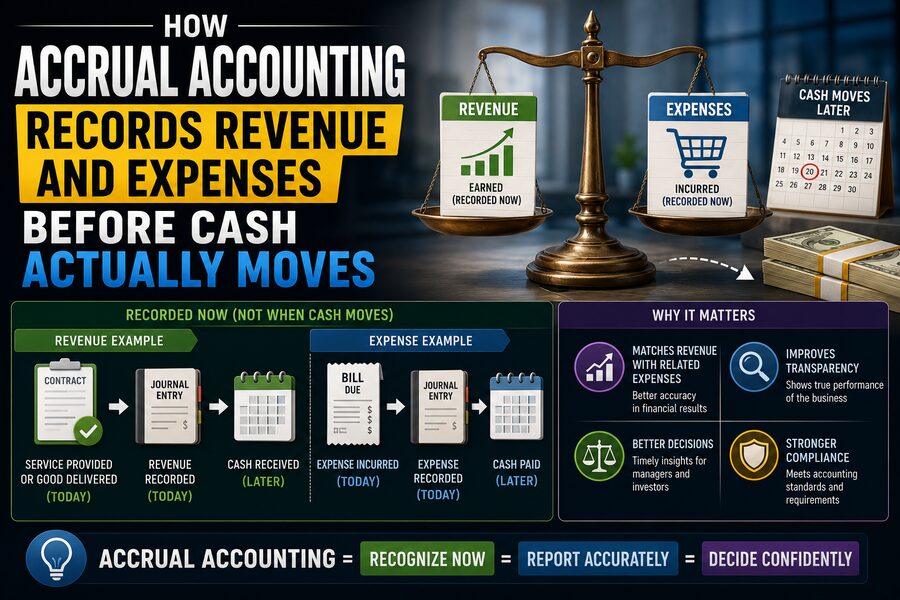

A company can make a sale without receiving cash immediately. It can also use electricity, receive legal services, or earn employee wages before paying the related bills.
If accounting recorded only the moments when money physically entered or left a bank account, financial statements could give a distorted picture of what actually happened during a period. 📊
This is why many businesses use accrual accounting.
Accrual accounting records revenue when it is earned and expenses when they are incurred, even if the associated cash payment happens earlier or later.
The system separates two ideas that are often confused:
Economic activity and cash movement.
A business may earn revenue today and collect the cash next month. It may incur an expense this month and pay it next quarter. Accrual accounting records the economic event in the period when it belongs rather than waiting for the bank transaction.
This approach helps financial statements show a more complete picture of a company’s performance, assets, liabilities, and obligations. 🧾⚖️
🔍 Cash Accounting vs. Accrual Accounting
The easiest way to understand accrual accounting is to compare it with cash accounting.
Under cash accounting:
- Revenue is generally recorded when cash is received.
- Expenses are generally recorded when cash is paid.
Under accrual accounting:
- Revenue is recorded when earned under the applicable recognition rules.
- Expenses are recorded when the underlying economic obligation or consumption occurs.
Suppose a consulting firm completes a $20,000 project in March but allows the customer to pay in April.
Under cash accounting, the revenue might appear in April.
Under accrual accounting, the company generally records the revenue in March because that is when the service was performed and the revenue was earned.
The April cash collection affects the company’s cash balance, but it does not create another $20,000 of revenue. 💵
📅 Why Timing Matters
Imagine a company provides services continuously throughout December but customers do not pay until January.
If the business recorded revenue only when cash arrived, December might look unusually weak and January unusually strong.
Economically, however, much of the work happened in December.
Accrual accounting tries to place transactions in the accounting periods they economically relate to.
This makes comparisons between months, quarters, and years much more meaningful.
For investors and managers, that distinction matters because they often want to know:
How much business activity occurred during this period?
not simply:
How much cash moved during this period?
📈 Revenue Before Cash: Accounts Receivable
Suppose a software company provides $10,000 of services to a customer and sends an invoice payable in 30 days.
The customer has not paid yet.
The company still records revenue because it has earned the amount under the transaction terms.
A simplified journal entry might be:
Debit: Accounts Receivable $10,000
Credit: Revenue $10,000
Accounts receivable is an asset.
It represents money the company expects to collect from customers.
The income statement shows $10,000 of revenue even though the cash account has not changed yet. 📄
💵 What Happens When the Customer Pays?
Thirty days later, the customer sends the $10,000.
Now the accounting entry is:
Debit: Cash $10,000
Credit: Accounts Receivable $10,000
Notice what is missing:
There is no additional revenue.
Why?
Because the revenue was already recorded when it was earned.
The cash collection simply converts one asset into another:
Accounts Receivable → Cash
The company’s total assets may stay the same at the instant of collection, while the composition of those assets changes.
🧾 Expenses Before Cash: Accrued Expenses
The same principle works for expenses.
Suppose employees earn $50,000 of wages during the final week of December, but payday does not occur until January.
The company has already received the employees’ work in December.
Therefore, under accrual accounting, the wage expense belongs in December.
The company might record:
Debit: Wage Expense $50,000
Credit: Wages Payable $50,000
The wage expense appears on the December income statement.
The wages payable appears on the balance sheet as a liability because the company owes money to employees.
Cash has not moved yet. 👥💰
💸 What Happens When the Wages Are Paid?
When the company pays employees in January:
Debit: Wages Payable $50,000
Credit: Cash $50,000
Again, there is normally no new wage expense at the time of payment for those already-accrued wages.
The expense was recognized in December.
January’s payment simply removes the liability and reduces cash.
This is one of the central ideas of accrual accounting:
Payment timing and expense timing do not have to be the same.
⚡ Utility Bills Are a Classic Example
Consider electricity used during December.
The utility company may not send the bill until January.
But the electricity was consumed in December.
An accrual-based company may therefore estimate the December utility expense before receiving the invoice.
It could record:
Debit: Utilities Expense
Credit: Accrued Expenses Payable
When the bill arrives and is later paid, the liability is adjusted and settled.
This allows December’s financial statements to include the cost of resources actually consumed during December. ⚡
⚖️ The Matching Concept
A major objective of accrual accounting is to associate expenses with the periods in which the related economic benefits or activity occur.
This is often discussed through the matching concept.
Suppose a company sells a product for $1,000 in June.
The product originally cost the company $600.
If both the sale and the associated cost relate to June, accrual accounting records:
Revenue: $1,000
Cost of goods sold: $600
The result is:
Gross profit: $400
This gives a clearer picture than recording the revenue in one month and the product cost in another simply because cash happened to move at different times. 📊
📦 Inventory Shows Why Cash Timing Can Be Misleading
Suppose a retailer buys $100,000 of inventory in January and pays the supplier immediately.
Under pure cash logic, January might appear to contain a $100,000 expense.
But the inventory has not necessarily been sold yet.
Under accrual accounting, the purchase generally creates an asset:
Inventory
The cost is typically recognized as an expense—cost of goods sold—when the related inventory is sold.
So if only $30,000 of that inventory cost relates to products sold in February, that portion becomes an expense in February.
The remaining inventory stays on the balance sheet as an asset until sold or otherwise written down.
🧾 Accounts Payable
Not every expense requires an estimated accrual.
Sometimes the company receives the supplier’s invoice before paying it.
Suppose a business receives $15,000 of equipment maintenance services in March and an invoice is due in April.
It may record:
Debit: Maintenance Expense $15,000
Credit: Accounts Payable $15,000
Accounts payable represents amounts owed to suppliers.
When the company pays the bill:
Debit: Accounts Payable $15,000
Credit: Cash $15,000
The expense remains in March, while the cash movement happens in April. 🔧
⏰ Accrued Expenses vs. Accounts Payable
The terms are closely related but can be distinguished.
Accounts payable commonly refers to obligations for which a supplier invoice has already been received.
Accrued expenses often refer to costs that have been incurred but have not yet been invoiced or formally billed.
Examples of accrued expenses include:
- Wages earned but not yet paid
- Interest accumulated but not yet paid
- Utilities consumed but not yet billed
- Professional services received but not yet invoiced
Both are liabilities.
📈 Accrued Revenue
Revenue can also be earned before an invoice is issued.
Suppose an engineering firm performs work throughout March under a contract but does not invoice the customer until April.
If the applicable revenue-recognition criteria are met, the firm may recognize the March revenue and record an asset often called:
- Accrued revenue
- Contract asset
- Unbilled receivable
depending on the circumstances and accounting framework.
The key idea is that earning revenue and billing the customer are not always the same event. 🏗️
🔄 Cash Can Also Move Before Revenue Is Earned
Accrual accounting handles the reverse situation too.
Suppose a customer pays $12,000 in advance for a one-year software subscription.
The company receives cash immediately.
But it has not yet earned the full $12,000 because it still owes the customer months of service.
Instead of recognizing all $12,000 as immediate revenue, the company may initially record:
Debit: Cash $12,000
Credit: Deferred Revenue $12,000
Deferred revenue is generally a liability because the company still owes goods or services to the customer.
As service is provided over time, portions of the liability are converted into revenue. 💻
📅 Example of Deferred Revenue
Suppose the $12,000 subscription covers 12 months evenly.
Each month, the company might recognize:
$12,000 ÷ 12 = $1,000
The entry could be:
Debit: Deferred Revenue $1,000
Credit: Subscription Revenue $1,000
No new cash arrives during that monthly recognition.
The cash was already received earlier.
This demonstrates that accrual accounting works in both directions:
Revenue can occur before cash.
and:
Cash can occur before revenue.
💳 Prepaid Expenses Are the Expense-Side Equivalent
Suppose a company pays $24,000 in advance for 12 months of insurance.
Cash leaves immediately.
But the company does not usually recognize the entire $24,000 as expense on the first day.
Instead, it initially records an asset:
Prepaid Insurance $24,000
Then each month:
$24,000 ÷ 12 = $2,000
is recognized as insurance expense.
The accounting gradually converts the prepaid asset into expense as the insurance coverage is consumed. 🛡️
🏢 Depreciation Is Another Accrual Concept
Suppose a company buys a machine for $500,000 and pays cash immediately.
The machine may provide economic benefits for many years.
Expensing the entire $500,000 immediately could distort one year’s performance.
Instead, the machine is generally recorded as a long-term asset and its cost is allocated over its useful life through depreciation, subject to applicable accounting rules.
For example, if the accounting method results in $50,000 of annual depreciation, the company records that expense even though no $50,000 cash payment occurs each year.
The original cash payment happened when the asset was purchased.
Depreciation is therefore a major example of an expense that can appear without a corresponding current-period cash outflow. 🏭
📊 Why Profit Is Not the Same as Cash Flow
This is one of the most important consequences of accrual accounting.
A company can report a profit while experiencing cash problems.
Imagine:
- Revenue earned: $1,000,000
- Expenses incurred: $800,000
- Accrual profit: $200,000
But suppose customers have paid only $500,000 so far.
The business may be profitable on the income statement while still waiting for a large amount of cash.
If payroll, suppliers, and lenders require immediate payment, the company can face a liquidity problem despite reporting profit.
That is why analysts examine both:
- Income statement
- Cash flow statement
💰📉
🧮 Accrual Accounting and the Balance Sheet
Accrual accounting creates many assets and liabilities that represent timing differences.
Common assets include:
- Accounts receivable
- Accrued revenue
- Inventory
- Prepaid expenses
Common liabilities include:
- Accounts payable
- Accrued wages
- Accrued interest
- Deferred revenue
These accounts connect economic activity recorded on the income statement with cash movements that occur at different times.
The balance sheet therefore acts partly as a record of transactions whose economic and cash timing do not match.
🧾 Adjusting Entries at Period-End
At the end of an accounting period, companies often make adjusting entries.
These entries ensure that revenues and expenses are recorded in the appropriate period.
Typical adjustments include:
- Accrued wages
- Accrued interest
- Unbilled revenue
- Depreciation
- Prepaid expense usage
- Deferred revenue recognition
Suppose employees earned three days of wages before the year-end date but will not be paid until the following year.
An adjusting entry records those three days of expense in the current year.
Without the adjustment, expenses would be understated and profit overstated.
🔁 Reversing Entries
Some accruals are later reversed to simplify bookkeeping.
For example, an estimated wage accrual recorded on December 31 may be reversed on January 1.
When payroll is processed normally, the full payroll entry can then be recorded without accidentally double-counting the prior-period accrual.
Not every accrual uses reversing entries, but they can make recurring accounting processes easier to manage.
🧮 Estimates Are Sometimes Necessary
Accrual accounting frequently requires estimates because the exact amount may not yet be known.
Suppose a company knows it consumed electricity in December but has not received the bill.
Accountants may estimate the amount using:
- Historical usage
- Meter readings
- Contract rates
- Prior invoices
When the actual invoice arrives, the estimate can be adjusted.
This means accrual accounting can involve professional judgment.
The goal is reasonable and supportable measurement—not pretending that uncertain amounts are perfectly known.
🏦 Interest Accrues Over Time
Interest provides another straightforward example.
Suppose a company owes interest on a loan, but the lender requires payment only every six months.
Interest still economically accumulates each month.
The company may record:
Debit: Interest Expense
Credit: Interest Payable
month by month.
When the cash payment is finally made, the liability is reduced.
This prevents several months of financing cost from suddenly appearing only on the payment date. 🏦
🧑💼 Why Managers Prefer Accrual Information
Accrual accounting can help managers understand:
- Whether operations are profitable
- Which periods generated revenue
- What obligations are building up
- How much customers owe
- What expenses have already been incurred
Cash balances remain essential, but they answer a different question.
Cash says:
How much money is available right now?
Accrual profit says:
How much economic revenue and expense were recognized for this period?
Managers often need both perspectives.
📈 Why Investors Use Accrual-Based Financial Statements
Investors want to evaluate the economic performance of a business over time.
Cash receipts can be highly irregular.
A customer may pay an annual invoice upfront.
Another may pay 90 days later.
If analysts looked only at cash receipts, business performance could appear extremely volatile even when operations were stable.
Accrual accounting smooths these timing differences by placing revenue and expenses into the periods to which they relate under applicable accounting rules.
This can make profitability and operating trends easier to evaluate. 📊
⚠️ Accrual Accounting Can Also Be Misused
Because accrual accounting requires judgments and estimates, it creates opportunities for poor-quality or aggressive accounting.
For example, management might recognize revenue too early or underestimate certain expenses.
This could temporarily make profits appear stronger.
Auditors and accounting standards therefore establish rules around:
- Revenue recognition
- Expense recognition
- Estimates
- Provisions
- Asset valuation
Analysts also compare accrual earnings with actual cash flow.
If reported profits rise dramatically while operating cash flow remains persistently weak, that may deserve investigation. 🔍
💡 Earnings Quality
The relationship between earnings and cash flow is often discussed as part of earnings quality.
Suppose two companies each report $10 million of profit.
Company A collected most of its sales in cash.
Company B’s profit depends heavily on rapidly growing receivables that customers have not yet paid.
The reported profit is identical, but the underlying cash characteristics are different.
This does not automatically mean Company B’s earnings are improper.
It does mean analysts may want to examine:
- Receivable growth
- Collection periods
- Revenue recognition
- Customer quality
Accrual accounting provides useful economic information, but cash realization still matters.
📜 Accounting Standards Govern Recognition
Companies do not simply choose any timing they want.
Accrual financial reporting is governed by accounting standards such as:
- IFRS
- U.S. GAAP
The exact recognition requirements vary depending on the transaction and applicable framework.
Revenue recognition, for example, involves more than simply saying, “We sent an invoice.”
Accountants must determine when the relevant performance obligations have been satisfied and whether recognition criteria are met.
Similarly, expenses and liabilities are recognized according to applicable rules and estimates.
🧩 A Simple Example
Imagine a graphic design agency completes a project in December.
The contract price is:
$5,000
The agency pays designers:
$2,000
in January.
The client also pays:
$5,000
in January.
Under accrual accounting, December may still show:
Revenue = $5,000
Expense = $2,000
Profit = $3,000
At December 31, the balance sheet might include:
Accounts Receivable = $5,000
and:
Wages Payable = $2,000
Then January’s cash flows settle those balances.
The economic result belongs largely to December even though the actual cash movements occur in January. 📅
🔄 The Accounting Cycle Behind the Scenes
A typical accrual process can be thought of as:
Economic event occurs
⬇️
Revenue or expense is recognized
⬇️
Receivable, payable, prepaid asset, or deferred liability may be created
⬇️
Cash moves later or may have moved earlier
⬇️
Balance sheet timing account is settled
This framework connects the income statement, balance sheet, and cash flow statement.
🆚 Why Small Businesses Sometimes Use Cash Accounting
Cash accounting is simpler.
A small business may find it easier to record transactions based solely on bank activity.
It can be practical when:
- Operations are simple
- Few credit transactions occur
- Inventory is limited
- Reporting requirements permit it
However, larger or more complex organizations commonly rely on accrual accounting because their economic activity and cash flows occur at very different times.
Applicable tax and financial-reporting rules can also determine which accounting methods are available or required.
🧠 A Useful Analogy
Imagine ordering dinner at a restaurant.
You receive and consume the meal at 8:00 PM.
You pay the bill at 9:00 PM.
Economically, the restaurant provided the service before the cash moved.
Accrual accounting focuses on when the economic event happened.
Cash accounting focuses on when payment occurred.
Now imagine buying a one-year gym membership upfront.
The gym receives all the cash on day one, but it still owes you months of access.
Accrual accounting recognizes that not all cash received immediately represents revenue already earned.
This timing logic appears throughout business accounting. 🍽️💳
✅ Conclusion
Accrual accounting records financial activity according to when revenue is earned and expenses are incurred, rather than simply waiting for cash to enter or leave a company’s bank account. 💰📊
If a business sells goods or provides services before receiving payment, it can record revenue along with an asset such as accounts receivable.
If employees perform work before payday or utilities are consumed before an invoice arrives, the company can record expenses along with liabilities such as accrued wages or accounts payable.
The reverse can also happen. A customer may pay before revenue has been earned, creating deferred revenue, or a company may pay insurance in advance and record a prepaid expense.
These timing accounts allow financial statements to separate economic performance from cash timing.
That distinction is crucial because profit is not the same thing as cash flow.
A company can be profitable while waiting for customers to pay, or it can receive large amounts of cash before actually earning the associated revenue.
The central principle is therefore straightforward:
Record the economic activity in the period where it belongs, and record the cash movement when the cash actually moves. ⚖️
By doing this, accrual accounting gives managers, investors, lenders, and other users a more complete picture of what a business earned, what it consumed, what customers owe it, and what obligations it still needs to pay. 🧾📈