
A company may receive cash today for a product it will deliver next month, complete work today but collect payment later, or sell a multi-year subscription whose value must be recognized gradually over time. In all of these situations, one important accounting question appears:
When should the business actually record revenue? 📊
The answer is not simply “when the money arrives.”
Modern accounting systems use revenue recognition rules to determine when economic activity has progressed far enough for revenue to be reported in the financial statements. These rules are essential because recognizing revenue too early can make a company appear more profitable than it really is, while recognizing it too late can understate performance.
Revenue recognition systems therefore track contracts, deliveries, services, milestones, payments, refunds, discounts, and customer obligations so accounting records reflect what the business has actually earned.
The core principle is:
Revenue is generally recognized when a company satisfies its obligation to provide promised goods or services to a customer—not necessarily when cash is received. 💵➡️📦➡️📈
🧾 Revenue Is Not the Same as Cash
One of the most important accounting concepts is the difference between cash collection and revenue recognition.
Suppose a customer pays $12,000 upfront for a one-year software subscription.
The business receives all $12,000 immediately.
However, it has not yet provided a full year of service.
Recording all $12,000 as revenue on the first day would imply that the company had already completed its obligation.
Instead, the payment is initially treated largely as a contract liability, often called deferred or unearned revenue.
If the service is provided evenly throughout the year, the company may recognize approximately:
$1,000 of revenue per month
for 12 months.
So:
Cash received today ≠ Revenue earned today
This distinction is central to accrual accounting. 📅
📚 Why Revenue Recognition Rules Exist
Investors, managers, lenders, regulators, and tax authorities depend on financial statements to understand business performance.
Without common revenue recognition principles, companies could manipulate results simply by choosing convenient times to record sales.
For example, a company might:
- recognize revenue before delivering products,
- record multi-year contracts immediately,
- ignore likely refunds,
- count deposits as sales,
- accelerate transactions near quarter-end.
Standardized revenue recognition rules make financial reports more comparable and reduce opportunities for misleading reporting. 🛡️
Major accounting frameworks use structured principles for determining when and how much revenue should be recognized.
🧩 The Contract Is the Starting Point
Revenue recognition usually begins with a contract with a customer.
A contract does not always need to be a lengthy paper document.
It may be:
- a signed agreement,
- an accepted purchase order,
- an online subscription,
- another enforceable arrangement.
The agreement establishes what each party is expected to provide.
For example:
Customer promises: Pay $5,000
Company promises: Deliver equipment and provide installation
The accounting system must understand both sides of this exchange.
Without a valid customer arrangement and enforceable rights and obligations, revenue recognition may need to wait.
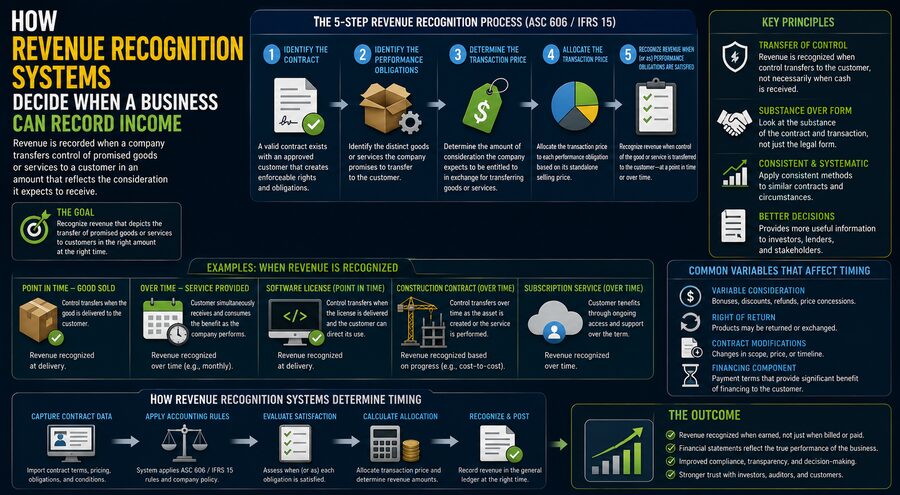
🎯 Step 1: Identify the Customer Contract
A revenue system first determines whether an arrangement qualifies as a contract for accounting purposes.
Questions may include:
- Have both parties approved the agreement?
- Are each party’s rights identifiable?
- Are payment terms identifiable?
- Does the arrangement have commercial substance?
- Is collection reasonably expected under the applicable accounting framework?
Once the contract is identified, the system can analyze what the company has promised to deliver.
📦 Step 2: Identify Performance Obligations
A customer contract may contain one product or many separate promises.
These promises are often called performance obligations.
Imagine a technology company sells:
- a server,
- installation,
- two years of technical support.
The accounting system must determine whether these represent separate obligations or parts of a combined obligation.
If they are distinct, revenue may be recognized at different times.
For example:
Server → Revenue when control transfers
Installation → Revenue when installation is completed
Support → Revenue gradually over two years
This is why revenue recognition can become much more complicated than simply recording an invoice. ⚙️
💵 Step 3: Determine the Transaction Price
Next, the system determines how much consideration the company expects to receive.
Sometimes the price is simple.
For example:
Product price = $10,000
But many contracts contain variable elements such as:
- discounts,
- rebates,
- performance bonuses,
- penalties,
- refunds,
- usage charges,
- volume incentives.
Suppose a construction contractor receives:
$1,000,000 base payment
plus:
$100,000 bonus if completed before a deadline
The accounting system must estimate how much of that variable amount can appropriately be included in recognized revenue.
The goal is to avoid recording amounts that are likely to reverse later.
🧮 Step 4: Allocate the Price to Different Obligations
If a contract contains multiple performance obligations, the total transaction price must often be divided among them.
Suppose a company sells:
- hardware,
- software license,
- support
for a combined contract price of:
$9,000
If their normal standalone prices are:
Hardware = $6,000
Software = $3,000
Support = $1,000
their total standalone value is:
$10,000
The $9,000 contract price can then be allocated proportionally.
The revenue system uses this allocation to determine how much revenue belongs to each promised item.
This matters because each obligation may be satisfied at a different time. 📊
✅ Step 5: Recognize Revenue When Obligations Are Satisfied
The final step is determining when the customer receives control of the promised goods or services.
Revenue may be recognized:
- at a specific point in time,
- progressively over time.
This distinction is one of the most important decisions in revenue accounting.
📦 Revenue Recognized at a Point in Time
Many ordinary product sales are recognized at a particular moment.
For example, a retailer sells a laptop.
Revenue may be recognized when control of the laptop transfers to the customer.
Indicators might include:
- delivery has occurred,
- customer has legal title,
- customer has accepted the product,
- seller no longer controls the asset.
The exact timing depends on the contract and applicable accounting rules.
For an online order, revenue might therefore be recognized when the product is delivered rather than when the customer clicks “Buy.” 🚚
⏳ Revenue Recognized Over Time
Services are often provided continuously.
Examples include:
- software subscriptions,
- maintenance contracts,
- consulting services,
- managed services,
- some construction arrangements.
If a customer receives benefits as the company performs, revenue may be recognized over time.
For a one-year service worth $24,000, a simple straight-line pattern might recognize:
$2,000 per month
if service is delivered evenly.
Other contracts use progress measurements based on:
- hours worked,
- costs incurred,
- units delivered,
- milestones achieved.
The objective is to represent actual performance.
🏗️ Long-Term Projects Need Progress Measurement
Construction and engineering contracts can last several years.
Waiting until the final day to recognize all revenue may provide a poor picture of economic performance if the customer is receiving value throughout the project.
A company may therefore recognize revenue based on progress.
Suppose a project is worth:
$10 million
and an appropriate progress measure indicates that the company has completed:
40%
of its obligation.
Subject to the accounting requirements and contract facts, recognized revenue may be approximately:
$4 million
The system must carefully track project activity to support this calculation. 🏗️📈
💳 What Happens When the Customer Pays First?
When cash arrives before the company earns the revenue, the amount is generally recorded as a liability rather than immediate revenue.
For example:
Cash received: $6,000
Service period: 6 months
At payment:
Cash increases by $6,000
Contract liability increases by $6,000
Then, as one month of service is provided:
Contract liability decreases by $1,000
Revenue increases by $1,000
This liability represents the company’s remaining obligation to the customer.
🧾 What Happens When Revenue Comes Before Cash?
The opposite can also happen.
A company may earn revenue before collecting payment.
Suppose a consulting firm completes $20,000 of work and invoices the customer with payment due in 30 days.
The accounting system may record:
Revenue = $20,000
Accounts receivable = $20,000
Cash is collected later.
When payment arrives:
Cash increases
Accounts receivable decreases
No new revenue is recognized at that point because the revenue was already earned.
📦 Shipping Terms Can Change Timing
For physical goods, shipping arrangements can affect revenue timing.
Depending on contract terms, control may transfer:
- when goods leave the seller,
- when they reach the customer,
- after customer inspection or acceptance.
Revenue systems therefore need access to logistics information.
A business may integrate accounting software with:
- warehouse systems,
- shipping carriers,
- order-management systems.
This helps ensure that revenue is recorded when the underlying delivery event actually occurs. 🚚📦
↩️ Returns Complicate Revenue
Retailers often allow customers to return products.
Suppose a business sells 10,000 units but historically expects 5% to be returned.
It may not be appropriate to treat every dollar of gross sales as final revenue without considering expected returns.
Revenue systems can estimate return obligations based on:
- historical return rates,
- product type,
- customer behavior,
- seasonal patterns.
The accounting system may recognize revenue net of expected returns and record related refund liabilities.
This prevents reported revenue from being overstated. 🔄
🎁 Discounts, Coupons, and Rebates
Pricing is not always straightforward.
Customers may receive:
- promotional discounts,
- loyalty points,
- rebates,
- volume discounts,
- future credits.
These incentives can affect the transaction price.
For example, if a manufacturer sells products for $1 million but expects to pay $80,000 in rebates, the accounting system may need to reflect an expected net amount closer to:
$920,000
depending on the arrangement and accounting rules.
Revenue systems therefore require more than invoice data—they may need pricing, promotion, contract, and historical behavior data.
🧑💼 Principal vs. Agent: Gross or Net Revenue?
Some businesses arrange transactions without actually controlling the product or service being sold.
Consider an online marketplace.
A customer pays:
$100
for a product sold by an independent merchant.
The marketplace keeps:
$15 commission
and sends:
$85
to the merchant.
Should the marketplace report:
$100 revenue
or:
$15 revenue?
That depends partly on whether the marketplace is acting as the principal or merely as an agent.
If it is only arranging the transaction, revenue may be recognized on a net basis as the commission.
This distinction can dramatically affect reported revenue even when profit remains similar.
🎫 Gift Cards Illustrate Deferred Revenue
Suppose a customer buys a $100 gift card.
The business has received cash but has not yet provided goods or services.
At the time of sale:
Cash = +$100
Revenue = $0
Contract liability = +$100
When the gift card is redeemed for merchandise:
Contract liability decreases
Revenue is recognized
Gift cards therefore provide a simple example of why cash collection and revenue recognition are different events. 🎁
💻 Subscription Software Creates Recurring Recognition
Software-as-a-Service companies often collect subscription fees monthly or annually.
An annual subscription paid upfront might be:
$1,200
If the service is delivered evenly for 12 months, the company may recognize:
$100 revenue per month
This creates a recurring schedule.
Revenue recognition software can automate these schedules across thousands or millions of customer contracts.
Without automation, keeping track of every start date, renewal, upgrade, discount, and cancellation would become extremely difficult.
🔄 Contract Changes Require Recalculation
Customer contracts frequently change.
A customer may:
- upgrade a subscription,
- add users,
- remove services,
- extend the contract,
- renegotiate price.
The accounting system must determine how the modification affects existing and future revenue.
Sometimes the change is treated as a separate contract.
Other times the original revenue schedule must be adjusted.
This is one reason revenue recognition software often includes specialized contract-modification logic.
📅 Cutoff Is Critical at Month-End and Quarter-End
Companies report financial results for specific periods.
Therefore, accountants must ensure that transactions are recorded in the correct period.
This is called cutoff.
Suppose goods leave a warehouse on March 31 but control does not transfer until April 2.
Recognizing revenue in March could overstate first-quarter results.
Revenue systems use delivery dates, contract terms, acceptance information, and other evidence to determine the appropriate accounting period.
Cutoff testing is especially important during audits. 🔍
🛡️ Why Auditors Examine Revenue Carefully
Revenue is often one of the most closely examined areas in financial reporting.
Why?
Because management may feel pressure to hit:
- sales targets,
- earnings forecasts,
- growth expectations,
- bonus thresholds.
Recognizing revenue prematurely can temporarily make results look stronger.
Auditors therefore examine evidence such as:
- contracts,
- invoices,
- shipping documents,
- acceptance records,
- payment records,
- revenue schedules.
Strong automated controls can reduce the risk of incorrect recognition.
🤖 What Revenue Recognition Software Actually Does
Modern revenue recognition platforms can automate complex accounting decisions.
They may ingest data from:
- CRM systems,
- billing software,
- ERP systems,
- payment processors,
- order systems,
- contract databases.
The platform then applies accounting rules to determine:
- performance obligations,
- transaction prices,
- allocation amounts,
- recognition schedules,
- contract assets,
- contract liabilities.
This allows accountants to manage large volumes of contracts consistently.
🧮 Revenue Subledgers
Large companies may use a specialized revenue subledger.
Rather than posting every individual contract calculation directly into the general ledger, detailed revenue calculations are maintained in a dedicated system.
The revenue subledger may track:
- customer contracts,
- recognition schedules,
- deferred balances,
- adjustments,
- audit history.
At period end, summarized journal entries flow into the general ledger.
This improves scalability and provides detailed supporting records.
🔌 Integration With Billing Systems Matters
Billing and revenue recognition are related but different.
A billing system answers:
“How much should we charge the customer?”
A revenue system answers:
“How much of that amount has the company earned for accounting purposes?”
For simple businesses, the answers may happen at roughly the same time.
For subscriptions and complex contracts, they can differ significantly.
This is why businesses often integrate billing and revenue systems while keeping their accounting logic separate. 🔗
📊 Contract Assets and Contract Liabilities
Two important balance-sheet concepts are contract assets and contract liabilities.
📈 Contract Asset
A contract asset can arise when a company has earned revenue but its right to payment depends on something beyond simply waiting for payment.
📉 Contract Liability
A contract liability arises when the customer has paid—or owes payment—before the company has fully performed.
These balances help explain the timing difference between:
- invoicing,
- cash,
- performance,
- revenue.
Revenue recognition systems keep these amounts synchronized with customer contracts.
🧠 Estimates Require Judgment
Not every revenue decision is purely mechanical.
Companies may need judgment when estimating:
- variable consideration,
- refunds,
- performance bonuses,
- contract modifications,
- progress toward completion,
- collectibility.
A good revenue system can automate calculations, but accounting professionals still need to define policies and review unusual transactions.
Automation improves consistency; it does not eliminate professional judgment.
⚠️ Revenue Recognition Can Affect Business Metrics
The timing of recognized revenue influences many important financial measures.
These include:
- revenue growth,
- gross margin,
- operating profit,
- earnings per share,
- deferred revenue,
- accounts receivable.
Investors may also analyze measures such as recurring revenue and remaining contract obligations.
Because recognition timing affects reported results, businesses must apply policies consistently from period to period.
🧾 Example: A Hardware and Support Contract
Imagine a company sells:
- equipment,
- installation,
- one year of support
for a total contract value of:
$24,000
Suppose the accounting analysis allocates:
Equipment = $16,000
Installation = $2,000
Support = $6,000
The system might recognize:
$16,000 when the equipment transfers to the customer.
$2,000 when installation is completed.
$500 per month for 12 months of support.
The customer may have paid the entire $24,000 upfront, but the revenue follows performance—not simply cash timing.
This example demonstrates the purpose of revenue recognition clearly. 📦🔧📅
🛍️ Example: Retail Sale
A customer walks into a store, purchases a jacket, pays immediately, and takes it home.
In this simple transaction:
- contract exists,
- product is delivered,
- payment is made,
- control transfers immediately.
Cash collection and revenue recognition occur almost simultaneously.
This simplicity is why many consumers never notice the complexity of revenue accounting.
The complexity becomes visible when payment and performance occur at different times.
💼 Why Businesses Invest in Revenue Automation
Manual spreadsheets may work for a small company with a handful of contracts.
As the business grows, complexity increases.
A company may have:
- thousands of subscriptions,
- contract upgrades,
- multiple currencies,
- refunds,
- bundled products,
- different service periods.
Manually calculating recognition schedules becomes expensive and risky.
Automated systems can provide:
- standardized rules,
- period-end reporting,
- audit trails,
- reconciliation,
- exception monitoring.
This can reduce closing time and improve financial-control quality. ⚙️
🔐 Internal Controls Are Essential
Because revenue is financially important, access to recognition rules should be controlled.
A robust system may require:
- role-based permissions,
- approval workflows,
- change logs,
- period locking,
- reconciliation procedures.
For example, a salesperson should not normally be able to modify accounting recognition policies simply to improve quarterly results.
Separation of duties helps protect financial reporting integrity.
🌍 Different Industries Have Different Revenue Challenges
Revenue recognition appears across every industry, but the practical challenges vary.
💻 Software
Subscriptions, licenses, implementation services, and renewals.
🏗️ Construction
Long-term projects, progress measurements, modifications.
✈️ Airlines
Tickets sold before flights, loyalty programs, cancellations.
📱 Telecommunications
Devices bundled with service contracts.
🛍️ Retail
Returns, gift cards, loyalty rewards.
🎬 Media
Advertising arrangements, licensing, subscriptions.
The underlying principles remain similar, but the data and business processes can differ significantly.
🧠 The Central Question: Has the Business Earned It?
Revenue recognition can appear highly technical, but the basic accounting logic is easy to understand.
A company should not record revenue merely because:
- it signed a contract,
- sent an invoice,
- received cash,
- expects to make a sale.
Instead, the accounting system asks:
What did the company promise the customer?
How much consideration belongs to that promise?
Has the company actually satisfied that obligation?
Once the answer is yes, the corresponding revenue can generally be recognized according to the applicable accounting framework.
💰 Turning Business Activity Into Reliable Financial Reporting
Revenue recognition systems sit between operational activity and financial reporting.
Orders may originate in a sales platform.
Deliveries may be tracked by logistics software.
Subscriptions may be managed by billing systems.
Payments may arrive through banks or processors.
The revenue recognition system connects these events and determines when they represent earned income.
That process helps ensure that:
Cash received early becomes deferred until earned.
Revenue earned before payment becomes receivable or another appropriate contract balance.
Long-term services are recognized over time.
Product sales are recognized when control transfers.
Refunds, discounts, and contract changes are accounted for appropriately.
The central principle is straightforward:
Revenue recognition systems decide when income can be recorded by matching financial reporting to the moment a business actually fulfills its promises to customers—not simply to the moment money changes hands. 💰📊✅
That distinction is what allows financial statements to present a more accurate picture of how a business is truly performing.