
Every business that buys products or services faces a deceptively simple question:
Is this invoice actually correct? 💼
A supplier may send an invoice for 500 units, but perhaps only 450 were delivered. The agreed price may have been $20 per unit, but the invoice may show $22. A duplicate invoice may arrive twice. A delivery may be partially damaged, delayed, or never received.
If a company pays every invoice without checking it against other records, errors can quickly become expensive.
That is why many finance and procurement teams use a control process called three-way matching.
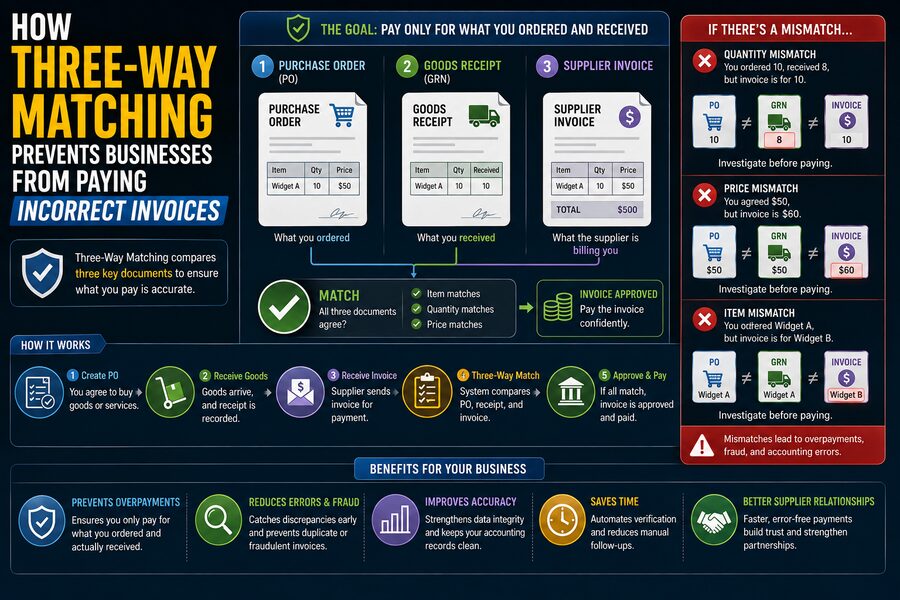
Three-way matching compares three key documents before payment is approved:
Purchase Order → Goods Receipt → Supplier Invoice
If the quantity, price, and other important details agree across all three, the invoice can usually move forward for payment.
If something does not match, the system flags the transaction for review. ⚠️
This simple accounting control can prevent overpayments, duplicate payments, unauthorized purchases, fraud, and disputes with suppliers.
🧠 What Is Three-Way Matching?
Three-way matching is an accounts-payable control used to verify that a supplier invoice accurately reflects what the company ordered and what it actually received.
The three records are typically:
- Purchase Order (PO) — what the business agreed to buy.
- Goods Receipt or Receiving Report — what the business actually received.
- Supplier Invoice — what the supplier is asking the business to pay.
The accounts-payable system compares these documents before releasing payment.
Conceptually:
Ordered = Received = Invoiced
If those three elements align within the company’s accepted tolerance, the invoice is considered matched.
📄 Document 1: The Purchase Order
The purchase order is created before the supplier delivers the goods or services.
It usually contains details such as:
- Supplier name
- Item description
- Quantity ordered
- Agreed unit price
- Total purchase value
- Delivery location
- Payment terms
- Purchase order number
Suppose a company orders:
1,000 office chairs at $80 each
The purchase order value is:
1,000 × $80 = $80,000
This document represents the commercial agreement that the company authorized.
When the invoice arrives later, accounts payable can check whether the supplier is billing according to those agreed terms.
📦 Document 2: The Goods Receipt
The second document confirms what actually arrived.
When the supplier delivers the order, warehouse or receiving staff may record a goods receipt, sometimes called a receiving report.
Suppose the purchase order was for:
1,000 chairs
but only:
950 chairs
arrive.
The receiving record should show 950.
This matters because the company generally should not pay for 1,000 units if only 950 were received—unless there is some specific contractual or operational reason.
The goods receipt creates an independent record of physical delivery. 📦
🧾 Document 3: The Supplier Invoice
The supplier invoice is the request for payment.
It may show:
- Invoice number
- Invoice date
- Purchase order reference
- Quantity billed
- Unit price
- Taxes
- Freight
- Discounts
- Total amount due
- Payment terms
Suppose the supplier invoices:
1,000 chairs × $80 = $80,000
But the goods receipt shows only:
950 chairs received
The three-way match immediately identifies a discrepancy.
🔍 A Simple Three-Way Match Example
Imagine a company buys computer monitors.
The records show:
Purchase Order:
100 monitors at $250 each
Goods Receipt:
100 monitors received
Supplier Invoice:
100 monitors at $250 each
Everything matches.
The invoice total is:
100 × $250 = $25,000
Because quantity and price agree, the invoice can be approved automatically or with minimal review. ✅
Now imagine the invoice instead shows:
100 monitors at $275 each
The quantity matches, but the unit price does not.
The system flags the invoice because:
PO price = $250
while:
Invoice price = $275
That difference prevents an incorrect payment from slipping through unnoticed.
💸 How Three-Way Matching Prevents Overpayments
Overpayments can happen for many reasons.
A supplier may accidentally bill the wrong quantity.
An outdated price may be used.
Freight charges may be duplicated.
Taxes may be calculated incorrectly.
Without matching, the finance team might simply pay the invoice.
Three-way matching introduces a checkpoint.
Before money leaves the company, the system asks:
Did we authorize this purchase?
Did we receive it?
Is the invoice consistent with both?
This makes accidental overpayment much less likely.
🚫 Preventing Payment for Goods Never Received
One of the biggest risks in accounts payable is paying for something that never arrived.
Suppose the company orders:
500 industrial valves.
The supplier invoices all 500.
But the receiving team records:
420 valves delivered.
Without a receiving record, accounts payable may have no reason to question the invoice.
With three-way matching, the discrepancy is obvious:
Ordered: 500
Received: 420
Invoiced: 500
The missing 80 units must be investigated before full payment is released.
🧮 Quantity Matching
Quantity matching compares:
Quantity ordered
with:
Quantity received
and:
Quantity invoiced
Suppose:
PO quantity = 200
Receipt quantity = 198
Invoice quantity = 200
The invoice may be held because the business appears to have received two fewer units than billed.
However, companies often allow small tolerances.
For low-value items, a difference of one or two units may be acceptable.
The matching rules depend on risk, product type, and company policy.
💵 Price Matching
Price matching compares the unit price on the invoice with the price on the purchase order.
Suppose:
PO price = $50 per unit
Invoice price = $52 per unit
For 10 units, the difference is only:
$20
For 100,000 units, the difference becomes:
$200,000
A seemingly small unit-price error can therefore create a major financial impact at scale.
Automated matching catches these differences consistently.
🎯 Matching Tolerances Prevent Unnecessary Delays
Not every mismatch should stop payment.
Imagine the purchase order is for:
$10,000
and the invoice is:
$10,001
The $1 difference may come from rounding.
Requiring manual investigation for every tiny variance would waste time.
Companies therefore configure tolerance levels.
For example:
Price difference allowed: ±1%
Quantity difference allowed: ±2 units
Total variance allowed: $50
If the mismatch stays within tolerance, the system may approve the invoice automatically.
If it exceeds tolerance, the invoice is routed for review.
This balances control with efficiency. ⚖️
🤖 Automated Three-Way Matching
Large companies may process thousands or millions of invoices.
Manually checking every document would be extremely expensive.
Modern enterprise systems automate much of the process.
An ERP or accounts-payable platform can compare:
PO data → Receipt data → Invoice data
in seconds.
If everything matches, the invoice can move straight toward approval.
If not, the system creates an exception.
This is often called straight-through processing or touchless invoice processing when little or no human intervention is required.
Automation allows finance teams to focus on unusual cases instead of routine invoices.
📊 What Happens When There Is a Mismatch?
A mismatch does not automatically mean fraud or supplier error.
There may be a legitimate reason.
For example:
- Partial delivery
- Damaged goods
- Price change approved separately
- Backordered items
- Incorrect receiving entry
- Freight charge added later
- Tax adjustment
- Early-payment discount
The invoice is usually placed on hold while the responsible team investigates.
The issue may be resolved by:
- Correcting the invoice
- Updating the PO
- Recording the missing receipt
- Issuing a credit memo
- Approving an exception
The purpose is not merely to reject invoices.
It is to make sure the final payment is supported by accurate records.
🔁 Partial Deliveries Make Matching More Complex
Suppliers do not always deliver an entire order at once.
Suppose a company orders:
1,000 units.
The supplier delivers:
400 today
300 next week
300 later
Each receipt must be recorded accurately.
If the supplier invoices only the first 400 units, the system should compare that invoice against the corresponding received quantity.
A good ERP system can handle these partial matches.
Without careful receipt tracking, valid invoices may be incorrectly blocked—or invalid ones may be approved.
📑 Duplicate Invoices Are Another Major Risk
Imagine a supplier sends invoice:
INV-48291
Accounts payable pays it.
Later, the supplier accidentally resends the same invoice.
If the system does not detect duplicates, the company may pay twice.
Three-way matching helps reduce this risk, though duplicate-invoice checks are usually a separate control as well.
Systems may compare:
- Supplier
- Invoice number
- Invoice amount
- Invoice date
- Purchase order
- Payment history
Together, these controls help stop accidental duplicate payments.
🛡️ Three-Way Matching Also Helps Prevent Fraud
Three-way matching is not only about mistakes.
It can also make fraud more difficult.
Suppose an employee creates a fake supplier invoice.
Without supporting records, they might try to get it paid.
With three-way matching, the system expects evidence that:
- A legitimate purchase order was authorized.
- The goods or services were actually received.
- The invoice matches both.
Creating a convincing false transaction now requires manipulating several independent records instead of only one.
That makes fraudulent payments harder to execute. 🔐
👥 Segregation of Duties Makes the Control Stronger
Three-way matching works best when different people control different stages.
For example:
Buyer: creates the purchase order.
Warehouse employee: confirms receipt.
Accounts payable employee: processes the invoice.
Treasury or authorized manager: releases payment.
This is called segregation of duties.
If one person controls ordering, receiving, invoicing, and payment, they may be able to manipulate the whole process.
Splitting responsibilities reduces that risk.
🏢 Why Accounts Payable Depends on Good Procurement Data
Three-way matching can only work when the underlying records are accurate.
If buyers create vague purchase orders such as:
“Consulting services — approximately $20,000”
the system may struggle to determine whether an invoice is correct.
Good purchase orders should clearly define:
- What is being purchased
- Quantity
- Price
- Terms
- Delivery expectations
Accurate procurement data makes automated matching much more reliable.
📥 Receiving Accuracy Is Just as Important
Suppose the warehouse receives 100 units but forgets to enter the receipt.
The supplier sends a perfectly valid invoice.
The matching system sees:
PO: 100
Receipt: 0
Invoice: 100
The invoice gets blocked.
From accounts payable’s perspective, the system is working correctly.
The real problem is missing receiving data.
This is why purchasing, warehouse, and finance processes must be coordinated.
🧰 Matching Services Instead of Physical Goods
Three-way matching is easiest with tangible products because someone can physically count what arrived.
Services are more complicated.
Suppose a consulting firm invoices for:
100 hours.
What counts as the “receipt”?
A company may use a service entry sheet, timesheet, milestone approval, or manager confirmation.
The three records might become:
Purchase Order → Service Confirmation → Invoice
The same principle still applies:
Was the service authorized, performed, and billed correctly?
🧾 Two-Way Matching vs. Three-Way Matching
Not every invoice requires three documents.
In two-way matching, the company compares:
Purchase Order ↔ Invoice
This may be appropriate when formal receiving data is unnecessary.
For example, some subscriptions or low-risk services may not have a traditional goods receipt.
Three-way matching adds the receiving record:
Purchase Order ↔ Receipt ↔ Invoice
This provides stronger control.
🔐 Four-Way Matching Adds Quality Inspection
Some organizations use four-way matching.
The fourth record may be an inspection or quality-acceptance document.
The process becomes:
Purchase Order → Goods Receipt → Inspection → Invoice
This can be useful in industries where receiving a product is not enough.
The product may also need to pass quality control before payment.
Examples include:
- Aerospace
- Pharmaceuticals
- Manufacturing
- Food production
- Construction materials
The additional control reduces the risk of paying for defective goods.
⏳ Matching Errors Can Cause Late Payments
Three-way matching improves control, but poorly designed processes can create payment delays.
Suppose an invoice is correct, but the warehouse forgets to record delivery.
The invoice remains blocked.
The supplier does not get paid on time.
Late payment can lead to:
- Supplier complaints
- Late fees
- Lost discounts
- Damaged relationships
- Supply interruptions
Companies therefore need both strong controls and efficient exception resolution.
💰 Early-Payment Discounts Can Be Lost
Suppliers may offer terms such as:
2/10, net 30
This might mean a 2% discount if the invoice is paid within 10 days, otherwise the full amount is due within 30 days.
If a valid invoice sits in a mismatch queue for two weeks because of poor internal data, the company may lose the discount.
At scale, these lost discounts can be substantial.
Efficient three-way matching therefore has a direct financial benefit beyond preventing incorrect payments.
📈 Exception Rates Reveal Process Problems
Companies often measure the percentage of invoices that fail automatic matching.
Suppose:
80% match automatically.
20% require manual intervention.
Finance teams may analyze why those 20% fail.
Common causes might include:
- Incorrect PO prices
- Missing receipts
- Supplier invoice errors
- Tax differences
- Freight mismatches
If one cause dominates, the company can improve the upstream process.
For example, better receiving discipline might significantly increase automation.
🤖 AI and OCR Are Improving Invoice Processing
Modern accounts-payable platforms increasingly use Optical Character Recognition (OCR) and AI to extract invoice data.
The system may read:
- Invoice number
- Supplier name
- PO number
- Quantity
- Unit price
- Tax
- Total
That information can then be matched automatically against ERP records.
Some systems also learn from past exceptions and supplier formats.
The goal is to reduce manual data entry and improve processing speed.
⚠️ Automation Does Not Eliminate the Need for Controls
A fully automated process can make correct transactions faster.
But it can also make incorrect transactions faster if the configuration is poor.
For example, overly generous tolerances could allow significant overbilling.
Incorrect supplier master data could route payments to the wrong account.
Companies therefore need strong governance around:
- Matching rules
- Approval limits
- Supplier master data
- User permissions
- Exception handling
Automation should strengthen controls, not bypass them.
🧮 A Detailed Example
Suppose a manufacturer orders:
2,000 bearings at $12 each
The purchase order total is:
2,000 × $12 = $24,000
The warehouse receives:
1,950 bearings
The supplier invoice shows:
2,000 bearings at $12.50
Now compare all three:
Purchase Order:
Quantity = 2,000
Price = $12
Goods Receipt:
Quantity = 1,950
Invoice:
Quantity = 2,000
Price = $12.50
There are two mismatches.
First:
50 units have not been received.
Second:
The invoice price is $0.50 higher than the agreed price.
If the company paid the invoice as submitted:
2,000 × $12.50 = $25,000
But based on received quantity and PO pricing:
1,950 × $12 = $23,400
Potential overpayment:
$1,600
Three-way matching catches the problem before payment. 🚨
📊 Three-Way Matching Strengthens Financial Reporting
Incorrect supplier invoices do not affect only cash.
They can also distort accounting records.
If a company records an overstated invoice, it may overstate:
- Expenses
- Inventory
- Accounts payable
- Cost of goods sold
Accurate matching therefore supports more reliable financial statements.
It helps ensure recorded liabilities correspond to legitimate purchases and actual receipts.
🔍 Auditors Value Strong Matching Controls
Internal and external auditors often examine the procure-to-pay process.
Three-way matching provides clear evidence that payments were supported by authorized transactions.
Auditors may test samples of payments and verify:
Was there an approved PO?
Was receipt documented?
Did the invoice match?
Was the payment properly authorized?
Strong matching controls can reduce financial-control risk.
🔄 Where Three-Way Matching Fits in Procure-to-Pay
Three-way matching is one part of a larger business process commonly called procure-to-pay, or P2P.
A simplified process looks like:
Need identified → Purchase requisition → Approval → Purchase order → Delivery → Receipt → Invoice → Matching → Payment
Each stage creates information used by the next.
Three-way matching acts as a critical checkpoint near the end.
It verifies that what the company is about to pay reflects what happened earlier in the process.
🧠 Why Matching Works So Well
Three-way matching is powerful because the three records are created at different moments for different purposes.
The purchase order records intent.
The goods receipt records reality.
The invoice records the supplier’s claim.
Payment is safest when all three agree.
That creates a simple but effective control triangle:
What we agreed to buy
What we actually received
What we are being asked to pay
When those three tell the same story, confidence in the payment is much higher.
✅ The Bottom Line
Three-way matching prevents businesses from paying incorrect invoices by comparing the purchase order, receiving record, and supplier invoice before payment is released. 🧾✅
The process helps detect:
- Incorrect quantities
- Wrong prices
- Missing deliveries
- Unauthorized purchases
- Duplicate payments
- Supplier billing errors
- Potential fraud
Modern ERP and accounts-payable systems can automate much of this work.
Invoices that match within approved tolerances can move through automatically.
Invoices with significant discrepancies are held for investigation.
The most effective systems combine three-way matching with good procurement data, accurate receiving records, segregation of duties, approval controls, duplicate detection, and efficient exception management.
The central idea is simple:
Do not pay an invoice just because someone sent it.
First verify that the business actually authorized the purchase, received what it ordered, and was billed according to the agreed terms. 💼🔍
That basic discipline can save companies substantial amounts of money while improving supplier relationships, auditability, cash control, and financial accuracy.