
Every business that handles significant amounts of money has to answer a basic accounting question:
Do the transactions recorded in our accounting system match what actually happened in the bank account? 💳📊
That comparison is called bank reconciliation.
In a small business, someone might manually compare a bank statement with a spreadsheet and tick off matching payments one by one. But large companies may process thousands, hundreds of thousands, or even millions of transactions across multiple bank accounts, currencies, subsidiaries, and payment systems.
Checking every transaction manually would be extremely slow.
This is why many companies use automated bank reconciliation systems.
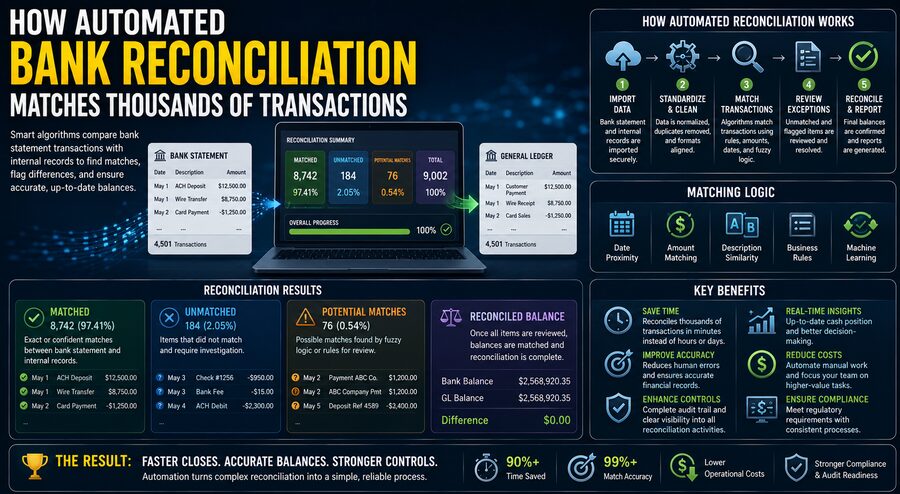
These systems import bank transactions, compare them with accounting records, apply predefined matching rules, identify differences, and send only the exceptions to employees for review.
The basic workflow is:
Bank transactions ➡️ accounting records ➡️ matching engine ➡️ matched items + exceptions
Automation transforms reconciliation from a repetitive checking exercise into a rules-driven data-processing system. ⚙️🏦
📘 What Is Bank Reconciliation?
Bank reconciliation compares two sets of financial records.
The first comes from the company’s internal accounting system.
This may include:
- Customer payments
- Supplier payments
- Payroll
- Bank fees
- Transfers
- Refunds
- Interest
- Cash deposits
The second dataset comes directly from the bank.
The company then determines whether the two sides agree.
For example, the accounting system might contain:
Invoice payment recorded: $5,000
The bank statement might show:
Incoming transfer: $5,000
If the transaction details are consistent, the system can mark the item as reconciled.
The principle is simple.
The difficulty comes from scale and imperfect data.
🔍 Why Transactions Do Not Always Match Perfectly
If every bank transaction contained exactly the same information as the accounting entry, reconciliation would be easy.
Real-world financial data is rarely that clean.
A bank may display:
ACME LTD INV 81729
while the accounting system records:
Customer: Acme Limited
Invoice: 81729
Amount: $8,425
These records refer to the same payment, but their descriptions are different.
Other complications include:
- Different transaction dates
- Bank processing delays
- Combined payments
- Partial payments
- Foreign exchange differences
- Bank charges
- Duplicate entries
- Missing references
- Typographical errors
Automated reconciliation systems therefore need more sophisticated matching logic than simply asking whether two text strings are identical.
📥 Step 1: Import the Bank Data
The first step is collecting transaction information from banks.
Modern companies may receive bank data through:
- Bank APIs
- Secure file transfer
- Electronic bank statements
- Treasury platforms
- Open banking connections
- Standard financial message formats
The imported record may contain fields such as:
Transaction date
Value date
Amount
Currency
Reference
Bank account
Counterparty
Transaction type
The reconciliation platform stores this information in a standardized structure.
This normalization is important because different banks may represent transactions differently.
📚 Step 2: Import the Company’s Accounting Records
The system also retrieves internal financial records.
These may come from:
- ERP systems
- Accounting software
- Accounts receivable
- Accounts payable
- Treasury systems
- Payment platforms
- Billing systems
Common enterprise systems may contain enormous volumes of accounting entries.
The reconciliation platform therefore needs to know which ledger account corresponds to which bank account.
Conceptually:
Bank account 12345 ↔ General ledger cash account 1001
Once both datasets are available, matching can begin.
🧹 Step 3: Normalize the Data
Before transactions are compared, the system often cleans and standardizes the data.
Suppose one source contains:
$1,250.00
while another contains:
1250
These amounts are equivalent.
The system may also standardize:
- Date formats
- Currency codes
- Uppercase/lowercase text
- Spaces
- Punctuation
- Account numbers
- Payment references
For example:
“INV-001928”
and:
“INV 001928”
might be converted into a common normalized format.
This increases the probability of finding correct matches. 🧠
✅ Step 4: Exact Matching
The simplest automated rule is an exact match.
The system might require:
Amount = exact
Reference = exact
Date = exact or within tolerance
For example:
Bank:
15 Aug | $2,700 | REF 51073
Ledger:
15 Aug | $2,700 | REF 51073
This is a very high-confidence match.
The software can reconcile the transaction automatically without human review.
For many businesses, a significant percentage of transactions can be cleared using straightforward rules like this.
📅 Date Tolerances Handle Processing Delays
Accounting dates and bank dates often differ slightly.
A company may record a payment on Monday.
The bank may process it on Tuesday.
An automated rule can therefore allow a date tolerance.
For example:
Amount must match exactly
Reference must match
Bank date can be within ±3 days
This prevents legitimate transactions from becoming unnecessary exceptions merely because banking systems processed them on different dates.
Tolerance rules must be controlled carefully, however.
A tolerance that is too broad can increase the risk of incorrect matches.
💰 Amount Tolerances
Some transactions may differ slightly in value.
This can happen because of:
- Foreign exchange
- Bank charges
- Rounding
- Payment processor fees
- Tax adjustments
A system may therefore allow small amount tolerances.
For example:
Accounting amount: $10,000
Bank amount: $9,997
If the company knows the bank deducts a $3 transfer fee, the reconciliation rule may recognize the relationship.
Tolerance-based matching is useful, but companies typically establish strict limits and approval policies.
🔤 Reference Matching
Transaction references are extremely valuable.
Examples include:
- Invoice numbers
- Customer IDs
- Payment IDs
- Purchase order numbers
- Check numbers
Suppose the bank narrative says:
PAYMENT ACME 392817
while the accounting system contains:
Customer ACME | Invoice 392817
The matching engine can identify the shared reference:
392817
and combine it with amount and date information.
Reference extraction can dramatically improve automated matching rates.
🔎 Fuzzy Matching
Sometimes transaction descriptions are similar without being identical.
A matching system may use fuzzy matching.
For example:
Bank:
GLOBAL INDSTRL LTD
Ledger:
Global Industrial Limited
An exact text comparison would fail.
A fuzzy matching algorithm can calculate similarity between the strings and recognize that they likely refer to the same organization.
It may examine:
- Shared words
- Character similarity
- Abbreviations
- Common spelling variations
- Known customer aliases
Fuzzy matching is especially useful when bank descriptions are shortened or reformatted.
However, lower-confidence matches may be routed for human review rather than accepted automatically. 🔍
🔗 One-to-One Matching
The easiest relationship is:
One bank transaction ↔ one accounting transaction
Example:
Bank payment:
$4,500
Ledger invoice receipt:
$4,500
This is known as one-to-one matching.
But large accounting environments frequently require more complicated relationships.
🧩 One-to-Many Matching
Suppose a customer pays three invoices in one bank transfer:
Invoice A: $1,000
Invoice B: $2,500
Invoice C: $1,500
The bank receives:
$5,000
There is no single $5,000 ledger item.
The software must determine that:
$1,000 + $2,500 + $1,500 = $5,000
This is one-to-many matching.
Automated systems can search combinations of open items using amount, customer, reference, and date information.
Without automation, employees might spend considerable time manually finding these combinations.
🔄 Many-to-One and Many-to-Many Matching
The reverse can also happen.
Several bank transactions may correspond to one accounting entry.
For example:
Bank deposit 1: $2,000
Bank deposit 2: $3,000
Ledger entry:
$5,000
This is many-to-one matching.
More complicated cases involve multiple transactions on both sides.
For example:
Three bank entries ↔ five ledger entries
These many-to-many scenarios are common in settlement systems, payment processors, and high-volume retail businesses.
The matching engine may need to search many possible combinations.
🛒 Card Payments Create Additional Complexity
Retailers often receive customer payments through card processors.
Suppose customers make purchases totaling:
$100,000
The payment processor deducts:
$2,500 in fees
The company receives:
$97,500
The bank therefore shows $97,500, while the sales system may show $100,000.
The reconciliation system must understand:
Gross sales – processor fees = bank settlement
This is an example of rule-based transformation.
The reconciliation engine is not merely comparing two numbers.
It is applying business logic.
💱 Foreign Currency Complicates Reconciliation
International businesses may record a transaction in one currency but settle it in another.
For example:
Invoice: €10,000
Bank receives:
$11,650
The amounts cannot be compared directly.
The system may need:
- Exchange rates
- Settlement dates
- FX gain/loss calculations
- Bank spread information
The accounting platform may automatically create foreign-exchange adjustments.
Automated reconciliation ensures that the actual settlement is connected with the original transaction and the appropriate FX entries.
🏧 Bank Fees Can Be Posted Automatically
Bank statements often contain fees that were not recorded beforehand.
For example:
Monthly service charge: $75
The reconciliation system may recognize the transaction type and automatically create or propose an accounting entry:
Debit: Bank Fee Expense $75
Credit: Cash $75
Once posted, the bank transaction and ledger entry can match.
This is sometimes called auto-posting or automatic journal creation.
Strong approval controls are important because automatically generating accounting entries affects financial statements.
⏳ Outstanding Checks and Deposits in Transit
Some differences are completely legitimate.
Suppose a company records a check payment on Friday.
The supplier does not deposit it until Wednesday.
The ledger shows the payment immediately, but the bank does not.
This is an outstanding item.
Similarly, a company may record a cash deposit before the bank has processed it.
This is often called a deposit in transit.
Reconciliation systems track these timing differences until the corresponding bank transaction eventually appears.
🚨 Exceptions Go to Human Review
The goal of automation is not necessarily to eliminate accountants.
It is to eliminate repetitive matching work.
Transactions that cannot be matched confidently are moved into an exception queue.
Examples include:
- Missing references
- Unexpected amounts
- Duplicate payments
- Large unexplained differences
- Unknown counterparties
- Very old outstanding items
Employees investigate these exceptions.
A useful workflow becomes:
Thousands of transactions ➡️ automated matching ➡️ small group of exceptions ➡️ human investigation
This dramatically reduces workload.
📊 Match Confidence Scores
More advanced systems may calculate a confidence score.
For example:
100% confidence: exact amount, exact reference, correct date
95% confidence: exact amount, strong fuzzy reference match
75% confidence: amount close, weak description similarity
The organization might set rules such as:
95%+ ➡️ automatically reconcile
80–94% ➡️ review suggested match
Below 80% ➡️ manual investigation
This approach allows automation while preserving control over ambiguous cases.
🤖 Machine Learning Can Improve Matching
Some modern reconciliation platforms use machine learning to identify patterns from historical decisions.
Suppose an accountant repeatedly matches bank description:
ABC PMT SERV
with customer:
ABC Payment Services Ltd.
The system may learn this relationship and suggest it automatically in the future.
Machine learning can help with:
- Counterparty recognition
- Description classification
- Match ranking
- Exception routing
- Pattern detection
However, deterministic accounting rules remain important because financial controls require explainability and consistency.
The strongest systems often combine:
Rules + statistical matching + human oversight
🧮 Matching Algorithms Must Avoid Combinatorial Explosion
One-to-many matching can become computationally difficult.
Imagine 500 unmatched ledger transactions and a single bank amount.
Searching every possible combination of ledger entries would require an enormous number of calculations.
Reconciliation systems therefore use constraints such as:
- Same customer
- Similar date range
- Matching currency
- Reference similarity
- Maximum number of combined items
These restrictions dramatically reduce the search space.
The system searches intelligently rather than trying every mathematically possible combination.
🔁 Reconciliation Can Run Daily Instead of Monthly
Historically, companies often performed bank reconciliation at month-end.
Automation makes much more frequent reconciliation practical.
Many organizations now reconcile:
Daily
or even multiple times per day.
Frequent reconciliation provides several advantages:
- Errors identified earlier
- Fraud detected faster
- Cash positions become more accurate
- Month-end workload decreases
- Outstanding items are resolved sooner
Instead of discovering a problem weeks later, finance teams can detect it within hours.
🔐 Reconciliation Is an Important Financial Control
Bank reconciliation is not merely administrative work.
It is an important accounting control.
It can help detect:
- Duplicate payments
- Unauthorized withdrawals
- Missing deposits
- Accounting errors
- Fraud
- Incorrect bank charges
If the ledger says cash should be present but the bank says otherwise, someone must explain the difference.
Automating the process does not eliminate controls.
In good systems, automation strengthens them by making reconciliation more frequent and systematic.
👥 Segregation of Duties
Financial systems often enforce segregation of duties.
For example:
Employee A: creates payment
Employee B: approves payment
System: imports bank activity
Employee C: investigates reconciliation exceptions
Separating responsibilities reduces the chance that one person can create, approve, and hide an improper transaction.
Automated reconciliation platforms often include roles and permissions to support this structure.
📝 Audit Trails Record Every Decision
A robust reconciliation system records:
- Who matched the transaction
- Which rule matched it
- When it was matched
- Whether it was manually overridden
- Who approved the adjustment
- Which journal entry was created
This creates an audit trail.
If auditors later examine the reconciliation, they can understand exactly how each transaction was resolved.
This is especially important for regulated or publicly traded companies. 📚
🏦 Reconciliation Across Many Bank Accounts
Large organizations may operate:
- Payroll accounts
- Collection accounts
- Supplier payment accounts
- Tax accounts
- Foreign currency accounts
- Subsidiary accounts
A multinational company may have hundreds or thousands of bank accounts across many banks.
Automation allows all of these accounts to be handled through a centralized platform.
Instead of each finance team downloading spreadsheets manually, bank feeds can be collected automatically and reconciled according to standardized rules.
📈 Reconciliation Metrics Help Finance Teams Improve
Companies monitor performance indicators such as:
Auto-match rate
Percentage of transactions matched without human intervention.
Exception rate
Percentage requiring investigation.
Aging
How long unmatched transactions remain unresolved.
Processing time
How quickly reconciliation is completed.
For example:
Total transactions: 100,000
Automatically matched: 96,000
Exceptions: 4,000
The automation rate is:
96%
Finance teams can then improve rules to reduce recurring exceptions.
⚠️ Automation Can Produce Incorrect Matches
Automated reconciliation is powerful, but poorly designed rules can create risk.
Suppose several transactions have the same amount:
$1,000
If the system matches only on amount, it could connect the wrong records.
Strong rules therefore combine multiple fields such as:
Amount + date + reference + counterparty
High-risk transactions may require stricter criteria.
Companies should regularly test their matching rules to ensure that a high auto-match percentage does not come at the expense of accuracy.
🧠 Exception Patterns Can Reveal Process Problems
Repeated reconciliation exceptions may indicate problems elsewhere.
For example:
Many missing payment references
could mean customers are receiving unclear payment instructions.
Frequent processor differences
might indicate settlement configuration issues.
Repeated duplicate entries
could point to an integration problem.
Therefore, reconciliation is not merely a cleanup process.
It can reveal weaknesses in upstream financial operations.
🔌 Integration With ERP and Treasury Systems
Automated reconciliation works best when integrated with the company’s broader financial architecture.
A typical flow might be:
Bank ➡️ reconciliation platform ➡️ ERP ➡️ treasury dashboard
Matched transactions update ledger status.
Unmatched items generate tasks.
Adjustments may flow back into the ERP.
Cash balances may update treasury forecasts.
This reduces manual data entry and keeps multiple financial systems synchronized.
🧭 A Simplified Automated Reconciliation Example
Imagine a company receives 25,000 bank transactions overnight.
The automated process could work like this:
1. Import 25,000 bank transactions. 📥
2. Import open accounting entries.
3. Standardize dates, amounts, references, and descriptions.
4. Run exact one-to-one matching.
18,000 transactions clear automatically.
5. Run tolerance and reference rules.
4,000 more clear.
6. Run one-to-many settlement matching.
2,000 more clear.
7. Use fuzzy matching and historical patterns.
700 are suggested or cleared according to policy.
8. Send 300 exceptions for manual review. 🔍
Instead of checking 25,000 lines, employees investigate only the 300 transactions that genuinely require judgment.
That is the central efficiency advantage.
🏁 Conclusion
Automated bank reconciliation allows companies to compare huge volumes of bank transactions with accounting records without manually checking every line. 🏦⚙️
The system imports data from banks and internal accounting platforms, normalizes it, and applies layers of matching logic.
It can recognize:
Exact matches
Date differences
Amount tolerances
Shared references
One-to-many payments
Processor fees
Foreign currency settlements
Recurring bank charges
More advanced systems can use fuzzy matching and machine learning to improve suggestions, while deterministic accounting controls ensure financial accuracy.
The objective is not simply:
“Match as many transactions as possible.”
It is:
“Match as many transactions as possible accurately, explainably, and under controlled rules.”
Transactions that meet high-confidence criteria are reconciled automatically.
Transactions that remain ambiguous are routed to accountants for investigation.
This creates a scalable process:
Thousands of financial records ➡️ automated rules ➡️ high-confidence matches ➡️ small exception queue ➡️ human judgment
The result is faster month-end closing, better cash visibility, earlier error detection, stronger controls, and dramatically less repetitive work.
For large finance departments, automated reconciliation is therefore much more than a convenience. It is a core financial-processing system that turns thousands of imperfect transaction records into a controlled, auditable view of where the company’s cash actually went. 💰📊✅