
A company can report strong sales and even show an accounting profit while still struggling to pay suppliers, employees, lenders, or taxes.
Why?
Because profit is not the same thing as cash. 📊💰
A business may record revenue before customers actually pay. It may buy expensive equipment that reduces cash immediately but affects accounting profit gradually through depreciation. It may borrow money, repay debt, build inventory, pay dividends, or invest in new facilities. All of these activities change the amount of cash available to the company, but many are not obvious from the income statement alone.
That is why businesses use the cash flow statement.
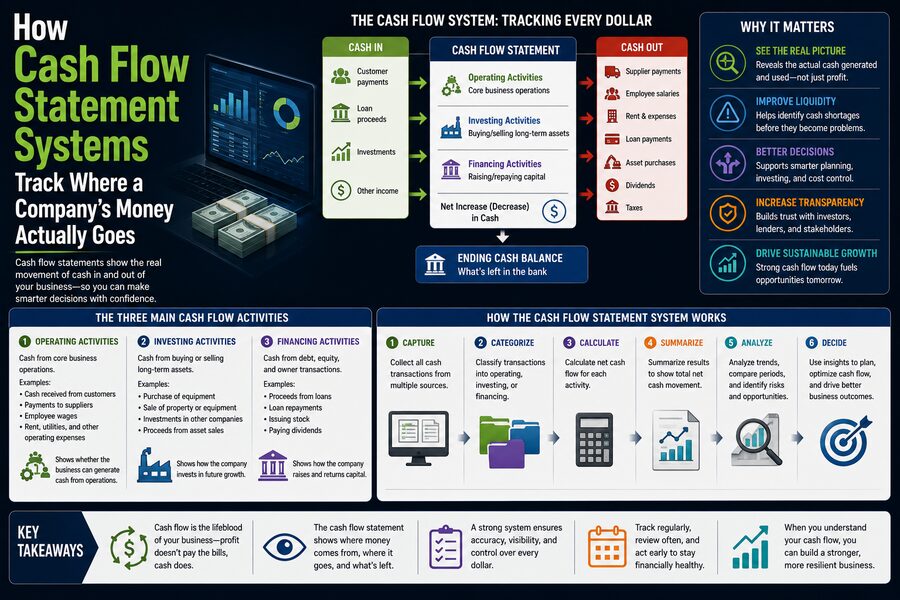
The cash flow statement explains how cash and cash equivalents changed during a reporting period by organizing movements into three major categories:
- Operating activities
- Investing activities
- Financing activities
Behind this seemingly simple report is an accounting system that collects information from bank transactions, customer receipts, supplier payments, payroll, asset purchases, loans, and many other sources.
The result answers one of the most important questions in business:
Where did the company’s cash come from, and where did it actually go? 💵🔍
🧠 Why the Income Statement Does Not Tell the Whole Story
An income statement measures profitability using accounting rules.
Suppose a company sells $100,000 worth of products in December.
If the customer agrees to pay 60 days later, the company may record the $100,000 as revenue in December even though no cash has arrived yet.
The income statement may show:
Revenue: $100,000
But the bank account may still show:
Cash received: $0
This happens because most businesses use accrual accounting.
Accrual accounting records economic activity when it is earned or incurred, not necessarily when cash physically moves.
The cash flow statement reconnects accounting activity with real cash movement.
💳 The Fundamental Cash Equation
At the highest level, the cash flow statement reconciles:
Beginning Cash
plus:
Net Cash Change
equals:
Ending Cash
For example:
Beginning cash = $500,000
During the year:
- Operating activities generate $300,000
- Investing activities use $450,000
- Financing activities provide $200,000
Net change:
$300,000 − $450,000 + $200,000 = $50,000
Therefore:
Ending cash = $550,000
The statement explains exactly how the company moved from the beginning balance to the ending balance.
🏭 1. Cash Flow From Operating Activities
The first section tracks cash associated with the company’s normal business operations.
This usually includes cash related to:
💵 Customer collections
📦 Supplier payments
👥 Employee wages
🏢 Rent
⚡ Utilities
📣 Marketing expenses
💰 Interest and taxes, depending on reporting rules
For a healthy established business, operating activities are often expected to generate positive cash over time.
Why?
Because the core business should ideally collect more cash from customers than it spends running daily operations.
🛒 Customer Payments Create Operating Cash Inflows
Suppose a retailer sells merchandise.
Customers may pay using:
💵 Cash
💳 Credit cards
🏦 Bank transfers
📱 Digital payment systems
The accounting system records the sale and eventually records the cash settlement.
If a customer buys on credit, the business first creates an accounts receivable balance.
When the customer later pays:
Accounts receivable decreases
and:
Cash increases
The cash flow system captures that collection as part of operating cash flow.
📦 Supplier Payments Create Operating Cash Outflows
Businesses must buy goods and services from suppliers.
A manufacturer may purchase:
- Raw materials
- Packaging
- Components
- Maintenance services
- Logistics
If the company buys on credit, the purchase may first create an accounts payable balance.
When cash is finally paid to the supplier:
Cash decreases
and:
Accounts payable decreases
This cash movement appears in operating activities.
👥 Payroll Is Another Major Operating Cash Flow
Employee salaries may represent one of the largest recurring cash expenses.
A payroll system calculates:
- Gross wages
- Taxes
- Benefits
- Pension contributions
- Net employee payments
When payroll is processed, cash leaves the business.
The cash flow system ultimately reflects those payments as operating outflows.
A company may therefore appear profitable but still face cash pressure if payroll and supplier payments occur before customers pay their invoices.
🔄 Working Capital Has a Huge Effect on Cash
One of the most important concepts in cash flow analysis is working capital.
Working capital accounts include items such as:
📥 Accounts receivable
📦 Inventory
📤 Accounts payable
🧾 Accrued expenses
Changes in these accounts can create major differences between profit and cash flow.
Consider accounts receivable.
If customers owe the company more money at year-end than at the beginning of the year, some recognized revenue has not yet been collected.
That reduces operating cash flow relative to profit.
📥 Why Rising Accounts Receivable Can Reduce Cash Flow
Suppose a company reports:
Net income = $1 million
but accounts receivable increases by:
$300,000
That means $300,000 of recognized customer-related activity remains tied up in unpaid invoices.
From a cash perspective, the business did not receive that money yet.
Under the indirect cash-flow method, the increase in accounts receivable is therefore deducted from net income.
This converts accrual profit toward actual cash generated.
📦 Inventory Can Consume Large Amounts of Cash
Inventory is another major working-capital item.
Suppose a retailer purchases an additional:
$500,000 of inventory
before the holiday season.
The inventory is still an asset on the balance sheet.
It is not necessarily an expense yet.
But cash has already left the company.
Therefore, an increase in inventory generally reduces operating cash flow.
This is why rapidly growing companies can become cash constrained even while sales are rising.
Growth often requires more inventory before the resulting revenue is collected. 📈➡️💸
📤 Accounts Payable Can Temporarily Preserve Cash
Accounts payable works in the opposite direction.
Suppose a company receives $200,000 of materials from suppliers but has not paid for them yet.
The business has effectively received short-term financing from its suppliers.
Cash remains in the company’s bank account.
An increase in accounts payable therefore generally increases operating cash flow under the indirect method.
However, this should not automatically be viewed as permanently “free cash.”
The suppliers eventually need to be paid.
📊 Direct vs. Indirect Cash Flow Methods
Companies can present operating cash flow using two main approaches.
💵 Direct Method
The direct method shows actual categories of cash received and paid.
For example:
Cash received from customers: $5,000,000
Cash paid to suppliers: −$2,800,000
Cash paid to employees: −$1,100,000
Cash paid for taxes: −$300,000
This approach is intuitive because it looks directly at cash movements.
🔄 Indirect Method
The indirect method begins with net income and adjusts for items that affected accounting profit but not cash.
A simplified version might look like:
Net income: $800,000
Add back depreciation:
+$200,000
Increase in accounts receivable:
−$150,000
Increase in inventory:
−$100,000
Increase in accounts payable:
+$80,000
Result:
Operating cash flow = $830,000
The indirect method explains why accounting profit differs from operating cash.
🧱 Why Depreciation Is Added Back
Depreciation often confuses people when they first learn cash flow statements.
Suppose a company buys a machine for:
$1 million
The cash may leave immediately when the machine is purchased.
However, accounting rules may spread the machine’s cost over several years as depreciation expense.
If annual depreciation is:
$100,000
the income statement records that expense.
But no new $100,000 cash payment occurs when depreciation is recorded.
Therefore, under the indirect cash-flow method, depreciation is added back to net income.
The actual machine purchase appears elsewhere: in investing activities.
🏗️ 2. Cash Flow From Investing Activities
Investing cash flow tracks money spent on or received from long-term assets and investments.
Common examples include:
🏭 Factory equipment purchases
🏢 Building purchases
💻 Technology infrastructure
🚚 Vehicles
🌍 Land
📊 Investment securities
🏢 Business acquisitions
These transactions often involve large amounts of cash.
🛠️ Capital Expenditures Consume Cash
When a company purchases long-term assets, the spending is commonly called capital expenditure, or CapEx.
Suppose a manufacturer spends:
$5 million
on a new production line.
The full $5 million may immediately reduce cash.
However, the income statement will not usually show a $5 million operating expense immediately.
Instead, the equipment is capitalized as an asset and depreciated over time.
Therefore:
Cash flow statement → shows large investing outflow
while:
Income statement → recognizes expense gradually
This difference is essential for understanding how much money the business is actually investing.
🏢 Selling Assets Creates Investing Cash Inflows
Investing activities can also generate cash.
Suppose a company sells an unused warehouse for:
$2 million
The cash received appears as an investing inflow.
The income statement may separately recognize a gain or loss depending on the warehouse’s accounting value.
Again, cash flow and accounting profit are measuring different things.
🧾 Acquisitions Can Produce Huge Cash Outflows
If a company buys another business for cash, the transaction may create one of the largest investing outflows in the reporting period.
For example:
Acquisition of subsidiary: −$400 million
That does not necessarily mean the company performed poorly.
It may indicate management is investing aggressively for future growth.
Cash-flow analysis therefore requires context.
A negative investing cash flow can be completely normal for a company expanding its productive capacity.
🏦 3. Cash Flow From Financing Activities
Financing activities explain how the company raises and returns capital.
They can include:
🏦 Borrowing money
💳 Repaying loans
📈 Issuing shares
🔄 Repurchasing shares
💰 Paying dividends
This section shows how owners and lenders influence the company’s cash balance.
💵 Borrowing Creates Cash Without Creating Revenue
Suppose a company borrows:
$10 million
from a bank.
Cash immediately increases by $10 million.
But this is not revenue.
The company has also created a liability that must eventually be repaid.
Therefore, the $10 million appears in financing cash flow rather than operating revenue.
This prevents borrowed money from being mistaken for business performance.
💸 Debt Repayment Uses Financing Cash
When the company later repays the principal of the loan, cash decreases.
That repayment appears as a financing outflow.
Interest treatment can vary under different accounting frameworks, but the repayment of principal is clearly financing-related.
A company with large debt maturities may therefore experience major cash outflows even while its operating business remains profitable.
📈 Issuing Shares Brings Cash Into the Business
A corporation can raise money by selling new shares to investors.
For example:
New equity issued: $50 million
The company receives cash.
The transaction does not create sales revenue because investors are providing capital rather than buying products.
It appears under financing activities.
💰 Dividends Send Cash Back to Owners
When a company pays dividends to shareholders, cash leaves the business.
Suppose:
Dividends paid: $5 million
That becomes a financing cash outflow.
This is another example of a cash payment that does not appear as a normal operating expense on the income statement.
🔄 Share Buybacks Also Reduce Cash
Companies sometimes repurchase their own shares.
For example:
Share repurchases: −$100 million
This reduces cash and shareholders’ equity.
Investors analyzing cash flows often examine how much cash management directs toward buybacks compared with:
🏭 New investment
🔬 Research
💰 Dividends
🏦 Debt repayment
Cash allocation reveals management priorities.
🧮 How Accounting Systems Build the Cash Flow Statement
Modern companies do not usually construct cash flow statements by manually reading bank accounts at the end of the year.
Instead, the report is built from interconnected accounting records.
A typical accounting environment contains:
📘 General ledger
📥 Accounts receivable system
📤 Accounts payable system
👥 Payroll system
🏦 Treasury system
🏗️ Fixed-asset register
📦 Inventory system
Transactions flow from these systems into the general ledger.
The cash flow statement then classifies and reconciles the relevant movements.
📘 The General Ledger Is the Accounting Backbone
The general ledger contains accounts representing the company’s financial activity.
Examples include:
- Cash
- Accounts receivable
- Inventory
- Equipment
- Accounts payable
- Loans
- Revenue
- Expenses
Every accounting transaction affects at least two accounts under double-entry bookkeeping.
For example, when a customer pays:
Debit Cash
Credit Accounts Receivable
The cash-flow reporting system recognizes that the cash increase relates to operating activity.
🏦 Bank Reconciliation Confirms Actual Cash
The cash account in the ledger must agree with actual bank balances.
But timing differences can occur.
For example:
- A check may be recorded but not yet cleared.
- A bank charge may appear before accounting records are updated.
- A customer transfer may reach the bank unexpectedly.
Businesses therefore perform bank reconciliations.
The accounting system compares:
Book cash balance
with:
Bank statement balance
and explains any differences.
This process is crucial because the cash flow statement ultimately needs reliable cash data.
🔄 Why Double-Entry Accounting Helps Track Cash Movement
Every cash transaction has another side.
If cash goes down because equipment is purchased:
Cash decreases
and:
Equipment increases
If cash increases because a loan is received:
Cash increases
and:
Loan liability increases
This relationship helps accounting systems classify cash flows correctly.
The corresponding account often reveals the economic purpose of the cash movement.
🧠 Automated Classification Rules Improve Reporting
Large organizations may process millions of transactions.
Accounting software therefore uses rules to classify many movements automatically.
For example:
- Customer receipts → operating
- Equipment purchases → investing
- Loan proceeds → financing
- Dividend payments → financing
Unusual transactions may require accountant review.
The more standardized the underlying chart of accounts and transaction coding, the easier cash-flow reporting becomes.
🌍 Foreign Currency Adds Complexity
Multinational companies may hold cash in several currencies.
For example:
💵 U.S. dollars
💶 Euros
💷 British pounds
💴 Japanese yen
Exchange rates change.
The company may therefore experience a change in reported cash value even when no actual cash transaction occurs.
Cash flow statements typically reconcile the effect of exchange-rate changes separately so users can distinguish operating movement from currency translation.
🔐 Intercompany Transactions Must Be Eliminated
Large corporate groups often contain many subsidiaries.
One subsidiary may pay another subsidiary.
From the perspective of each legal entity, cash moved.
But from the perspective of the consolidated group, the money merely moved from one company pocket to another.
Consolidated reporting therefore eliminates many intercompany cash flows.
Otherwise, group-level receipts and payments would be overstated.
📅 Timing Can Dramatically Affect Period-End Cash
Imagine a business pays suppliers on January 2 instead of December 31.
That two-day timing difference could materially change year-end cash.
Similarly, a large customer payment received on December 30 rather than January 3 can make the closing cash balance look much stronger.
Analysts therefore examine working-capital trends instead of looking only at one closing balance.
A single period-end snapshot can sometimes be misleading.
🔍 Cash Flow Helps Detect Earnings Quality
Investors often compare:
Net income
with:
Operating cash flow
If a company repeatedly reports increasing profit while operating cash flow remains weak, analysts may investigate why.
Possible explanations include:
📥 Rapidly rising receivables
📦 Excess inventory
🧾 Aggressive revenue recognition
⚠️ One-time accounting adjustments
This does not automatically mean something is wrong.
But cash provides an important reality check because companies ultimately need actual money to pay obligations.
💡 What Is Free Cash Flow?
A widely used analytical measure is free cash flow.
Although definitions vary, one simple version is:
Free Cash Flow = Operating Cash Flow − Capital Expenditures
Suppose:
Operating cash flow = $20 million
and:
Capital expenditures = $8 million
Then:
Free cash flow = $12 million
This approximates the cash remaining after funding operations and necessary long-term investment.
That cash may potentially be used for:
💰 Dividends
🏦 Debt repayment
📈 Acquisitions
🔄 Share repurchases
💵 Cash reserves
⚠️ Free Cash Flow Is Not an Accounting Standard Line Item
Unlike the three main cash-flow categories, free cash flow is generally an analytical measure rather than a standardized primary financial statement total.
Different companies or analysts may calculate it differently.
For example, some may adjust for:
- Leases
- Acquisitions
- Stock-based compensation
- Certain one-time expenditures
Therefore, users should check the exact definition before comparing companies.
🏃 Fast-Growing Companies Can Have Negative Cash Flow
Negative cash flow is not automatically bad.
Imagine a fast-growing retailer.
It may spend heavily on:
📦 Inventory
🏬 New stores
💻 Technology
👥 Employees
The company might intentionally consume cash today to create future growth.
Similarly, a technology company may invest heavily in data centers or infrastructure.
The critical questions are:
Why is cash negative?
and:
Can the company finance that cash use safely?
Context determines whether negative cash flow is strategic investment or a sign of financial distress.
🚨 Persistent Operating Cash Burn Can Be Dangerous
While negative investing cash flow can be normal, persistent negative operating cash flow deserves careful attention.
If a mature business continuously spends more cash on daily operations than it collects from customers, it must finance the deficit somehow.
It may need to:
🏦 Borrow
📈 Issue shares
💰 Use cash reserves
🏢 Sell assets
These sources cannot necessarily continue forever.
Cash-flow statements help reveal whether the underlying business model generates cash independently.
📊 Cash Flow Forecasting Looks Forward
The historical cash flow statement explains what already happened.
Businesses also create cash flow forecasts.
A forecast estimates future:
💵 Customer receipts
📤 Supplier payments
👥 Payroll
🏦 Loan payments
🏗️ Capital expenditures
💰 Taxes
This allows management to predict periods when cash may become tight.
For example:
Expected cash in March: $800,000
Expected payments: $1.1 million
Projected shortfall:
$300,000
Management can arrange financing before the problem becomes urgent.
🏦 Treasury Systems Manage Daily Liquidity
Large companies often have dedicated treasury teams.
Treasury monitors:
💵 Bank balances
🏦 Debt facilities
💱 Foreign currencies
📅 Payment schedules
📈 Short-term investments
The cash flow statement is primarily a reporting tool, while treasury systems focus on operational liquidity.
Together, they help answer two different questions:
What happened to cash?
and:
Will we have enough cash when future payments are due?
🤖 Automation Is Improving Cash Flow Reporting
Modern accounting platforms increasingly automate transaction classification and reconciliation.
Systems can connect directly to:
🏦 Banks
💳 Payment processors
📦 Procurement systems
👥 Payroll software
🏗️ Asset-management platforms
This reduces manual data entry.
Artificial intelligence and rule-based systems may also identify unusual transactions or suggest cash-flow classifications.
However, accountants still need to review complex transactions because economic substance can be more complicated than the payment description suggests.
🔍 Cash Flow Statements Help Managers Allocate Capital
Cash-flow analysis is useful not only for investors but also for management.
Executives can see how much cash is being directed toward:
🏭 Operations
🏗️ Expansion
🔬 Research
🏦 Debt reduction
💰 Shareholders
A profitable business with weak cash conversion may need to improve collections or inventory management.
A company producing strong free cash flow may have flexibility to expand or return capital to owners.
Cash-flow data therefore influences strategic decisions.
🧩 A Complete Example
Imagine a company begins the year with:
$1 million in cash
During the year, it:
💵 Collects $8 million from customers
📦 Pays $5 million to suppliers and employees
🏭 Buys $2 million of equipment
🏦 Borrows $1 million
💰 Pays $500,000 of dividends
Operating cash flow:
+$3 million
Investing cash flow:
−$2 million
Financing cash flow:
+$500,000
because:
+$1 million borrowing − $500,000 dividends = +$500,000
Net increase:
+$1.5 million
Ending cash:
$2.5 million
The cash flow statement tells the story clearly:
The company’s operations generated cash, the business invested heavily in equipment, and financing provided additional support.
That is much more informative than simply knowing whether the company reported a profit.
✅ Conclusion
Cash flow statement systems track where a company’s money actually goes by following changes in cash through the accounting system and organizing them according to the economic purpose of each movement.
Operating activities show whether the core business is collecting more cash than it spends on day-to-day operations. Investing activities reveal money committed to long-term assets, acquisitions, and investments. Financing activities show how cash moves between the company and its lenders or owners. 💵📊
The statement also explains why accounting profit does not always translate directly into money in the bank.
Accounts receivable may represent revenue that has not yet been collected. Inventory can consume cash before it is sold. Depreciation reduces accounting profit without requiring a current-period cash payment. Equipment purchases consume cash immediately even though their accounting cost is spread over many years.
Behind the final report, accounting systems connect bank transactions, receivables, payables, payroll, fixed assets, loans, and the general ledger. Reconciliations and classification rules then ensure that the beginning and ending cash balances can be explained.
The central principle is straightforward:
Profit tells you whether accounting revenue exceeded accounting expenses. Cash flow tells you whether money actually entered or left the business. 💰🔍
A company ultimately pays wages, suppliers, debt, taxes, and investments with cash—not accounting profit.
That is why the cash flow statement is one of the most important tools for understanding whether a business is merely reporting success on paper or actually generating the financial resources needed to keep operating, investing, and growing.